

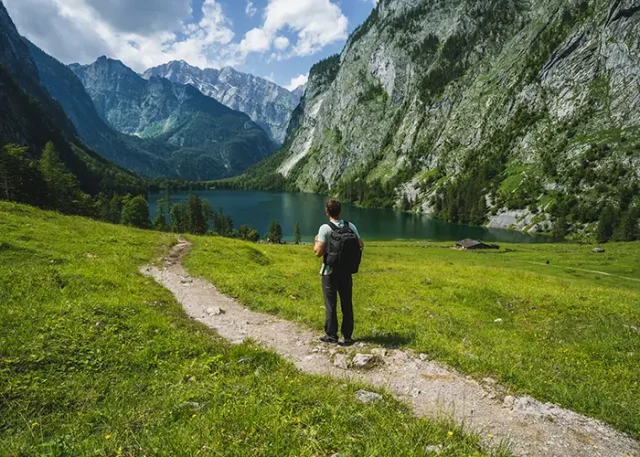
Austria sits among some of Europe’s most dramatic mountain regions, yet the hiking experience there feels noticeably different from its neighbors. It is not more scenic than the Dolomites, not wilder than the Pyrenees, and not more efficient than Switzerland. What Austria does differently is less obvious, but more influential. It prioritizes continuity. Not excitement, not spectacle, not even challenge in the heroic sense. Austria builds its hiking experience around the assumption that people want to keep walking day after day without friction. That single priority shapes everything else.
Austria Designs for Repetition, Not Peak Moments
Many alpine destinations organize hiking around highlights. A famous pass, a dramatic viewpoint, a summit, or a signature route. Austria is less interested in individual moments and more interested in how those moments connect.
Routes are designed so that effort is spread evenly rather than concentrated. You rarely encounter days that feel dramatically harder or easier than the rest. The experience becomes consistent. This allows hikers to settle into a rhythm quickly and stay there.
That rhythm is the point. Austria assumes that the real challenge is not a single hard day, but maintaining energy and motivation across many moderate ones.
Trail Networks Favor Flow Over Drama
Austrian trails tend to follow terrain in a way that minimizes interruption. Forest paths transition smoothly into alpine pastures. Climbs are introduced gradually. Descents are rarely punishing.
This approach does not remove difficulty, but it smooths it. You are rarely jolted by sudden changes in terrain or demand. Instead, the trail encourages steady movement. The walking feels continuous rather than segmented into struggle and relief.
In contrast to countries that emphasize vertical drama, Austria emphasizes horizontal progress.
Villages Are Integrated, Not Highlighted
In Austria, villages are not destinations in themselves. They are anchors. You pass through them, resupply, rest, and continue. They support the walking without demanding attention.
This integration matters. When villages are not framed as attractions, they do not interrupt momentum. You do not feel the need to stop longer than necessary or to adjust your pace around them. They exist to keep the journey moving.
The result is a hiking experience where human presence supports continuity instead of competing with it.
Mountain Huts Serve the Day, Not the Narrative
Austria’s huts are practical by design. They appear where you need them, not where they would look impressive. Meals are filling rather than performative. Shelter is reliable rather than scenic.
This utilitarian approach reinforces the idea that the hike is not a story arc. It is a sequence of days. Huts are tools that make those days sustainable. They do not exist to punctuate the experience with meaning or drama.
This is a subtle but important difference. Austria treats huts as infrastructure, not as destinations.
Difficulty Is Honest and Predictable
Another thing Austria prioritizes is transparency. Routes tend to be exactly as difficult as they appear on paper. Elevation gain, distance, and time estimates are reliable. Surprises are rare.
This honesty reduces mental fatigue. When you know what a day will require, you can pace yourself accordingly. Austria assumes hikers value reliability more than novelty.
That assumption pays off over time. The absence of surprise keeps cumulative fatigue manageable.
Transport Exists to Preserve Momentum
Austria’s transport system is designed to support continuity, not convenience. Buses, lifts, and trains allow hikers to link routes logically rather than forcing awkward loops or dead ends.
This does not make hiking easier. It makes it cleaner. You are less likely to waste energy solving logistical problems at the beginning or end of the day. That energy stays focused on walking.
Austria removes friction that interrupts momentum, not effort that defines it.
Weather Is Treated as a Variable, Not a Test
In Austria, weather planning is practical rather than heroic. Routes are chosen based on conditions, and alternatives are built into the system. This does not eliminate bad weather, but it prevents it from dominating the experience.
Because the system allows adjustment without drama, weather becomes something you work with rather than something you endure. This keeps the experience stable even when conditions are not ideal.
Stability, again, is the priority.
The Culture Reinforces Sustainable Walking
Austrian hiking culture values consistency and preparedness over bravado. People choose routes they can maintain, not routes that impress. There is little emphasis on pushing limits for their own sake.
This cultural tone influences how visitors behave. You are not subtly pressured to go faster, higher, or harder. The environment rewards pacing and restraint.
Over time, this creates an experience that feels calm even when the terrain is serious.
Why This Feels Different From Other Alpine Countries
In places like the Dolomites, scale and visual intensity define the experience. In Switzerland, precision and efficiency take center stage. In the Pyrenees, rawness and distance shape the walk.
Austria does none of these aggressively. It prioritizes continuity instead. Days connect cleanly. Effort accumulates evenly. The experience is built to last rather than to peak.
This is why some hikers initially find Austria less exciting. There is no obvious climax. What they often realize later is that they finished stronger than expected.
Where Organized Options Fit Naturally
Because the system already prioritizes continuity, organized options like hiking tours in Austria integrate seamlessly. They do not reshape the experience. They simply reduce planning overhead while preserving the same rhythm.
The walking still feels earned. The days still accumulate. The structure does not replace effort, it protects it.
What Austria Ultimately Optimizes For
Austria optimizes for the middle of the journey. Not the start, not the finish, but everything in between. It assumes that the quality of a hiking experience is determined by how well it sustains itself over time.
That is what Austria prioritizes that other alpine countries often do not. It does not chase drama, difficulty, or spectacle. It builds an environment where walking can continue without constant negotiation.
For hikers who value endurance over intensity and flow over performance, that quiet priority makes all the difference.