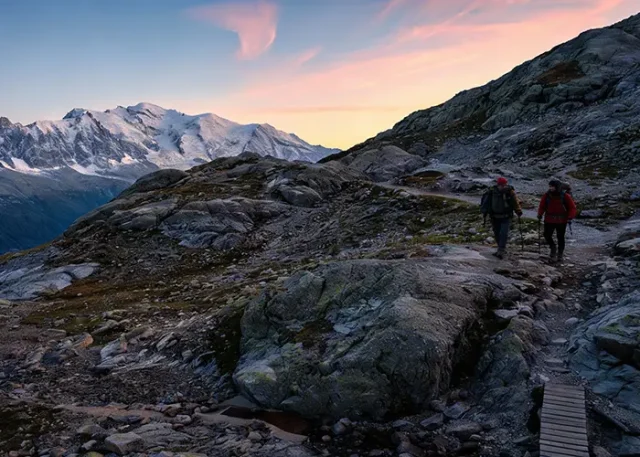
The Tour du Mont Blanc is one of the most recognizable long-distance hikes in Europe, and that recognition shapes expectations before anyone sets foot on the trail. Many people assume that popularity and structure dilute the experience. They imagine crowds, predictability, and a lack of authenticity. What they often discover instead is something more nuanced. The Tour du Mont Blanc works not despite being controlled, but because of how carefully that control is applied.
The Route Is Designed to Be Finished
Unlike routes that evolve organically or remain loosely defined, the Tour du Mont Blanc is deliberately complete. It is not a suggestion or a collection of possibilities. It is a loop with a clear start, clear direction, and clear end.
That completeness removes ambiguity. You are not asking what comes next. You are committing to a sequence that has already been tested and refined. This changes the mental experience of walking. Energy goes into movement and recovery rather than into constant planning.
Control Is Applied to Logistics, Not to Effort
What the Tour du Mont Blanc manages well is everything around the walking. Accommodation exists where days naturally end. Food is available without detours. Transport sits close enough to provide options without breaking immersion.
What it does not manage is the physical work. Every climb still has to be climbed. Every descent still taxes knees and feet. Fatigue accumulates honestly. The control removes friction, not consequence.
The Mountains Are Framed, Not Neutralized
The terrain on the Tour du Mont Blanc is serious, but it is presented at a distance. Glaciers, ridges, and steep faces dominate the view, while the trail itself remains measured and readable.
This framing allows hikers to experience scale without being forced into constant exposure. The mountains feel large without feeling aggressive. You are aware of risk without being consumed by it.
Predictability Creates Momentum
Each day on the route follows a recognizable rhythm. Climb, traverse, descend, recover. That rhythm reduces hesitation. You wake up knowing what the day will ask of you.
Momentum builds not because the days are easy, but because there are few reasons to stall. When decision-making fades, continuation becomes the default. This is one of the Tour du Mont Blanc’s quiet strengths.
Crowds Change the Tone but Not the Work
The presence of other hikers alters the psychological experience. You are rarely alone, especially in peak season. This reduces uncertainty and increases reassurance.
What it does not reduce is effort. You still manage your own pace, your own fatigue, and your own recovery. Walking among others does not flatten the physical demand. It simply removes isolation from the equation.
Accommodation Shapes Recovery, Not Difficulty
Sleeping in huts or hotels affects how the body rebounds, not how hard the days are. Good food and shelter allow consistency. They do not shorten climbs or smooth descents.
This distinction is important. Comfort supports endurance. It does not replace it. The satisfaction of finishing comes from sustained effort, not from hardship layered onto it artificially.
Weather Modifies Days Without Redefining Them
Mountain weather influences the Tour du Mont Blanc, but it rarely destabilizes it. Routes remain clear. Alternatives exist. Poor conditions make days heavier, not uncertain.
This predictability reinforces trust in the route. You adapt rather than improvise. The environment remains serious, but the experience remains legible.
The Route Rewards Consistency Over Courage
The Tour du Mont Blanc does not ask for bravery. It asks for steadiness. You are not tested by fear or exposure. You are tested by repetition, by cumulative elevation, and by the ability to manage yourself over time.
This is why some hikers underestimate it early on and feel it later. The challenge is not concentrated. It is distributed.
Why Structured Options Fit Naturally
Because the route is already organized, Tours du Mont Blanc layer onto it without altering its nature. Guidance reduces logistical responsibility but leaves the core effort untouched.
The walking remains the same. The mountains remain the same. Only the planning burden shifts.
Why the Experience Still Feels Earned
Despite the structure, finishing the Tour du Mont Blanc feels legitimate. You remember the climbs, the long descents, the mornings where your legs resisted movement. Nothing about that is artificial.
The satisfaction comes from completion, not from survival. You did not outsmart the route. You stayed with it.
Understanding the Tour du Mont Blanc Clearly
The Tour du Mont Blanc is not wild in the raw sense, and it does not pretend to be. It is controlled, continuous, and deliberate. That control does not weaken the experience. It clarifies it.
Once you stop expecting unpredictability, the route reveals its real strength. It offers big mountains without chaos, effort without confusion, and a long, coherent walk that asks only one thing in return. That you keep going.