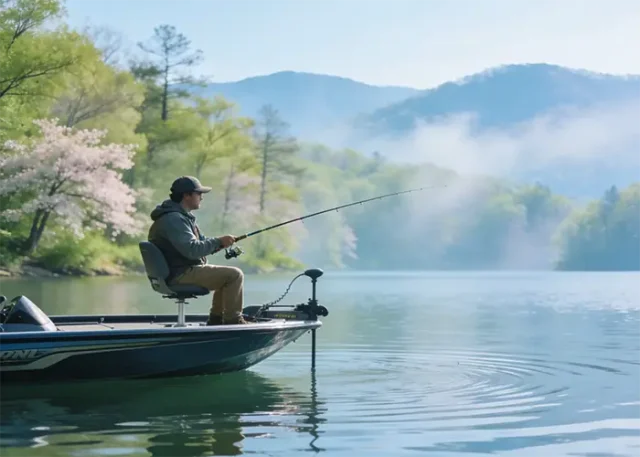
The single best week of bass fishing all year doesn’t happen on the same date everywhere. It rolls north like a slow green wave. In south Florida, the biggest largemouth of the season are fanning beds in February while ice is still coming off lakes in Minnesota. A bass is a cold-blooded animal running on water temperature, and as that water climbs into the upper 50s and low 60s, fish that spent winter sulking in deep water move up, feed hard, and spawn. If you’re willing to drive, you can ride that wave for two solid months and catch the spawn over and over again.
That’s the whole idea behind a spring bass road trip: start in the Deep South when the water first warms, then chase the warming gradient north and west as spring catches up to each new region. Plan it right and you’re fishing prime conditions the entire way.
A smart route can swing west, too — California’s lakes hit their stride in spring, and because regulations and timing out there don’t match the South, it’s worth checking the California fishing seasons before you point the truck toward Clear Lake. Here’s how I’d map the trip for 2026.
First Stop: Florida, Where Spring Starts Early
Florida gets the jump on everybody. By February and into March, the Florida-strain largemouth that grow to giant sizes are already in the spawning cycle on lakes like Okeechobee, the Kissimmee chain, and Rodman Reservoir. These fish live in warm, fertile water year-round, so their clock runs weeks ahead of the rest of the country.
The fishery here is built around shallow vegetation — hydrilla, eelgrass, lily pads, reeds. Pre-spawn females stage on the outside edges of that grass, then push inside to fan beds on hard bottom. The classic approach is to flip and pitch heavy soft plastics into the thickest cover, or work a topwater frog over the mats in low light.
Sight-fishing beds is its own skill: you’re looking for the light circle of a cleaned-off bed and the dark shadow guarding it. Florida bass on beds can be stubborn, refusing a bait twenty times before something snaps and they crush it. Patience here outfishes power.
Texas: Big Lakes, Bigger Fish
Roll west to Texas and the calendar shifts to March. Texas has earned a reputation for producing genuine trophy largemouth, thanks partly to the state’s selective-breeding program built around its biggest fish. Lakes like Sam Rayburn, Toledo Bend, and a few sleeper reservoirs in the central part of the state put out fish that make anglers from anywhere stop and stare.
The pattern follows the same biology — pre-spawn fish staging and moving shallow as the water warms — but the scale is bigger. On these sprawling reservoirs, you’re hunting the right pockets: protected coves on the north side of the lake that warm first, with a creek channel nearby so fish have a deep-water highway to the spawning flats.
A few things I’d key on in Texas spring:
- Fish the warmest water you can find. A protected northern cove can be several degrees warmer than the main lake, and those degrees pull fish up days earlier.
- Find the staging structure. The transition spots between deep water and spawning flats — points, creek mouths, the first stretch of timber — hold fish on the way in and out.
- Don’t ignore the post-spawn shad spawn. As bass finish spawning, the shad spawn fires up along grass and rip-rap at dawn, and feeding bass gang up to ambush them.
California: A Western Detour Worth the Miles
If you can swing the western leg, California in spring is a different animal — and one of the best big-bass destinations in the country. Clear Lake, the California Delta, Lake Berryessa, and the foothill reservoirs hold both giant largemouth and trophy spotted bass, and the variety of forage out there grows them thick.
Spring is prime time. As water temperatures climb, the same staging-to-spawn migration plays out, but the clear water of many California lakes opens the door to sight-fishing in a way the stained southern reservoirs don’t. The Delta is a maze of tidal current, grass, and structure that rewards anglers who learn to read moving water; Clear Lake is famous for the sheer size of its average fish.
The trade-off is that California’s fishing calendar and access rules differ from the rest of the trip, and timing your visit to the right window matters more here because conditions swing with elevation and water management. Get there in the heart of the pre-spawn and you’ll see why people make the drive.
The Tennessee Valley: Guntersville and Chickamauga
Back east, point the truck toward the Tennessee River chain in April. Lake Guntersville in Alabama and Chickamauga in Tennessee are two of the most productive largemouth fisheries in the country, both loaded with grass and both capable of true giants.
These lakes warm a bit later than Florida and Texas, which is exactly why they fit the road-trip timeline — by the time you arrive, the spawn is firing here. Guntersville’s vast hydrilla and milfoil beds hold fish in every phase, and a lipless crankbait ripped through the grass triggers vicious reaction strikes from pre-spawn fish. Chickamauga has built a reputation for fish that push the limits of what a largemouth is supposed to weigh.
Current is the underrated factor on these river systems. When the dams generate and water moves, bass position on the current side of structure and feed; when the flow stops, the bite often dies. Watch the generation schedule like you’d watch the tide on the coast.
North for the Late Wave: Smallmouth Country
By May and into June, the wave reaches the northern states, and the species shifts. This is smallmouth season in places like the upper Mississippi, Minnesota’s lakes, the St. Lawrence River, and the Great Lakes shoals. Smallmouth spawn a little later and a little cooler than largemouth, so the northern leg lines up perfectly as a finale.
Smallmouth relate to rock — gravel, boulders, rocky points and humps. In spring they move shallow to spawn over hard bottom, and a tube, a jerkbait, or a Ned rig worked along the rock will get bit. Pound for pound they fight harder than any largemouth, and the clear northern water makes for some of the most visual fishing of the whole trip.
Just check opener dates carefully up north — many states protect spawning bass with a closed season or catch-and-release-only window in spring, and the rules vary by state and even by body of water.
Reading the Wave Instead of the Calendar
The mistake most people make planning a spring trip is locking in dates months ahead and hoping the fish cooperate. The fish don’t read the calendar — they read the water. A warm, early spring can pull everything forward by two weeks; a cold, wet one pushes it back.
The fix is to stay flexible and follow the temperature. If the South gets an early warm-up, leave sooner. If a cold front stalls the spawn, slow down and fish the staging areas instead of the beds. Carry a thermometer, watch the forecast, and let surface temperature — not your itinerary — decide where you fish next.
Do that across a 2026 spring, and you won’t just catch the spawn once. You’ll catch it from Florida to the north woods, in lake after lake, riding the same green wave the whole way up the map.