Few places on earth carry the weight of Troy. Immortalized in Homer’s Iliad and Odyssey, reimagined countless times on page and screen, the ancient city in Türkiye’s North Aegean region has fascinated the world for millennia. Now, a wave of international exhibitions and cultural events is bringing Troy’s story to new audiences — but as Türkiye’s tourism community is quick to point out, nothing compares to standing inside those walls yourself.
A City Having a Moment
Troy is making headlines globally right now. A landmark exhibition of Trojan artefacts opened at the Colosseum in Rome on June 11th, showcasing 221 pieces selected from 19 museums across Türkiye — including the Troy Museum in Çanakkale — with 50 items never before displayed in Italy and another 80 drawn from Italian collections. It’s one of the most ambitious international presentations of Troy in recent memory.
Closer to summer, a photography exhibition opened at the Yunus Emre Institute in Amsterdam on June 28th, followed by a conference at Leiden University by Professor Rüstem Aslan, Head Archaeologist of the Troy excavations. Prior events at the Turkish House in New York rounded out a year of Troy-focused programming spanning multiple continents.
All of it, though, is a preview. The real thing is in Çanakkale.
Getting There
Troy sits just 30 kilometers from Çanakkale city center, a coastal gateway city at the northern entrance of the Dardanelles Strait. Daily flights connect Istanbul Airport to Çanakkale, and a scenic drive from Istanbul takes just a few hours — making this a very doable extension of any Türkiye itinerary.
What You’ll Find
Designated a UNESCO World Heritage Site, Troy reveals something most ancient ruins simply can’t offer: 5,000 years of continuous human settlement compressed into ten (and counting) distinct archaeological layers, from the Early Bronze Age through the Eastern Roman period. Technically, there’s no single “Troy” — there are many, stacked one upon another in the village of Tevfikiye.
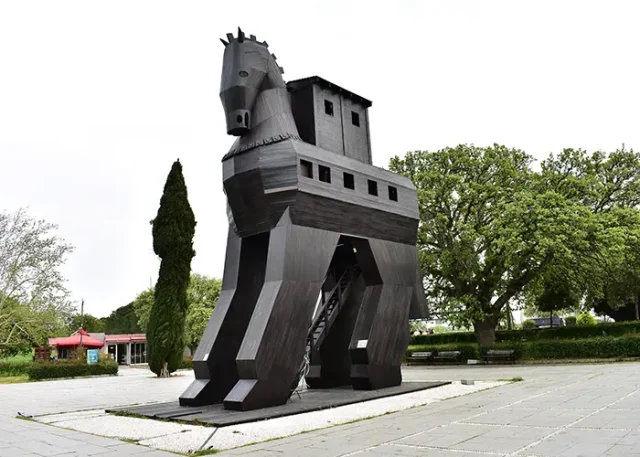
Visitors are welcomed at the entrance by a monumental wooden Trojan Horse, a nod to the myth that has permanently embedded this city in the imagination of Western civilization. From there, you wander through remarkably well-preserved ancient stone walls and streets that once belonged to Bronze Age fortifications and, later, a Roman Odeon and Bouleuterion.
Troy’s influence reaches further than most travelers realize. The city is directly tied to the origins of Rome: according to Virgil’s Aeneid, the Trojan prince Aeneas fled the fall of the city and eventually reached Latium, where his descendants founded Rome in 753 BCE. The “Aeneas Route,” tracing that legendary journey, is now recognized as a Cultural Route by the Council of Europe.
The Museum
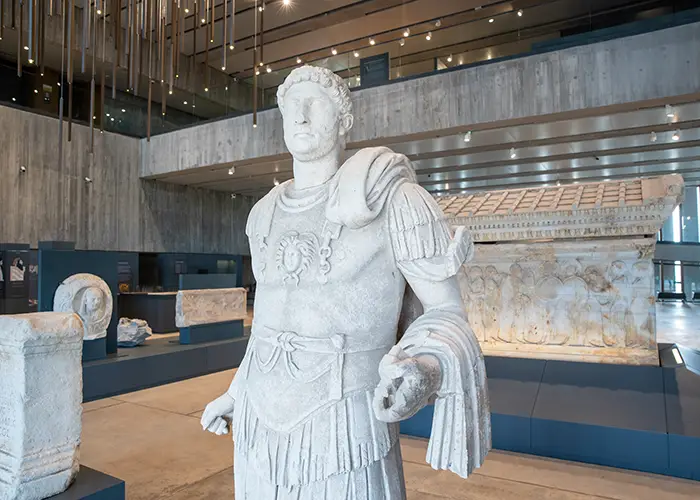
Don’t skip the Troy Museum, located right at the site entrance. The award-winning building — simple in form, impressive in impact — spreads Troy’s layered history across three levels through an immersive, contemporary experience. It’s the kind of museum that reframes everything you see when you step back outside into the ruins.
Beyond Troy: The Çanakkale Region
Troy is the centerpiece, but the surrounding region deserves more than a day trip. Çanakkale is a place of remarkable range:
- History and memory: Retrace the Gallipoli Campaign of World War I, and dive the coastal shipwrecks left behind.
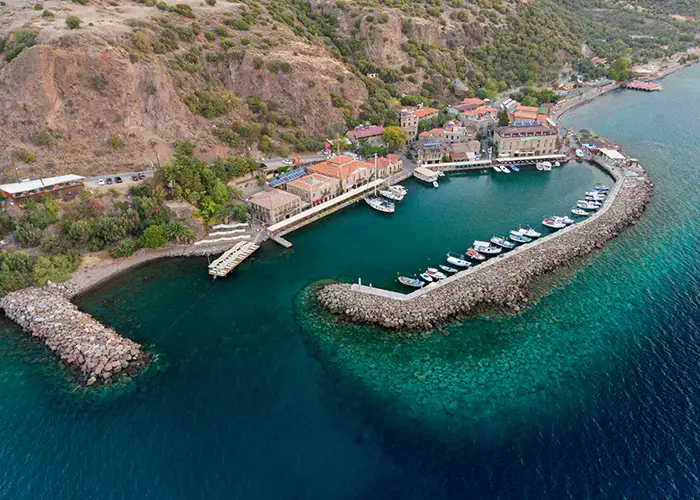
- Nature: Explore the emerald slopes of Mount Ida or swim the crystal-clear waters of Assos.
- Islands: The distinct charms of Bozcaada and Gökçeada are well worth the ferry crossing.
- Wine: Troy is part of the Troy Vineyard Route, a scenic drive stretching from Gallipoli through Eceabat, past the ruins, and out to Bozcaada — an island with a serious winemaking tradition.
- Food: Çanakkale’s culinary identity is built around Ezine cheese, olive oil-dressed vegetables, and fresh sardines from the Dardanelles and Saros Gulf. Pair them with a local wine and you’ve got a meal worth the trip alone.
Where to Stay
Çanakkale offers everything from chain hotels to boutique properties. For something more memorable, stay in Tevfikiye village itself — family-run pensions put you right at Troy’s doorstep and give you a genuine taste of local hospitality that the city hotels simply can’t replicate.
Hisarlik Hotel (Tevfikiye) — You won’t find a better-located base for exploring Troy. This small, family-run hotel sits directly opposite the Troy Museum, and the walk to the archaeological site takes about 15 minutes. The owners are a genuine highlight: travelers consistently rave about their warmth and deep knowledge of Troy’s history, and the home-cooked meals are worth lingering over. It’s a simple place, not a luxury retreat, but that’s not the point — the experience of waking up next to one of the ancient world’s most storied cities is the thing.
CURA Hotel (Çanakkale city center) — If you’d prefer a base in the city with easy access to restaurants, the waterfront, and day trips, CURA is a consistently well-reviewed pick. It’s a cozy, well-run boutique-style hotel with attentive staff and a solid breakfast spread — the kind of place where people note they felt genuinely looked after. Troy is about 30 minutes away by car.
Troy is located in Tevfikiye village, approximately 30 km from Çanakkale city center, Türkiye. It is open year-round and recognized as a UNESCO World Heritage Site.