
You’re three days into a road trip through Patagonia. The booking platform needs a confirmation, the navigation app wants a refresh, and the bar on your phone reads No Service. The next town is 80 kilometres of dust road away. Your home carrier, when you do find signal, will cheerfully bill you twenty dollars for the favour. It’s the moment most travellers wish they’d sorted their connectivity before leaving.
The good news in 2026 is that you almost certainly don’t need a physical SIM card to fix it. Travel eSIMs — embedded, software-activated mobile plans that download to your phone in under five minutes — have quietly become the connectivity layer of choice for the modern adventurer.
What an eSIM actually is
An eSIM is a SIM card built into your phone’s hardware. Instead of swapping a fiddly plastic chip, you scan a QR code and a destination data plan activates on your device. Your home number stays live for calls and 2FA codes. Every recent iPhone, Pixel and Samsung Galaxy supports it. U.S. iPhone 14 models onward are eSIM only.
Why it works for travelers who actually go places
Three reasons. First, no airport kiosks: you land in Reykjavík, Cusco or Hanoi with data already on — no queue, no photocopied passport, no language barrier. Second, multi-country regional plans: a single Europe-wide or Southeast Asia eSIM covers the whole loop without re-buying at every border. Third, real money savings. A 10 GB Europe plan typically lands in the $15–25 band for a month; the same data roaming on most home carriers can crest $100 in a long weekend.
For longer or rougher trips, the underlying network matters more than the brand on the landing page. A plan running on a tier-one host (EE in the UK, Orange in France, Telkomsel in Indonesia) holds signal far better in rural and high-altitude terrain than a budget reseller on a weaker network.
The catch: too many plans
The 2026 eSIM market is brilliant, fragmented and dense. More than forty providers compete, with over 80,000 plans worldwide differing in validity, hotspot rules, throttling thresholds and host network. Picking the one that actually fits a 14-day Patagonia loop is genuinely hard.
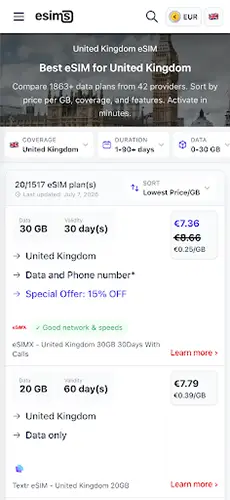
The cleanest shortcut is to use this eSIM comparison tool, which indexes the whole market across 227+ destinations and filters plans by data allowance, validity, hotspot support and underlying network. Independent, no paid rankings, with a free travel data calculator that estimates the right allowance before you buy.
The 5-minute pre-flight ritual
Before your next trip, do this once. Confirm your phone is eSIM-compatible and carrier-unlocked. Estimate your data allowance against the itinerary (rule of thumb: 1 GB per day for moderate use, more if you’re tethering or streaming maps offline). Buy a regional plan with hotspot enabled, on a tier-one host network, 30-day validity. Install it on home Wi-Fi the day before you fly. Label the line by region. Set it as your data line on arrival. Turn data roaming off on your home line.
Land. Connect. Walk straight past the SIM kiosk.
Suggested byline: By the editorial team at esims.io, an independent travel eSIM comparison platform used by more than 1.5 million travellers, with a 4.9/5 average user rating across iOS and Android.