
Millions of travelers visit America’s most iconic landscapes each year, drawn by sweeping views, dramatic geology and the promise of unforgettable photographs. Yet seeing a destination and truly understanding it are two very different experiences.
At the Grand Canyon, the scale of the landscape is immediately impressive. What is less obvious are the geological forces, ecosystems, wildlife and human stories that have shaped the region over millions of years. These deeper layers can be easy to overlook during a brief visit, particularly for travelers arriving with little time to explore.
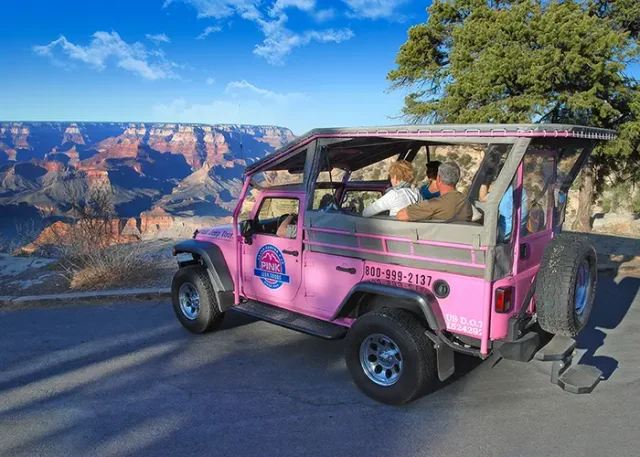
Pink Jeep Tours has spent decades helping visitors discover the landscapes surrounding the Grand Canyon, Sedona, Las Vegas, Branson and the Great Smoky Mountains. While the company’s distinctive pink vehicles may be its most recognizable feature, its local guides provide the knowledge and context that can turn sightseeing into a more meaningful encounter with a destination.
Experiencing More Than the Grand Canyon View
Many first-time visitors arrive at the Grand Canyon expecting to move between scenic overlooks, photograph the landscape and continue to their next stop. Guided experiences encourage travelers to slow down and look beyond the most famous views.
A knowledgeable guide can explain how layers of rock reveal the region’s geological history, identify wildlife and vegetation, and introduce the people and cultures connected to the Canyon. These stories help visitors understand that the Grand Canyon is more than a dramatic geological formation—it is also a complex, constantly changing environment.
Pink Jeep Tours’ South Rim experiences combine prominent viewpoints with interpretation from guides who understand the landscape. Depending on the itinerary, travelers may also journey through the Kaibab National Forest, experiencing the transition from forested terrain to the Canyon’s rim.
This approach builds anticipation while revealing an ecosystem that visitors might otherwise pass through without noticing.
A Growing Interest in Experiential Travel
Travelers are increasingly interested in experiences that offer more than a series of photo opportunities. They want to understand the destinations they visit, connect with local stories and return home with a stronger sense of place.
At the Grand Canyon, that can mean learning about its geological formation, Indigenous history, early explorers, wildlife and plant life. It can also involve recognizing how the forests surrounding the Canyon contribute to the wider landscape.
Social media may inspire travelers to visit, but it rarely captures the silence, scale and emotional power of standing at the rim. A guide can help bridge that gap by encouraging visitors to put what they see into a broader context.
Exploring the Canyon Responsibly
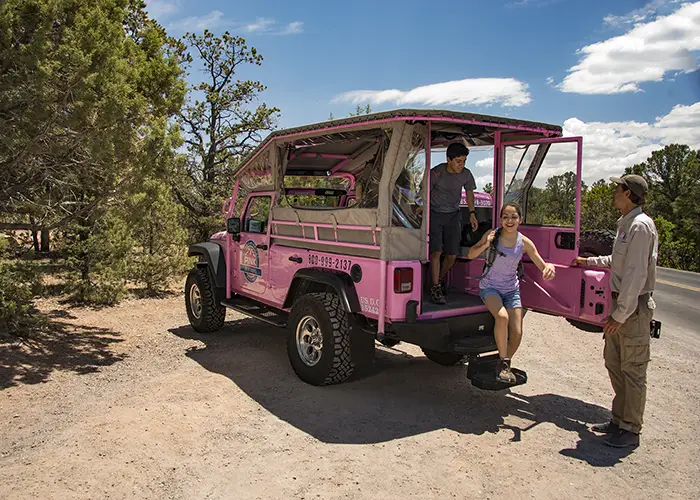
Greater interest in outdoor travel also makes responsible tourism increasingly important. Off-road routes, hiking areas and wildlife habitats require careful management to protect the environment while allowing visitors to experience it.
Responsible guided tours remain on designated routes, minimize disturbances to wildlife and help guests understand why seemingly small actions can affect a fragile landscape. Guides can also encourage travelers to observe their surroundings without attempting to control, approach or disrupt them.
This emphasis on stewardship is particularly important at the Grand Canyon, where forests, vegetation, wildlife, geological features and human activity are closely connected. Visitors who understand those relationships may leave with not only memorable photographs, but also a deeper respect for the landscape.
In Conversation with Pink Jeep Tours Guide Jared Warden
To explore how an expert guide can change the Grand Canyon experience, DRIFT Travel spoke with Pink Jeep Tours guide Jared Warden about storytelling, wildlife, conservation and the growing desire for more meaningful travel.
Pink Jeep guides are described as adventurers themselves. How does that genuine passion create an experience different from a scripted or self-guided tour?
I think the biggest difference is that our guides genuinely love the Canyon, and people can feel that right away. It’s not something we have to force or rehearse; it comes through naturally in the way we talk about the landscape, point out the details and share the stories that make the place so special to us.
A scripted tour can give you the basics, and self-guided exploring has its own freedom, but neither one really replaces that human connection. When you’re with someone who truly cares about the Grand Canyon, you get more than facts; you get enthusiasm, context and a sense that this place matters. That makes the experience feel richer and more personal.
For me, that’s what I love most. I never want guests to just see the Canyon—I want them to feel it. I want them to leave with a real sense of wonder and maybe even a little of the same love and respect for it that I have.
Is there a particular story about the Canyon that you never get tired of telling?
There are so many Canyon stories that never lose their power for me. Some are funny, some are inspiring and some really help people see the Grand Canyon as more than a landscape.
I love sharing the little details that stick with people—the burro that became an icon or the two women who made history on the river and documented the plants along the way. Those stories bring out the personality of the Canyon and the people who have been connected to it.
What makes the Grand Canyon so remarkable is that there’s always another layer to uncover. You can talk about the geology, river, wildlife, Indigenous history, explorers, early visitors and people who helped shape its legacy, and it still never feels repetitive.
These stories really belong here. The Canyon is something you have to experience in person because being here gives the stories a depth you can’t quite capture any other way.
What is the most surprising thing guests learn on tour?
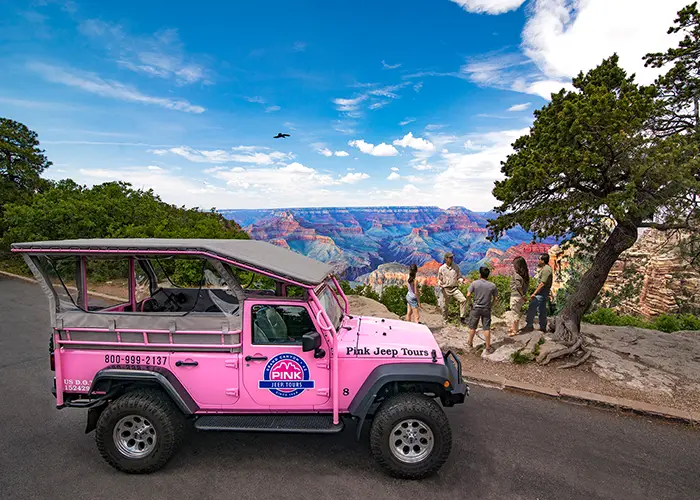
One of the most surprising things guests learn is just how much living history and living nature are intertwined with the Grand Canyon. A lot of people arrive expecting only the big view, and they’re amazed to discover how much is going on beyond the rim—from the geology and wildlife to the forests, plants and seasons that shape the experience around the Canyon.
It’s not just a place you look at; it’s a whole living landscape that changes as you spend time with it.
Guests are often surprised by how much personality the Canyon and its surroundings have. The pinyon, juniper, ponderosa, birdlife, quiet details in the forest and stories tied to the land all add layers most people don’t expect. They come for the scenery, but they leave with a real sense of wonder for the entire ecosystem.
How does the off-road portion of the South Rim Journey change a visitor’s relationship with the Canyon?
I think the off-road element changes the experience by helping people feel the Canyon as part of a larger living landscape, not simply as a series of overlooks.
Coming in through the Kaibab National Forest slows everything down in a meaningful way. You start to notice the transition from forest to rim country, and that makes the reveal of the Canyon feel more powerful and personal.
The route also gives guests a better chance to see wildlife along the way. In quieter terrain, people are often more tuned in to the movement around them, whether that’s birds, deer, elk or subtle signs of life in the forest. That sense of discovery makes the journey feel more immersive and adventurous.
By the time guests reach the Canyon, they’ve already had an experience that builds anticipation and creates a stronger emotional payoff. It helps people understand the Grand Canyon as more than a destination. The forest, wildlife and surrounding land all add context to how they experience the Canyon itself.
How do you balance off-road and hiking experiences with responsible stewardship?
Balance is really at the heart of it. We want guests to have a meaningful experience, but we also want to ensure we’re respecting the land that makes that experience possible. That means staying on designated routes, being mindful of wildlife and understanding that some of the most beautiful areas around the Canyon are also the most fragile.
I think about hiking areas the same way. Those paths can feel more wild and natural, which is part of their appeal, but that also means guests need to move carefully and remain aware of their surroundings. We talk about the landscape in a way that helps people appreciate it without trying to control or overrun it.
I’m often reminded of Aldo Leopold’s idea that we need to “think like a mountain”—to understand that every part of the landscape is connected. That feels especially true here, where the visitor experience, wildlife, vegetation and land itself all belong to one another. Stewardship means helping people enjoy the Canyon in a way that respects that larger whole.
How have travelers and their expectations evolved with the growth of experiential travel and social media?
Even as a newer guide, I can already feel that guests are coming in with a deeper desire to experience the Grand Canyon, not just see it. People still want the iconic photos, of course, but they’re also asking better, more curious questions about the geology, wildlife, history, surrounding forest and what makes this place feel so powerful once you’re actually here.
The mix of guests is broad, but their expectations are becoming more intentional. Younger travelers often arrive with a strong interest in experiences they can share and remember, while families are looking for something that gives everyone a meaningful connection. Couples tend to be drawn to the emotional side of the experience—the beauty, pace and feeling of being somewhere special together.
Across those groups, people seem more open to slowing down and taking in the Canyon rather than rushing through it.
Social media definitely plays a role. Many guests arrive having seen the Canyon presented in a polished, filtered way, so there’s often a moment when they realize the real experience is bigger, quieter and more moving than they expected. That’s one of the things I love most about guiding: helping people move from the image of the Canyon to the actual feeling of standing here and being part of it.
If you could change one thing about how travelers approach iconic destinations such as the Grand Canyon, what would it be?
I’d change the tendency to treat places like the Grand Canyon as something to consume quickly instead of something to genuinely encounter. Too many travelers arrive expecting a checklist experience, when what these landscapes really ask for is attention, patience and respect.
I’d also want people to understand that preservation is not the same as keeping a place frozen or overly managed. Real conservation means allowing a landscape to remain itself, even when that means it feels a little wild, less controlled or harder to package perfectly.
The Canyon is powerful because it still has that independence, and I think visitors get more out of it when they approach it with humility instead of entitlement.
For me, the ideal shift is from “What can I get from this place?” to “How can I meet this place on its own terms?” That mindset changes everything. It opens people up to the geology, wildlife, silence, history and the fact that the Canyon is not a product, but a living landscape with its own integrity.
More information about available experiences can be found at Pink Jeep Tours.