
The electric cargo bike has become one of the most exciting travel tools of the decade.
For families, it can replace short car trips. For outdoor travelers, it can carry gear to parks, beaches, campgrounds and trailheads. For city explorers, it offers a more flexible way to move through traffic, park close to the destination and bring more than a standard bicycle could ever handle.
Among premium cargo e-bikes, the Tern GSD has earned a strong reputation. It is compact, polished, highly configurable and widely respected as a serious car-replacement bike. For many riders, especially families who want a premium urban cargo solution, it has become one of the benchmark names in the category.
But travel needs are changing.
In 2026, carrying people and cargo is no longer the full story.
Families now travel with phones, tablets, cameras, drones, lights, speakers, coolers and camping devices. Weekend trips are more digital. Outdoor adventures are more connected. Even a simple day at the lake can involve navigation apps, mobile payments, Bluetooth speakers, drone batteries and a portable fridge.
That creates a new question for anyone shopping for a premium cargo e-bike:
Should a modern family cargo bike only move people and gear, or should it also power the trip?
This is where the Fiido T3 Max makes the comparison interesting. It does not simply compete with the Tern GSD as another electric cargo bike. It adds one feature that feels increasingly important for travel-focused families and outdoor riders: portable power output.
The Tern GSD Set the Standard for Premium Cargo Bikes
Any fair comparison should begin by acknowledging what the Tern GSD does well.
The GSD is one of the best-known premium cargo e-bikes because it understands the family transportation problem. It is built to carry children, groceries and daily gear while remaining shorter and easier to manage than many traditional cargo bikes.
Its strength is refinement.
The latest GSD models use Bosch systems, premium components and a highly developed accessory ecosystem. The GSD S10 Gen 3, for example, is built around the Bosch Smart System, Bosch Cargo Line motor support, hydraulic braking and a compact frame designed for heavy everyday use.
For a parent doing school runs, a rider replacing local car trips or a household that wants a polished cargo solution, the GSD makes sense.
It is the kind of bike that has helped make cargo e-bikes feel normal.
That matters. The category needed products that showed families an e-bike could be more than recreation. The GSD helped prove that a cargo bike could become a serious transportation tool.
But when a product sits at the premium end of the market, expectations also rise.
If a buyer is spending thousands of dollars on a family travel vehicle, the question becomes: what should a premium cargo e-bike include today?
The New Travel Requirement: Power Everything
The modern family trip is powered by batteries.
A few years ago, the biggest question was whether the bike could carry two kids and groceries. That is still important. But now the trip may also include:
- Smartphones for maps, photos and communication;
- Tablets for kids during breaks or travel stops;
- Drone batteries for outdoor video;
- Bluetooth speakers for a picnic or beach day;
- Camping lights for evening use;
- A portable fridge or cooler;
- Camera batteries;
- A laptop or USB-C device;
- Emergency charging for unexpected situations.
A normal cargo e-bike can carry these items.
A more advanced travel-focused cargo e-bike can help power them.
That is the difference.
For outdoor travelers, the ability to charge devices is not a gimmick. It is a practical upgrade. If a family is spending the day at a lake, campground, festival, trailhead or remote picnic spot, access to power can define how long the trip lasts and how comfortable it feels.
This is where the Fiido T3 Max introduces a different idea.
It treats the cargo e-bike not only as transportation, but as an energy platform.
The Fiido T3 Max Changes the Cargo Bike Formula
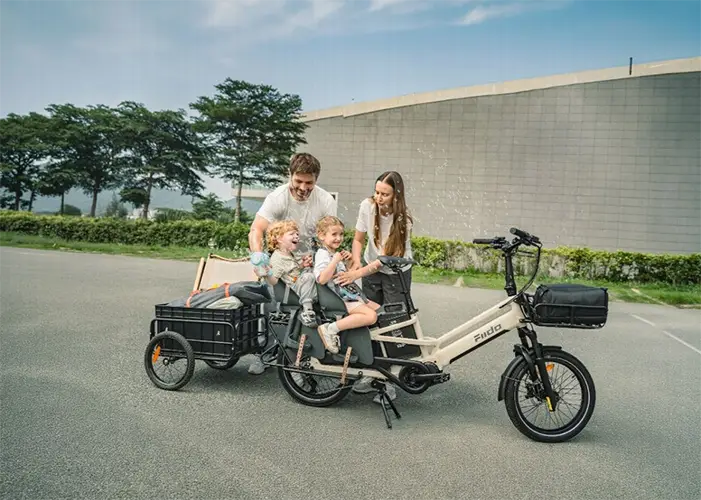
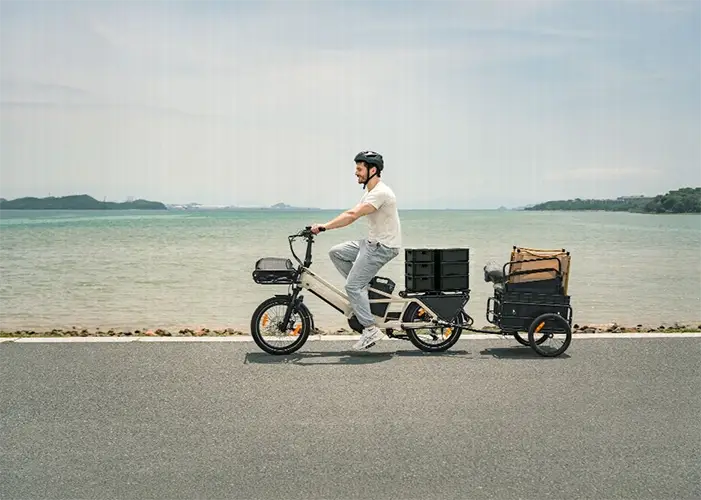
The Fiido T3 Max is a longtail electric cargo bike designed for family trips, outdoor use and daily transport. It combines a high payload rating, long-range battery options and portable power functionality in one platform.
On paper, the numbers are striking.
The T3 Max offers a payload capacity of up to 440.9 lbs, a dual-battery setup up to 1620Wh and portable power output through its extender battery system. It is designed not only to carry passengers and gear, but also to power devices such as phones, cameras, drones, camping lights, portable fridges and other small appliances with compatible accessories.
That makes the T3 Max feel less like a traditional cargo bike and more like a rolling travel base camp.
For families and travelers, this matters because the bike can support the entire day.
It can carry the kids.
It can carry the cooler.
It can carry the picnic setup.
It can help power the devices.
It can bring everything home.
This is the type of feature that changes how people think about the category.
What a Premium Cargo E-Bike Should Mean in 2026
For a long time, premium cargo e-bikes were judged by frame quality, motor system, brakes, accessories, safety certifications and ride feel.
Those still matter.
But the definition of “premium” is expanding.
A premium travel product should not only be well built. It should solve more problems.
For families, the problems are not theoretical.
A phone dies while navigating home from a remote park.
A drone battery runs out before the best sunset shot.
A camping light needs charging after dark.
A portable fridge needs power during a long picnic.
A speaker dies halfway through a beach gathering.
A child’s tablet needs charging during a long day away from home.
A bike that can help with those situations is doing more than moving cargo.
It is supporting the experience.
That is why a modern Electric Cargo Bike should be evaluated not only by how much it can carry, but by what kind of day it makes possible.
Tern GSD vs. Fiido T3 Max: Different Strengths
The Tern GSD and Fiido T3 Max are not identical products, and they should not be treated as if they are trying to do exactly the same thing.
The GSD is the premium urban cargo benchmark.
It is compact, refined and supported by a mature accessory system. Its Bosch platform and high-end build make it attractive for families who want a polished car-replacement bike for daily city life.
The T3 Max is more disruptive.
It focuses on high cargo capacity, dual-battery range and portable power output at a dramatically different price point. It is less about traditional premium brand positioning and more about feature value for families, outdoor users and travel-focused riders.
The real comparison is not simply “which bike is better?”
The better question is:
Which bike solves the problems that matter most to your lifestyle?
For dense urban families who prioritize dealer support, Bosch integration and a highly established ecosystem, the GSD remains a strong candidate.
For families who want a cargo bike that can double as an outdoor power station, the T3 Max brings something the traditional premium category has not fully answered.
The $6,000 Question: What Are You Paying For?
Premium cargo e-bikes can cost as much as a used car.
That is not automatically unreasonable. High-quality motors, frames, brakes, batteries, safety systems and accessories are expensive. Families also value reliability when children and heavy cargo are involved.
But high prices should invite careful questions.
Are you paying for brand reputation?
Are you paying for component quality?
Are you paying for dealer support?
Are you paying for a mature accessory ecosystem?
Are you paying for features that change how you travel?
The Tern GSD clearly delivers in many traditional premium categories. It has a strong reputation, serious engineering and a refined family cargo concept.
However, the Fiido T3 Max raises an uncomfortable but important question:
If a cargo e-bike costs several thousand dollars, should it also help power the outdoor lifestyle it is designed to support?
That question becomes especially relevant for travel buyers.
A family that mostly rides in the city may not care about charging a portable fridge or drone. A family that camps, films, fishes, attends outdoor events or spends weekends away from grid power might care a lot.
Why Portable Power Matters for Travel Families
Travel families carry more electronics than ever.
That does not mean they are less outdoorsy. It simply means outdoor life has changed.
Parents use phones for maps, bookings, photos, messages and emergency contact. Kids may use tablets during breaks. Outdoor creators may bring cameras and drones. Families may use portable lights at campsites or evening picnics. A small fridge or cooler can make a long day more comfortable.
Power has become part of modern travel infrastructure.
When a bike can provide power, it changes the travel plan.
A family can stay longer at the park.
A drone pilot can recharge between shots.
A camper can run lights after dark.
A photographer can keep cameras ready.
A parent can avoid the stress of a dead phone.
The T3 Max’s 1620Wh dual-battery capability and portable power output make this possible in a way that ordinary cargo e-bikes do not.
That is why the feature matters.
It is not about novelty.
It is about extending the usefulness of the bike beyond transportation.
The Outdoor Use Case: Where T3 Max Feels Different
The Tern GSD is excellent in urban environments.
The Fiido T3 Max becomes especially interesting when the road turns into a weekend route.
Imagine a family planning a day near a lake.
They bring food, drinks, towels, a picnic blanket, a camera, a drone, lights and a small speaker. They ride from a rental cabin or campsite to the waterfront. They spend the day outside and stay into the evening.
A standard cargo e-bike can carry much of the gear.
The T3 Max can carry the gear and help power the day.
That is the difference.
The same applies to fishing trips, outdoor markets, beach days, camping weekends, park events and family travel shoots.
When the cargo bike becomes part of the power plan, it becomes more than a vehicle.
It becomes infrastructure.
Cargo Capacity Still Matters
Portable power is the headline feature, but the T3 Max also needs to function as a real cargo bike.
Its 440.9 lbs payload rating gives it the capacity needed for family and gear-heavy travel use. That supports the idea of using the bike as a practical alternative to short car trips.
Cargo bikes succeed when they remove friction.
If a bike cannot carry enough, riders return to the car.
If a bike feels too limited, riders use it only for recreation.
If a bike can carry passengers, gear and supplies comfortably, it becomes part of everyday transportation.
This is where both the Tern GSD and Fiido T3 Max belong in the same conversation. They are both trying to make cargo e-bikes more practical for real families.
The difference is that the T3 Max adds another layer: energy.
Price and Value: The Real Travel Gear Test
Travel gear should be judged by how often it gets used and how many problems it solves.
A suitcase that only looks good is less valuable than one that survives real trips.
A camera that never leaves the bag is less useful than one that fits the workflow.
A cargo e-bike that is too expensive or too specialized may not become part of everyday life.
The Tern GSD is a premium product with premium appeal. For some buyers, that is exactly what they want.
The Fiido T3 Max offers a different argument: more functional range, high payload capacity and portable power at a much lower entry price.
For buyers who care about practical travel utility, that argument is powerful.
The T3 Max does not need to imitate the GSD feature for feature. It wins attention by changing the criteria.
Instead of asking which cargo e-bike feels most premium in the traditional sense, it asks which bike is more useful for the connected outdoor life families actually live.
How Families Should Choose the Right E-Bike
There is no universal winner for every rider.
A family living in a dense city may prioritize compact size, dealer service, security features and proven urban cargo accessories.
A family that travels often may prioritize battery capacity, power output, payload and outdoor versatility.
A rider using a bike mainly for school runs may care more about passenger accessories.
A rider using it for camping, filming or long weekend trips may care more about charging capability and range.
That is why buyers should compare the full ebike category before making a decision.
The right bike is not always the one with the highest price or the most established reputation.
It is the one that best supports the trips people actually take.
European Manufacturing and Long-Term Trust
Cargo e-bikes are not disposable gadgets.
They carry families, groceries, camping equipment, creative tools and sometimes the things people depend on during travel. Build quality and long-term confidence matter.
Fiido has highlighted European manufacturing for selected European-market models, including T3-series models manufactured in France. This does not mean every Fiido model is made in Europe, but it shows the brand’s attention to regional manufacturing expectations and product trust.
For travel buyers, this type of detail matters.
A cargo e-bike is not only a weekend toy. It can become part of family logistics, outdoor adventure and daily transportation.
The more responsibility the bike takes on, the more reliability matters.
The One Feature That Changes the Conversation
The Tern GSD deserves its reputation.
It is one of the most important premium cargo e-bikes on the market and remains a strong option for riders who want a refined urban car-replacement bike.
But the Fiido T3 Max introduces a feature that feels especially relevant for 2026: portable power.
That one difference changes the conversation.
A cargo e-bike that carries your family is useful.
A cargo e-bike that carries your family, carries your gear and helps power your day is something more.
It is a travel tool.
It is a campsite support system.
It is a family adventure platform.
It is a mobile power station on two wheels.
For riders who only need city cargo transport, the traditional premium formula may still be enough.
For families who live between city streets, weekend escapes, parks, campsites, lakes and outdoor events, the T3 Max makes a compelling case that the future of cargo e-bikes is not just about hauling.
It is about energy, flexibility and independence.
And that may be the one game-changing feature the premium cargo category can no longer afford to ignore.