
A new expedition cruise will combine one of the century’s longest total solar eclipses with an exploration of Australia’s remote Kimberley Coast.
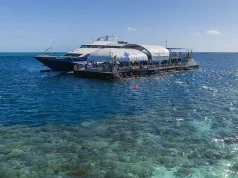
Wilderness Travel’s 16-day Total Solar Eclipse of 2028: The Kimberley Coast and Coral Frontier expedition is scheduled for July 11 to 26, 2028. Traveling aboard the 120-guest Coral Adventurer, participants will explore rivers, reefs, waterfalls and Indigenous cultural sites before witnessing more than five minutes of totality on July 22.
The round-trip journey from Darwin is designed for travelers who want to experience the eclipse as part of a broader adventure rather than making a brief trip solely to reach the path of totality.
More Than Five Minutes of Totality
On July 22, 2028, the Moon’s shadow will cross parts of Southeast Asia, Indonesia, Australia and New Zealand. According to NASA eclipse calculations, the longest possible duration of totality anywhere along the eclipse path will be approximately five minutes and 10 seconds.
That makes the 2028 event one of the longest total solar eclipses of the 21st century. By comparison, the total phase of the widely viewed April 2024 eclipse across Mexico, the United States and Canada lasted a maximum of about four minutes and 28 seconds.
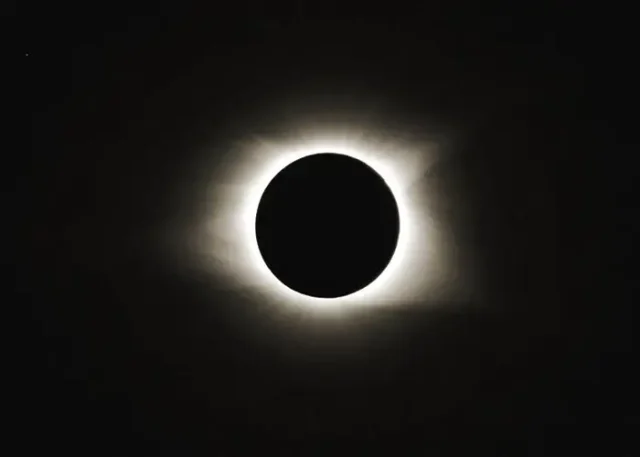
During totality, the Moon completely covers the bright face of the Sun. The sky darkens, brighter stars and planets may become visible, and the Sun’s outer atmosphere, known as the corona, can be seen surrounding the Moon.
The Coral Adventurer will position itself within the path of totality to provide guests with an unobstructed view from the water. A ship also offers a degree of flexibility that fixed land-based viewing locations cannot provide, although weather and cloud cover can never be predicted with complete certainty.
Astronomy at Sea With Dr. Alex Filippenko
The expedition will be joined by Dr. Alex Filippenko, a distinguished professor of astronomy at the University of California, Berkeley.
Filippenko is known for making complex astronomical subjects accessible to general audiences and has observed 20 total solar eclipses around the world. This will be his 17th eclipse journey with Wilderness Travel.
During the voyage, he will present talks about solar eclipses, astronomy and the wider universe. His participation adds a scientific component to the journey, helping travelers understand what they are seeing before the ship enters the Moon’s shadow.
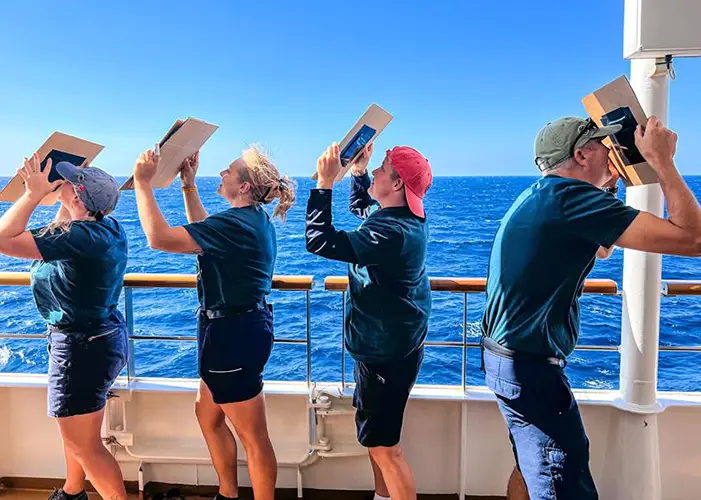
Although specialized equipment is not required to appreciate an eclipse, eye protection is essential. Certified solar-viewing glasses must be worn whenever any portion of the Sun remains visible. They may only be removed during the brief period of complete totality and must be replaced as soon as the Sun begins to reappear.
Exploring the Kimberley Coast
The eclipse is the centerpiece of the expedition, but much of the itinerary is devoted to the Kimberley, one of the most sparsely populated and visually dramatic regions of northern Australia.
Its coastline is characterized by towering sandstone cliffs, tidal rivers, waterfalls, isolated islands and ancient rock formations. Many locations are difficult or impossible to reach by road, making small-ship cruising one of the most effective ways to explore the region.
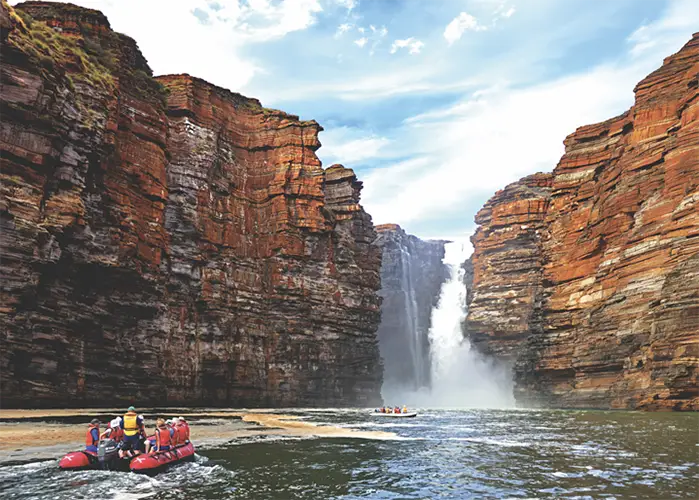
Among the planned destinations is the King George River, a remote waterway surrounded by red sandstone gorges. Expedition boats will carry travelers inland beneath the cliffs toward King George Falls, where twin waterfalls descend from the plateau during the wetter part of the season.
The voyage will also visit Montgomery Reef, an extensive reef system that appears to rise from the ocean as the tide falls. Water pours from the exposed reef in channels and cascades, attracting fish, turtles, seabirds and other marine life.
As with most Kimberley expeditions, landings and daily activities will depend on tides, weather and local conditions.
Remote Reefs and Coral Atolls
Beyond the Kimberley coastline, the itinerary ventures into some of the least-visited marine environments off Western Australia.
Ashmore Reef Marine Park contains lagoons, reef flats, seagrass meadows and small islands that provide important habitat for seabirds, migratory shorebirds, marine turtles and dugongs. Hundreds of coral and fish species have been recorded within the protected area.
Scott Reef is known for its isolated position and dramatic outer reef walls, while Adele Island provides habitat for large populations of seabirds. The surrounding waters can offer opportunities for snorkeling and marine-life observation when conditions permit.
Another highlight is Rowley Shoals, a chain of coral atolls rising steeply from the ocean floor. Clear lagoons, coral gardens and abundant marine life have made the shoals a coveted destination for experienced snorkelers and divers.
Swimming, snorkeling and diving opportunities are planned throughout the expedition, subject to sea conditions and local regulations.
Mitchell River and Berkeley River
Following eclipse day, the expedition returns to the rugged landscapes of the Kimberley.
Mitchell River National Park is known for its layered sandstone country, waterfalls, woodlands and cultural significance to the Wunambal Gaambera people. The wider region supports numerous mammal, bird, reptile and amphibian species.
At the Berkeley River, travelers will journey inland between tall sandstone walls. Ospreys are frequently seen above the river, while saltwater crocodiles may be spotted along the banks. Expedition guides will interpret the landscape and help guests observe wildlife from an appropriate distance.
Meeting the Tiwi Community on Bathurst Island
Toward the end of the voyage, the ship will call at Bathurst Island, part of the Tiwi Islands north of Darwin.
Local Tiwi guides will introduce visitors to the island’s history and living culture, including a visit to the Historic Mission Precinct and Tiwi Design Centre. Established in 1969, the art center is one of Australia’s oldest Indigenous art organizations.
Artists at the center work in ochre painting, screen-printed textiles, ceramics and ironwood carving. Visitors will have an opportunity to learn about the meanings and traditions behind the work and purchase art directly from the community.
The visit is expected to conclude with a traditional dance performance before the ship returns to Darwin.
Life Aboard the Coral Adventurer
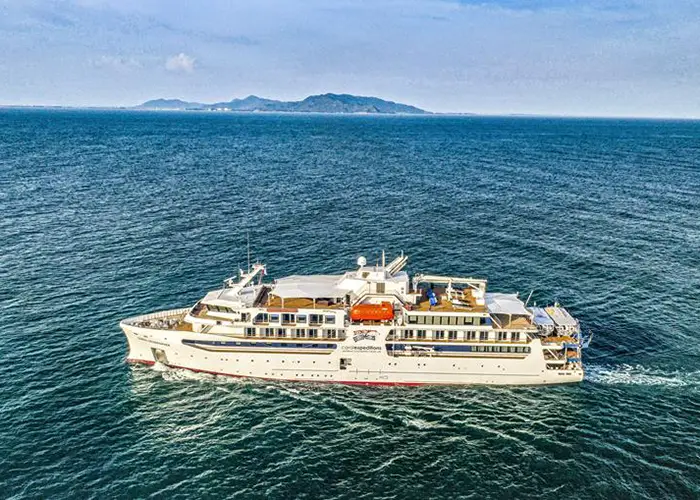
Purpose-built for remote Australian waters, the Coral Adventurer accommodates a maximum of 120 guests.
Its relatively small size allows it to enter coastal areas that are inaccessible to large cruise ships. The vessel also carries specialized Xplorer tenders used for shore landings, river journeys and close-up exploration.
All cabins face outward, while open deck areas provide space for wildlife watching, photography and eclipse viewing. The ship’s smaller passenger capacity should also make it easier for guests to attend lectures and join guided activities without the crowds associated with conventional cruising.
A Different Kind of Eclipse Journey
Eclipse travel often involves reaching a viewing location shortly before the event and leaving soon afterward. This expedition takes a different approach by building the celestial event into a two-week exploration of northern Australia.
The result is a journey that combines astronomy with expedition cruising, snorkeling, wildlife observation and Indigenous culture. Even without the eclipse, the Kimberley’s waterfalls, tidal reefs, sandstone gorges and remote islands would make for a compelling itinerary.
For travelers considering other upcoming celestial journeys, DRIFT has also covered the 2027 total solar eclipse in Luxor, Egypt. Those extending their time in Western Australia can find additional ideas in our guide to exploring Broome.
With more than five minutes of totality expected along the 2028 eclipse path, the Kimberley voyage offers an uncommon opportunity to witness one of nature’s most dramatic events in one of Australia’s wildest coastal regions.