
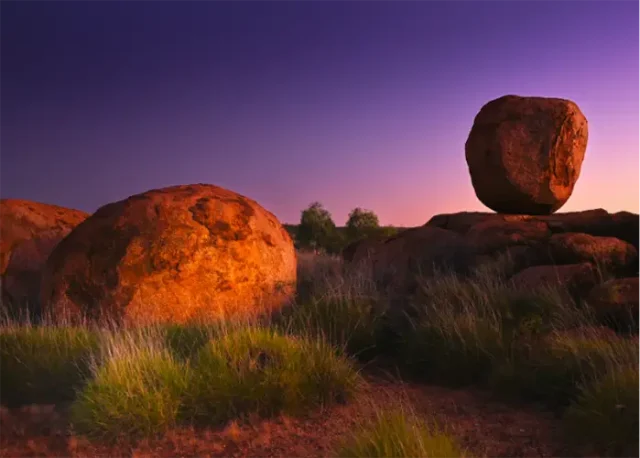
Karlu Karlu / Devils Marbles Conservation Reserve has long been one of the most recognizable landscapes in Australia’s Northern Territory. By day, visitors come to see its enormous granite boulders, some of which appear to balance improbably against the open desert. After sunset, the same formations become silhouettes beneath one of Australia’s darkest night skies.
That nighttime landscape has now received international recognition. DarkSky International has designated Karlu Karlu an International Dark Sky Sanctuary, making it the first in the Northern Territory and only the third in Australia.
The certification recognizes the exceptional darkness of the reserve’s skies, as well as the work being undertaken to protect the area from future light pollution. It also strengthens Karlu Karlu’s appeal as an astrotourism destination ahead of a total solar eclipse that will cross the region in 2028.
More Than a Geological Landmark
Located approximately 100 kilometres south of Tennant Creek beside the Stuart Highway, Karlu Karlu is a convenient stop for travelers driving between Alice Springs and Darwin. It can also be incorporated into a longer Northern Territory itinerary that includes Uluru, Kata Tjuta and Tjoritja / West MacDonnell National Park.
The reserve’s rounded and sometimes precariously balanced boulders were shaped by millions of years of geological change. A short self-guided walking route leads visitors among the formations, with interpretive signs explaining the geology and cultural importance of the area.
However, Karlu Karlu is much more than an unusual natural attraction.
Almost all of the 1,800-hectare reserve is a registered sacred site. The cultural landscape holds profound significance for the Kaytetye, Warumungu, Warlpiri and Alyawarra Traditional Owners, whose connections and responsibilities to the area extend back countless generations.
The reserve contains sacred places, Dreamings and stories that remain central to the identity and traditions of its Traditional Owners. Their support was an important part of obtaining the International Dark Sky Sanctuary designation.
Visitors are asked to remain on established routes, respect signs and refrain from climbing on the boulders.
Protecting One of Australia’s Darkest Skies
International Dark Sky Sanctuaries are generally remote places with exceptionally dark skies and minimal artificial light. Sites must demonstrate not only the quality of their nighttime environment but also a commitment to preserving it.
The process of obtaining the designation for Karlu Karlu took approximately one year. It included six months of night-sky measurements, an audit of artificial lighting and an assessment of potential threats to the reserve’s natural darkness.
Future development will need to follow lighting guidelines designed to limit unnecessary illumination. These measures will help preserve views of the stars while protecting the nocturnal environment.
Light pollution can interfere with the movement, feeding and breeding behavior of wildlife. Limiting it is especially important at Karlu Karlu, where the reserve supports more than 100 native plant species as well as birds, mammals, reptiles, frogs and other animals adapted to the desert environment.
New interpretive signs are also planned. In addition to explaining the importance of dark-sky conservation, future interpretation could create opportunities for Aboriginal-led storytelling about the night sky and its cultural connections.
What Stargazers Can See at Karlu Karlu
The reserve’s distance from major population centres allows the stars to emerge with remarkable clarity. On a dark, cloudless night, visitors may be able to see the Milky Way stretching across the sky without needing a telescope or other specialized equipment.
The boulders make the experience particularly atmospheric. Around sunset, their warm red and orange colors deepen before the formations become dark outlines against the stars.
Visitors hoping to experience the darkest possible conditions should plan their stay close to a new moon. It is also helpful to arrive before sunset, become familiar with the surroundings and allow at least 20 minutes for the eyes to adjust after darkness falls.
Bright phone screens, camera flashes and white flashlights can interfere with night vision. A flashlight with a red-light setting provides enough illumination for basic tasks without significantly affecting the experience of nearby stargazers.
Binoculars can reveal star clusters and details that are difficult to see with the naked eye, while a tripod will help travelers capture long-exposure photographs. Visitors should remember that drones are not permitted in the reserve.
A Dramatic Setting for the 2028 Total Solar Eclipse
Karlu Karlu is expected to attract even greater international attention on July 22, 2028, when a total solar eclipse crosses part of Australia.
The reserve will lie within the path of totality. For almost five minutes, the Moon will completely cover the Sun, briefly turning daylight into twilight above the desert and its giant granite boulders.
Experiencing a total eclipse from such a dramatic and culturally important landscape will be a rare opportunity. Demand for campsites, accommodations and transportation throughout the region will likely be high, so travelers should begin planning well in advance and monitor official announcements concerning access and eclipse-viewing arrangements.
Certified eclipse glasses must be worn during the partial phases of the eclipse. Regular sunglasses do not provide sufficient protection. Eye protection may only be removed during the brief period of totality and must be put back on as soon as the Sun begins to reappear.
Planning a Visit to Karlu Karlu
Karlu Karlu is approximately one hour south of Tennant Creek and about four-and-a-half hours north of Alice Springs by road. The reserve is accessible by conventional two-wheel-drive vehicles under normal conditions.
Although it can be visited throughout the year, the cooler months between April and September generally provide more comfortable conditions for walking and camping. Travelers visiting during warmer periods should carry plenty of water, use sun protection and avoid extended activity during the hottest part of the day.
A bush campground allows visitors to stay for sunset, stargazing and sunrise. It accommodates tents, camper trailers, caravans and motorhomes, although facilities are relatively simple. Campsites must be booked online before arrival, as payment cannot be made at the campground.
Visitors from outside the Northern Territory also need an NT Parks Visitor Pass. Generators are not permitted, helping maintain the quiet environment and absence of intrusive light after dark.
Current park conditions, camping requirements and visitor-pass information are available from the official Northern Territory Parks and Wildlife page. Additional destination information is available through Tourism Northern Territory.
Karlu Karlu’s new designation recognizes something increasingly rare: a landscape where natural darkness remains part of the experience. Here, the protection of the night sky complements the protection of Country, culture and wildlife—and gives travelers another reason to slow down and look upward.