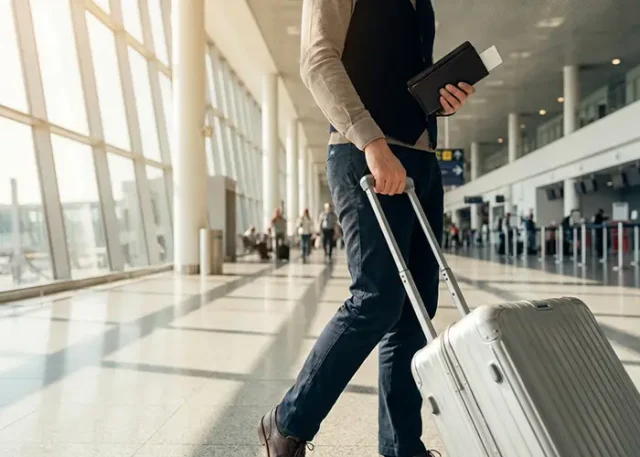
An airport transfer is a pre-booked private car that meets you inside the arrivals hall and drives you to a named address. It is not a taxi rank, and not a train with your cases wedged between your knees.
For anyone leaving Haywood County, the London leg starts long before that car does. No airline flies non-stop from Asheville Regional (AVL) to Heathrow, so nearly every itinerary routes through Charlotte, Atlanta or Chicago first. Heathrow then sits roughly 15 miles west of central London, about 45 minutes by road on an ordinary day.
Money is where visitors get caught out. A Piccadilly line single costs £5.90, the Elizabeth line charges a flat £15.50 into Zone 1, and Heathrow Express asks £26 on the day. A black cab meter lands between £75 and £110, and a fixed-fare private car between £45 and £120.
Two official bodies shape the rest. Transport for London licenses every private hire operator working the airport, and the Home Office now requires an Electronic Travel Authorisation from US passport holders before they board.
What follows covers how Haywood County travellers reach the UK, what separates a transfer from a cab, every route into the city at 2026 prices, why your terminal changes the pickup, what a dawn arrival does to day one, the questions worth asking before booking, onward trips past the M25, and the paperwork Americans forget.
Getting from Waynesville to London in one piece
Waynesville sits about half an hour from Asheville Regional, the easy part. AVL has no transatlantic service, so American, Delta and United all sell you a one-stop itinerary instead.
Charlotte Douglas is the usual answer, roughly 93 miles and two hours east by car, and it carries the shortest average layover on the route at about 1 hour 26 minutes. Atlanta works too, at 172 miles. Some skip the regional hop and drive across, removing a boarding pass and a chance of a missed bag.
Either way, expect 10 to 12 hours door to gate, an overnight crossing and a morning landing. You arrive tired and five hours out of step with home. That is when the landside decision hits: train, cab, or a car already waiting.
What a transfer is, and how it differs from a cab
Transfers work on a booking made days or weeks earlier, which changes almost everything. The driver gets your flight number in advance, tracks the inbound aircraft, adjusts the pickup when it lands early or late, then waits inside the terminal with a name board. You give up spontaneity and get certainty.
A black cab is the opposite arrangement. You join the rank, the meter starts, and traffic on the A4 costs you money in real time. Ride-hailing sits in between, cheap at 11:00 on a Tuesday and brutal when a dozen long-haul flights land together.
British licensing draws the line clearly. Private hire vehicles can only be pre-booked through a licensed operator and cannot legally be flagged down in the street, while black cabs can be hailed anywhere. Fixed pricing, meet and greet, luggage help and included waiting all follow from that pre-booked model.
Every route into London, with 2026 prices
Prices changed this year, so guides written in 2024 will mislead you. The current picture:
• Piccadilly line: £5.90 with contactless or Oyster, 50 to 60 minutes, £7 for a paper single. Cheapest, slowest, short on luggage space.
• Elizabeth line: a flat £15.50 to any Zone 1 station since 1 March 2026, 27 to 45 minutes, trains every 5 to 10 minutes from all terminals. The old off-peak discount is gone.
• Heathrow Express: £26 walk-up to Paddington, from £10 booked 30 days ahead, 15 minutes non-stop.
• National Express coach: from £8 to Victoria, 35 to 65 minutes, proper luggage holds underneath.
• Black cab: £75 to £110 on the meter plus airport extras.
• Ride-hailing apps: £40 to £110 once surge applies, with pickup from a car park rather than arrivals.
• Pre-booked private car: one agreed price, driver inside the terminal, waiting time included.
Read those numbers per person and the trains win easily. Read them per family and the picture flips. Four people on the Elizabeth line costs £62 before anyone reaches a hotel, and that assumes no second fare at the far end. Groups, heavy cases, small children and dawn landings are where a fixed price starts making arithmetic sense. Which terminal you come out of changes the sum again.
The terminal you land at is not a detail
Terminals at Heathrow operate as four separate buildings, not four doors in one hall. Terminal 2 handles most Star Alliance carriers, so a United connection usually arrives there. Terminal 3 takes a broad mix of long-haul airlines, Terminal 4 serves SkyTeam, and Terminal 5 belongs to British Airways and Iberia. Terminal 1 shut in 2015 but still appears on out-of-date blogs.
Four and five stand at opposite ends of the site, and the free inter-terminal train costs fifteen minutes you did not plan for. This is why a good operator asks for your flight number rather than your airline: the number names the exact arrivals hall your driver should be standing in. Airlines also shuffle terminals, so one printed on a January booking is worth rechecking the week you fly. For the building-by-building breakdown, one London chauffeur firm explains how private Heathrow transfers are arranged terminal by terminal.
Getting this right matters most when you are least sharp, which is how you will feel stepping off an overnight flight.
Your first British morning will not go to plan
Mornings after a red-eye follow a predictable shape. London runs five hours ahead of Haywood County, so a 19:00 departure from Charlotte lands you between 06:00 and 09:00 UK time, having slept badly in a seat.
Then comes the queue. Passport control can clear in ten minutes or swallow forty, and baggage reclaim runs from 20 minutes to over an hour when several wide-bodies arrive together. Good operators include 30 to 60 minutes of free waiting from touchdown, the feature worth checking hardest.
One more thing nobody warns you about: most London hotels will not give you a room before 14:00 or 15:00. Plan a bag drop and something outdoors, because fighting jet lag with a nap rarely ends well.
Questions worth asking before you book
Ask these before paying, whichever company you use:
• Confirm the operator holds a Transport for London private hire licence and shows the number.
• Ask whether the quoted price is fixed or subject to a meter.
• Check that free waiting starts from touchdown, not from the scheduled landing.
• Give the flight number so the driver can track the aircraft.
• Count your cases honestly and size the vehicle to them, not to the passenger seats.
• Request child seats at the booking stage, since they cannot be fitted on the day.
• Read the cancellation window before you pay.
Skip these and the risk is friction: a car sized for two carrying four, a driver in the wrong building.
Travelling beyond the capital
Beyond London is where many Haywood County itineraries actually go. Windsor sits about 20 minutes from the airport, Oxford an hour and a quarter, Bath around two hours, and the Southampton cruise terminals roughly ninety minutes.
Cross-airport runs are routine too: Gatwick, Stansted, Luton and London City feed onward flights to Edinburgh, Dublin and the continent. Trains handle some of these beautifully: Paddington to Bath takes about ninety minutes for far less than a car. But a train means dragging cases across the city first.
The paperwork Americans keep forgetting
Paperwork now starts at home. US citizens have needed an Electronic Travel Authorisation for the UK since 8 January 2025, and since 25 February 2026 airlines are legally required to refuse boarding without one. The fee rose to £20 per person on 8 April 2026. It lasts two years or until your passport expires, covers multiple visits of up to six months, and applies to every traveller including infants. Apply through gov.uk or the official UK ETA app, never a third-party reseller.
Three smaller things. British sockets are Type G at 230 volts, so pack an adapter. Contactless cards and phones work on every bus, train and Tube gate, with a £16.30 daily cap across Zones 1 to 6. And traffic runs on the left, which is disorienting as a pedestrian long before it matters as a driver.
Frequently asked questions
Do I need a UK ETA if I am only connecting through Heathrow?
Yes, in most cases. The authorisation covers travellers passing through UK airports as well as those staying, and carriers check it at boarding. Applying takes minutes through the official app, though allowing up to three working days is sensible.
How much does a private car from Heathrow into central London cost?
Between £45 and £120 for the standard run, set by vehicle size and operator rather than by traffic. Saloons sit at the lower end, seven-seaters and minibuses at the upper. The figure is agreed before you travel, so congestion on the M4 costs you time instead of money.
How long does the drive into the city take?
About 45 minutes for the 15 miles, using the M4 and A4. Morning peak stretches it; a Sunday at 07:00 beats it.
What happens if my Charlotte connection is delayed?
Your driver tracks the flight and moves the pickup, provided you supplied the flight number when booking. A late landing simply means a later collection. An early one often means the car is already there.
Which Heathrow terminals do transfer companies cover?
All four, arrivals and departures alike, with no premium for one over another. Your flight number decides where the driver stands.
What does meet and greet actually mean?
Meet and greet means the driver parks, walks into the arrivals hall and waits with a name board rather than texting you from a car park. They take the bags and walk you to the car. That is the difference between being collected and being located.
Is the Elizabeth line better value than a car?
For one or two people travelling light, yes. A flat £15.50 fare and a direct run to Bond Street or Liverpool Street is hard to argue with. For four people with four cases at 06:00, a single fixed price usually wins on both cost and sanity.
Can a transfer handle a family of five with large suitcases?
Yes, with the right vehicle booked in advance. Seven-seat people carriers take five passengers and their luggage comfortably, and minibuses cover 16 and above. Choose the size at the start, because upgrading on the kerb is not possible.
Are London private hire drivers licensed?
Yes. Drivers, vehicles and operators are licensed separately by Transport for London, with background checks and insurance specific to private hire work. Ask for the operator licence number if a company does not publish it.
Is there a surcharge for a 05:00 landing?
Reputable fixed-price operators charge the same round the clock, with no night premium and no surge multiplier. Metered cabs and apps behave differently at unsocial hours, which is when the gap between the two models is widest.
How far ahead should I book?
A few days is usually enough, though 05:00 departures, larger vehicles and bank holiday weekends fill first. Booking when you book the hotel costs nothing extra and removes a decision from your arrival day.
Bringing it together
A UK trip from Haywood County starts with a connection through Charlotte or Atlanta and ends, ten to twelve hours later, with a choice in an arrivals hall. A pre-booked private car meets you inside that hall and drives you to a named address, which is the whole difference between a transfer and a rank.
The trains stay excellent value at £5.90 to £26, beating a car outright for one traveller with one bag. Terminals 2 through 5 each behave differently, so the flight number matters more than the airline. Free waiting carries you through a slow baggage belt, licensing tells you who you are dealing with, and the same logic extends to Windsor, Oxford, Bath and the cruise ports.
Sort the ETA early, book the car when you book the hotel, and the first British morning takes care of itself.