

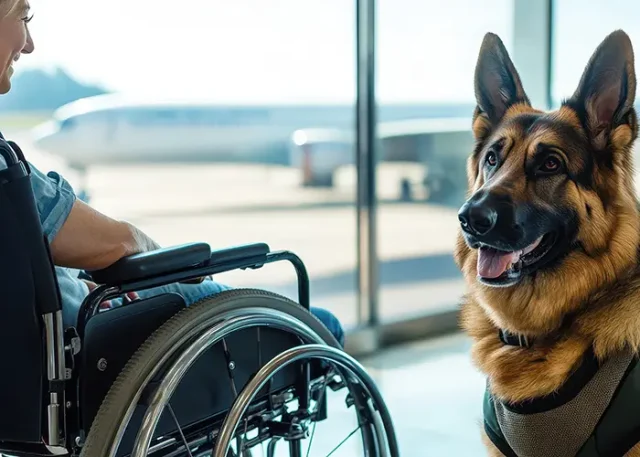
Key Takeaways
- Under United States Department of Transportation (DOT) regulations, only dogs individually trained to perform specific tasks for an individual with a disability qualify as service animals on flights. Emotional support animals (ESAs), comfort animals, and therapy pets are classified as standard pets.
- Airlines require the official DOT Service Animal Air Transportation Form submitted at least 48 hours prior to departure. Flights scheduled for 8 hours or longer also require the DOT Service Animal Relief Attestation Form. Qualified service dogs fly in the cabin at no additional charge.
- Service dogs must fit comfortably within the foot space of the handler seat or on the passenger lap (if small enough). They are legally prohibited from occupying passenger seats, blocking aircraft aisles, or sitting in emergency exit rows.
- No official government registry or certification card is legally required by federal law. Eligibility is established through task training, proper public behavior, and completed DOT documentation.
Understanding Federal Flight Regulations: ACAA vs. ADA
Air travel with a service animal in the United States is governed by the Air Carrier Access Act (ACAA) and enforced by the Department of Transportation, rather than the Americans with Disabilities Act (ADA) which covers land-based public accommodations. Federal ACAA rules mandate that all U.S. airlines and foreign carriers operating flights to or from the United States accept trained service dogs in the passenger cabin free of charge.
MyServiceAnimal helps handlers prepare documentation, organize Service Dog ID card registration, and build letters for travel and housinMg accommodations. This guide walks you through every step: before booking, forms and approvals, airport day-of-travel, in-flight rules, and special situations like international destinations and high risk countries.
Definition of a Service Animal Under DOT Rules
The Department of Transportation defines a service animal strictly as a dog, regardless of breed or type, that is individually trained to do work or perform tasks for the benefit of a qualified individual with a disability. Covered disabilities include physical, sensory, psychiatric, intellectual, or other mental disabilities. Examples of qualifying tasks include alerting individuals who are deaf, guiding individuals with visual impairments, pulling wheelchairs, detecting upcoming seizures, and interrupting anxiety or PTSD episodes.
Service Dogs vs. Emotional Support and Therapy Animals
Under current regulations, emotional support animals, therapy dogs, and comfort animals do not qualify as service animals for air travel. Because ESAs are not trained to perform specific active tasks to mitigate a disability, airlines treat them as standard carry-on or cargo pets, subject to carrier fees, size restrictions, and pet carrier requirements. Psychiatric Service Dogs (PSDs) remain fully recognized service animals under DOT rules, provided they are task-trained to assist their handler.
“A service dog’s success in an aircraft cabin depends entirely on public access training and desensitization to high-density environments. Handlers must ensure their dog is fully comfortable in tight, noisy spaces long before reaching the boarding gate.” — Dr. Sarah Jenkins, Certified Applied Animal Behaviorist and Service Animal Consultant
Essential DOT Forms and Pre-Flight Documentation
To streamline processing and prevent fraudulent claims, the DOT standardized documentation requirements across all commercial airlines operating in the United States. Passengers traveling with service animals must complete and submit official forms directly to the airline before departure.
The U.S. DOT Service Animal Air Transportation Form
The DOT Service Animal Air Transportation Form serves as a mandatory self-attestation regarding the animal’s health, training, and behavior. The form requires the handler to certify that the dog is fully vaccinated against rabies, has been individually trained to perform tasks, and understands proper public conduct. Handlers must provide the name and contact details of the animal’s veterinarian and trainer (or indicate self-training, which is fully permitted under federal law).
The DOT Service Animal Relief Attestation Form
For flights scheduled for 8 hours or longer, airlines require a second document known as the DOT Service Animal Relief Attestation Form. This form requires the handler to certify that the dog can either abstain from relieving itself during the long-haul flight or relieve itself in a sanitary manner without creating a health risk to other passengers (such as using absorbent pads or dog diapers).
“Submitting your U.S. Department of Transportation paperwork at least 48 hours in advance is not just a policy—it prevents delays at check-in and guarantees your animal’s documentation is validated in the airline system prior to arrival.” — Mark Rivera, Airline Accessibility Compliance Specialist
Major U.S. Airline Service Dog Policies Compared
While all U.S. airlines adhere to federal DOT regulations, submission methods, digital portals, and advance notice policies vary across carriers. The table below outlines key requirements for major domestic airlines.
| Airline | Submission Deadline | Digital Portal / Method | Max Service Dogs Per Passenger | Fee |
| Delta Air Lines | 48 hours before departure | My Trips / Accessibility Request Online Portal | 2 | Free |
| American Airlines | 48 hours before departure | Special Assistance Online Portal (SVAN Number Issued) | 2 | Free |
| United Airlines | 48 hours before departure | My Trips Accessibility Form Upload | 2 | Free |
| Southwest Airlines | 48 hours before departure | Special Assistance Online Form or Gate Verification | 2 | Free |
| Alaska Airlines | 48 hours before departure | Open Doors Organization SVAN Portal / Web Form | 2 | Free |
Pre-Travel Step-by-Step Preparation Checklist
Successful air travel with a service dog requires careful preparation in the weeks leading up to your flight. Following a structured timeline ensures all regulatory, medical, and behavioral requirements are satisfied prior to arrival at the airport.
- 30 Days Before Departure: Verify that your service dog’s rabies vaccination and routine vaccinations are current. Review destination-specific animal health rules, especially for international travel or non-contiguous U.S. locations like Hawaii.
- 14 Days Before Departure: Practice public access skills in crowded environments. Ensure your dog is comfortable navigating elevators, escalators, automatic doors, and busy transportation hubs.
- 48 Hours Before Departure: Complete the DOT Service Animal Air Transportation Form (and Relief Attestation Form for flights over 8 hours). Submit the completed forms through your airline’s accessibility portal or customer service desk to receive advance approval.
- 24 Hours Before Departure: Print hard copies of your approved DOT forms, vaccination records, and airline confirmation receipts. Pack an accessible carry-on kit containing collapsible bowls, waste bags, absorbent pads, leash, harness, and any necessary medications.
- Day of Travel: Limit food and water intake immediately prior to departure to prevent gastrointestinal discomfort. Arrive at the airport early to utilize designated post-security animal relief areas before boarding.
Navigating Airport Security and In-Flight Procedures
Travel day presents unique sensory challenges for service animals. Knowing airport screening procedures and aircraft seating policies helps ensure a seamless journey from check-in to arrival.
TSA Security Screening Protocols
The Transportation Security Administration (TSA) enforces specific protocols for service animal teams at airport checkpoints. Handlers and service dogs walk through metal detectors together. The TSA officer will inspect the dog’s harness, vest, or leash manually, but animals are never required to undergo X-ray screening. Handlers can request specialized assistance in advance through TSA Cares at least 72 hours prior to travel.
Aircraft Seating and Space Requirements
Federal ACAA regulations mandate that service animals must remain within the footprint of the handler’s assigned seat. Small dogs may sit on the handler’s lap, while larger dogs must rest on the cabin floor directly in front of or beside the handler’s feet. Service animals are strictly prohibited from extending into aircraft aisles or encroaching on neighboring passenger spaces without permission. Handlers traveling with service dogs cannot sit in emergency exit rows due to safety evacuation standards.
“Proper pre-flight hydration and potty scheduling are critical for flights exceeding four hours. Handlers should utilize post-security animal relief areas immediately prior to boarding to ensure a safe, comfortable journey for the dog.” — Dr. Elena Rostova, DVM, Veterinary Travel Health Advisor
International Flight Regulations and CDC Import Standards
Traveling internationally with a service dog requires compliance with both the origin country’s export requirements and the destination country’s animal import regulations. Foreign airlines operating flights outside the U.S. may enforce additional cabin requirements, though flights connecting to or from the U.S. remain bound by federal ACAA standards.
For passengers returning to the United States, the Centers for Disease Control and Prevention (CDC) enforces strict import rules to prevent foreign rabies introduction. All dogs entering or re-entering the U.S. must be at least 6 months old, microchipped, and accompanied by a completed CDC Dog Import Form. Dogs coming from high-risk rabies countries must meet additional serological titer testing and entry port requirements.
Frequently Asked Questions
Are emotional support animals still allowed to fly for free?
No. Under U.S. Department of Transportation regulations, airlines are no longer required to accept emotional support animals as service animals. Major carriers classify ESAs as standard pets, subjecting them to pet fees, carrier size limitations, and cabin availability. Psychiatric service dogs that are individually trained to perform active tasks remain fully protected service animals and fly in the cabin for free.
Do I need an official government registration or ID card for my service dog?
No. Neither the ADA nor the ACAA requires federal or state service animal registration, licensing, or official certification cards. Airlines cannot demand proof of registration as a condition for boarding. Eligibility is based on completed DOT forms, task training, and proper animal behavior in public.
How many service dogs can one passenger bring on a flight?
Under DOT regulations, qualified passengers with disabilities are permitted to travel with up to two trained service dogs. Both animals must fit comfortably within the passenger’s seating footprint without obstructing aisles or emergency exits. Passengers traveling with two service dogs may purchase an adjacent extra seat if additional floor space is needed.
What happens if my service dog displays disruptive behavior at the airport or on the plane?
Airlines reserve the right to deny transportation to any service animal that displays aggressive or disruptive behavior, such as growling, biting, lunging, excessive barking, or relieving itself in non-designated areas. If an animal cannot be controlled, the airline may classify it as a pet, charge pet fees, or refuse entry onboard.
Where can my service dog relieve itself at the airport?
All major U.S. commercial airports are required by federal law to provide designated animal relief areas, including post-security relief facilities within passenger terminal gates. Handlers should locate relief areas on terminal maps or ask airport staff prior to boarding.
References
U.S. Department of Transportation. Service Animals Traveling by Air. https://www.transportation.gov/airconsumer/passengers-disabilities/service-animals
Centers for Disease Control and Prevention. Requirements for Dogs Entering the United States. https://www.cdc.gov/importation/dogs/index.html
Transportation Security Administration. TSA Cares and Disability Assistance. https://www.tsa.gov/travel/passenger-support
American Kennel Club. Service Dog Rules and Airline Guidelines. https://www.akc.org/expert-advice/training/service-working-therapy-emotional-support-dogs/