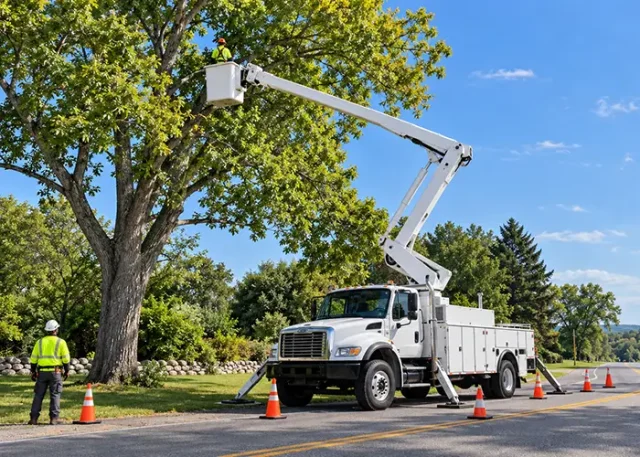
Truck with boom lift selection for tree work near conductors is not a reach problem. It is an electrical problem that happens to involve a machine, and the specification has to answer a simple question: how could current reach the crew, and what stops it?
There are four realistic paths. A machine that closes all of them is the right machine.
Path One: The Truck With Boom Lift Touches a Conductor
The obvious one, and the one the equipment is designed around.
Standard aerial platforms are not insulated. They are built for facades and rooftops, and near energized lines they offer no electrical protection at all. Work close to conductors calls for an insulated aerial device, built and tested to a recognized category rating, with periodic dielectric testing recorded and in date.
Ask for that test certificate by date, not by reassurance. An insulated boom with an expired test is an uninsulated boom.
Path Two: Through the Tree
Wood conducts, particularly when it is green, wet or heavy with sap. A limb resting against a conductor turns the whole tree into part of the circuit, and the crew is holding it.
This is why approach distances apply to the branches and the saw as well as to the basket, and why cutting sequence matters as much as machine choice. Work from the conductor side outward, take small sections, and treat every limb as live until it is on the ground.
Path Three: Down Through the Machine
If a conductor is contacted, the current looks for the ground, and the truck is standing on it.
Everyone at ground level needs to be clear of the vehicle, not leaning on the outrigger or handing tools up. Voltage gradients in the soil around a faulted machine are a genuine hazard, and the safe response to contact is to stay in the basket and keep everyone else away until the line is confirmed dead.
Path Four: The Limb That Falls Into the Line
The fourth path has nothing to do with the boom. It is a cut section swinging or dropping into conductors below.
Rigging, controlled lowering, and cut planning handle this, but the machine choice contributes: enough outreach to position the basket where the cut can be controlled, and enough precision to work the limb down rather than let it go. A machine parked too far back forces long reaches and awkward angles, which is where control is lost.
Who Is Permitted To Do This Work
Machine specifications do not override qualification rules. In the United States, workers who are not qualified for line clearance must keep well clear of energized conductors, commonly at least ten feet for lines up to fifty kilovolts and further as voltage rises.
Only qualified line clearance arborists, working under the rules written for that trade, may approach closer. A general tree crew hiring a truck with boom lift does not become qualified by having a better machine, and no hire agreement changes that.
Where the work genuinely needs to happen inside those distances, the correct route is usually the utility: de-energizing, covering conductors, or supervised access.
What To Ask Before You Book
- Is the aerial device insulated, and to what category?
- When was the last dielectric test, and can I see the certificate?
- Are the basket liner and any accessories part of the tested assembly?
- What is the working height and outreach at the basket load I will actually carry?
- Will the machine reach the cut positions without the boom passing near the line?
- Does the supplier have experience with utility clearance work?
Choosing the Machine That Closes Every Path
Tree work near power lines punishes assumptions. The machine has to be insulated and currently tested, the crew has to be qualified for the distances they will work in, the ground team has to stay clear of the truck, and the cutting plan has to keep sections away from conductors on the way down. Get those four right and the job is routine. Miss any one and the others will not save it. Suppliers such as Blade Platforms will state clearly what a machine is and is not rated for, so ask that question first, before reach or price, and let the answer decide what you hire.