

You can check out of Caesars Palace on a Sunday morning and be spinning the same branded slots from a sofa in Philadelphia that evening. Ten years ago that would’ve sounded strange. Today it’s pretty much how the biggest casino resort brands think about their guests.
The money explains the shift. The American Gaming Association’s State of the States 2026 report shows online casino revenue jumped 27.6% in 2025 to a record $10.73 billion. In Pennsylvania and New Jersey, online play out-earned the physical casino floors for the first time.
That’s a big deal for companies that used to judge a good year by hotel occupancy and buffet covers.
So which resort names made the jump well, and which ones tripped? We looked at ten brands you’ve likely walked through, from the Strip to Atlantic City to Niagara Falls, and at how their apps actually connect to the trips you take.
How we picked these casino resort brands
Plenty of online casinos borrow a glamorous name. We only counted companies that run real resorts people travel to. Then we checked three things:
- A real-money app or site that operates today, or a digital retreat big enough to teach us something.
- Whether playing online earns anything you can use on property, like room nights, dining credit or tier status.
- How the company got there: built its own tech, bought a digital business, rented someone else’s, or sold the brand outright.
Revenue mattered less than that last link back to the resort. That’s why Wynn makes the list even though it mostly walked away. A retreat can teach more than a win.
1. Caesars Entertainment: Caesars Palace Online and Horseshoe
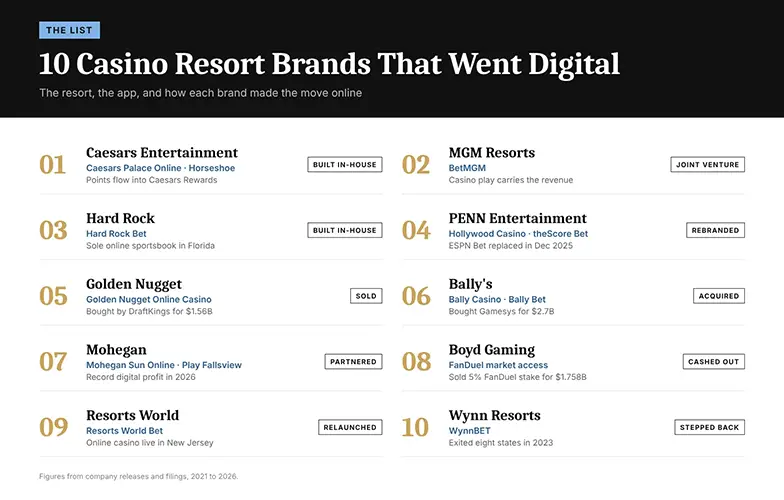
Caesars took a while to get serious, and its own executives admit the early casino product lagged. That changed in August 2023, when it launched Caesars Palace Online Casino as a standalone app tied directly to Caesars Rewards. A second brand, Horseshoe Online Casino, followed in October 2024.
The results show up in the books. Caesars Digital posted record first-quarter 2026 revenue of $374 million, with online casino revenue up 18% year over year.
For travelers, the useful bit is the loyalty link. Points earned in the app count toward the same Caesars Rewards tiers that pay for comped nights on the Strip, and there’s an in-app shop for redeeming them. When Alberta opened its regulated market in July 2026, Caesars took all three of its apps live there at once, according to the Caesars investor release. The portfolio also includes Harrah’s and Tropicana online casinos, plus WSOP.com for poker players.
2. MGM Resorts: BetMGM
BetMGM is a joint venture between MGM Resorts and Entain, and it’s quietly become more of a casino business than a sportsbook. In the second quarter of 2026, online casino revenue hit $483 million out of $711 million total. Sports betting brought in $228 million and didn’t grow at all.
Why does casino carry the load? Slots and table games run every night of the year. Sports have off-seasons and bad weekends. Even so, BetMGM expects 2026 net revenue near the lower end of its $2.9 billion to $3.1 billion range, so the market isn’t growing as fast as it did a few years back.
If you stay at Bellagio or the Borgata, you can earn MGM Rewards credits online that help you climb toward perks like upgraded rooms and waived resort fees. Most guests never link the two accounts, which is a mistake if you play even a little.
3. Hard Rock: Hard Rock Bet
Hard Rock runs one of the odder digital stories on this list. Its sportsbook is live in 10 states and is the only legal online sportsbook in Florida, thanks to the Seminole Tribe’s compact. That’s a monopoly most operators would kill for.
Hard Rock Digital, the venture behind the app, built its own sportsbook tech instead of renting it, which is rare for a brand that isn’t a pure tech company. The online casino side is smaller. It’s available in New Jersey and, since December 2025, in Michigan.
In July 2026, Hard Rock Bet launched its sportsbook and casino in Ontario, the brand’s first move beyond its home market. The pitch is consistent everywhere: earn Unity by Hard Rock points on the app, then spend them at the guitar-shaped hotel in Hollywood, Florida, or any Hard Rock property you pass through.
4. PENN Entertainment: Hollywood Casino and theScore Bet
Here’s a cautionary tale with a decent ending. PENN, which runs Hollywood Casino resorts across the Midwest and East Coast, signed a 10-year, $2 billion deal in 2023 to rename its sportsbook ESPN Bet.
It didn’t work. ESPN Bet never topped 2.6% of the online sports market, and the partners ended the deal early. On December 1, 2025, the app became theScore Bet overnight, with balances and open bets carried over automatically. PENN took an $825 million write-down along the way.
The part that survived is the Hollywood-branded online casino, which PENN now calls the center of its digital plans and still runs as a standalone app wherever online casino play is legal. The lesson is pretty blunt: a borrowed media brand can buy attention, but it can’t buy loyalty from people who’ve never stayed at your hotel.
5. Golden Nugget: The brand that sold its digital arm
Golden Nugget took a different route. Its online casino grew fast in New Jersey, and in 2022 DraftKings bought Golden Nugget Online Gaming in a $1.56 billion stock deal. Tilman Fertitta kept the hotels.
The brand lives on. Golden Nugget Online Casino launched in Ontario in August 2025 and went live in Alberta on day one of that market, July 13, 2026.
There’s a catch for travelers, though. Loyalty now runs through DraftKings’ Dynasty Rewards, so playing the Golden Nugget app doesn’t earn you much at the actual Golden Nugget in Las Vegas. The name made the jump. The resort perks mostly didn’t, so if you’re a Golden Nugget regular in Atlantic City or Laughlin, know that before you download expecting hotel comps.
6. Bally’s: Buying a digital company outright
Bally’s decided it didn’t have time to build. In October 2021 it paid $2.7 billion for Gamesys, the London-based operator behind Jackpotjoy and Virgin Games. That gave it a working casino platform and a team that had already run online casinos for years.
It’s paying off. Bally’s North America Interactive business grew revenue 36% year over year in the first quarter of 2026.
Bally Casino runs on the Gamesys tech, while the sportsbook moved to Kambi after an earlier platform didn’t work out. Bally’s also runs a separate Monopoly Casino brand in Ontario and New Jersey. Mixing a resort name with licensed board-game IP is unusual, and it seems to work.
7. Mohegan: Mohegan Sun Online and Play Fallsview
Connecticut legalized online casinos and sports betting in October 2021, and the market split between two tribal resort brands almost immediately. Foxwoods partnered with DraftKings. Mohegan Sun went with FanDuel’s technology.
Mohegan’s digital unit now covers Connecticut, Pennsylvania and Ontario. In Ontario it runs Play Fallsview, the online twin of the resort perched above Horseshoe Falls. Profit? In its third fiscal quarter of 2026, Mohegan reported record quarterly profit from digital while some land-based venues went flat.
One clever detail: Mohegan launched an exclusive Love Island slot in June 2026, available only on its Connecticut app. Exclusive titles give players a reason to stay put instead of hopping between apps for bonuses.
8. Boyd Gaming: Cashing out instead of building
Boyd never needed a famous app. In 2018 it traded access to its state licenses for a slice of FanDuel. That slice, eventually 5% of the company, went to Flutter in July 2025 for $1.758 billion in cash.
That’s a remarkable return for a company best known for downtown Las Vegas hotels and regional casinos.
Boyd still collects fixed annual fees from FanDuel through 2038 in several states, and it expects about $30 million in online operating income for 2026. Not every resort operator wants to run an app, and honestly, plenty shouldn’t. Some just want a fair price.
9. Resorts World: Second time’s the charm?
Genting’s Resorts World launched a New York sportsbook app in March 2022. It never found traction and shut down on June 30, 2025.
Instead of giving up, the company switched products. It signed Strive Gaming in April 2026 to handle player accounts, payments and fraud checks, and it launched an online casino in New Jersey in July 2026.
New Jersey also has the longest-running online casino market, live since 2013, so players there already trust apps tied to familiar resort names. That change of product makes sense, too. Sportsbooks fight over a handful of big games with huge marketing budgets, while casino players tend to stick with a brand they already know. Note that New Jersey requires every online casino to operate under an Atlantic City license, so even global names need a local partner.
10. Wynn Resorts: The brand that stepped back
Wynn is the outlier. WynnBET launched in 2020 with big plans, including a SPAC deal that later collapsed. In August 2023, Wynn shut the app down in eight states, saying the cost of marketing and promotions was too high.
In New York, WynnBET held about 0.6% of online betting handle. Its Michigan casino license ended up with Caesars, which used it to launch Horseshoe.
Wynn still runs a Nevada sports app and puts its money into resorts, including a new resort on Al Marjan Island set to open in September 2027. Luxury and exclusivity sell suites. They don’t easily sell a mass-market app.
What the strongest casino resort brands got right
Look across the list and one pattern stands out. The brands doing well online treat the app as another wing of the resort. Same loyalty account, same comps, same feel as walking onto the casino floor.
Jeff Bezos once put it this way: “Your brand is what other people say about you when you’re not in the room.”
For casino resorts, the “room” now includes a phone screen at 11 p.m. on a Tuesday. If the app feels cheap or disconnected from the hotel, guests notice.
The winners also lean on online casino rather than sports. Caesars, BetMGM and Mohegan all report that casino play grows faster and holds margin better. Sports betting buys headlines. Casino keeps people around.
Where the casino platform decision really gets made
Behind every app above sits a choice most guests never see: who owns the technology.
Caesars built its own casino platform. Bally’s bought one. Golden Nugget sold the whole digital business, Mohegan partnered with FanDuel and Kambi, and Resorts World licensed Strive Gaming’s back office. Each route carries a different price tag and a different timeline. Building in-house took Caesars years, and it had the budget to absorb mistakes.
Smaller resort groups rarely have that runway. Say you run three properties instead of fifty. A full engineering build could eat two years and several million dollars before the first deposit clears, and you’d still need people handling compliance, payments and fraud checks every day after launch. That’s why many regional operators and new brands start on a white label or turnkey iGaming platform, then customize the front end and loyalty link later. Providers like kanggiten.com offer that kind of setup for operators in tier-1 countries, covering game aggregation, payments and player management in one package.
The trade-off is control. A rented platform gets you live in months. Before you sign, though, get clear terms on who owns the player data and what happens if you migrate away later, because Golden Nugget’s story shows how much a brand gives up when the player relationship sits on someone else’s servers.
What this means for your next trip
If you visit any of these resorts, link your online and property loyalty accounts before you travel. It takes about five minutes and can turn a few casual sessions into a free night or a dinner credit. It’s also worth asking at check-in how your online play shows up in your offers. At brands that run one shared loyalty account, hosts can see your combined activity, and that sometimes shapes the room rate you’re quoted next time.
Also check where you are. Online casino play is legal in only a handful of states, and apps use geolocation, so the app that works in your Atlantic City hotel room may lock you out across the river in New York.
And set limits before you start. Every app on this list has deposit caps, time reminders and cool-off tools buried in the settings. Use them, especially on vacation, when it’s easy to lose track of time.