
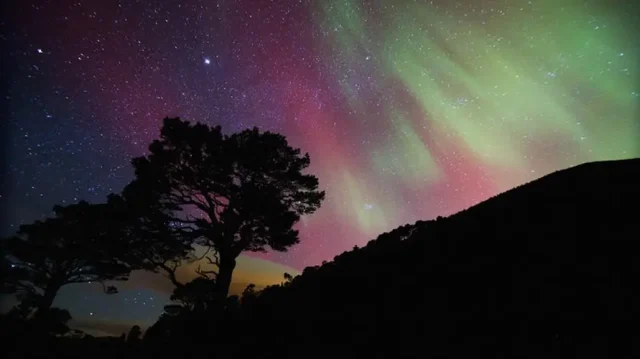
As light pollution dims the night sky for much of the world’s population, the Wilderness Group—comprising award-winning brands Wilderness Scotland, Wilderness Ireland, and Wilderness England—is highlighting the exceptional stargazing opportunities across its destinations, where some of Europe’s darkest skies remain unspoiled.
In addition to prime aurora watching in the North, the upcoming August 12th solar eclipse will be visible across parts of the UK and Ireland with significant coverage expected—over 90% in some areas—and the annual Perseid meteor shower peaking around the same time, there has never been a better time to get out on Scottish, Irish, and English trails and look up!
Scotland: A World-Class Stargazing Destination
Scotland boasts some of the most accessible dark skies in the region, with officially designated reserves and discovery sites scattered across the Highlands and islands.
Tomintoul and Glenlivet in Cairngorms National Park was designated a Dark Sky Park in 2018, making it Scotland’s most northerly. The surrounding mountains create a natural shield from light pollution, offering exceptional conditions for astrophotography and meteor watching.
Related trip: Wilderness Walking – Cairngorms National Park & Royal Deeside
- This journey—which offers some of the best easy hikes in the Cairngorms, including visits to Blair Castle, Glen Feshie, the royal estate of Balmoral, and the Abernethy Forest—pairs Highland scenery with some of Scotland’s clearest night skies. It is ideal for travelers keen to experience the quiet magic of stargazing and possible aurora-watching after immersive days exploring moorland, forest, and royal landscapes.
Galloway Forest Park in southwest Scotland became the UK’s first Dark Sky Park in 2009 and remains one of the finest. With a Gold Tier rating from DarkSky International, visitors can observe the Milky Way in extraordinary detail, spot meteors, and even glimpse the Andromeda Galaxy with the naked eye.
Related trip: Gravel Biking – Loch Lomond and Galloway
- By day, discover quiet trails, expansive forests, and hidden lochs along handpicked gravel routes that offer rewarding climbs and flowing descents; by night, settle into some of the UK’s darkest skies, where the absence of light pollution turns each evening into a front-row seat to the cosmos.
Ireland: Atlantic Skies and Ancient Landscapes
Ireland’s western coast, facing the Atlantic Ocean and with minimal light interference, hosts two exceptional dark sky reserves.
Kerry Dark Sky Reserve on the Iveragh Peninsula holds Gold Tier status—one of only a handful worldwide. Visitors can stargaze from locations like Ballinskelligs Beach or the slopes of the Kerry mountains, where the lack of artificial light reveals thousands of stars that are invisible from the more well-lit urban areas of the country.
Related Trip: Deluxe E-bike The Kerry Peninsulas
- Exhilarating E-biking by day—exploring the three peninsulas of the Kingdom of Kerry: the Beara, Iveragh, and Dingle—gives way to awe-inspiring nights, where coastal horizons disappear into star-filled skies and the Atlantic backdrop enhances the sense of vastness above.
The Mayo Dark Sky Park, located in a remote region of County Mayo, offers similarly pristine conditions. Its Atlantic-facing position and sparse population make it ideal for observing celestial events, from meteor showers to the northern lights.
Related Trip: Hiking & Island Hopping Ireland’s West Coast
- Explore rugged, little-visited islands and the windswept coastlines of Ireland’s west coast—learning about the rich cultural, mythological, archaeological, and geological history of these wild, rocky landscapes—then watch darkness fall over the Atlantic, where minimal development means uninterrupted views of constellations, shooting stars, and, on occasion, the stunning auroras.
England: Unexpected Darkness in the North
England’s most densely populated landscapes give way to surprising pockets of true darkness in its northern reaches.
Northumberland Dark Sky Park, spanning nearly 1,500 sq. km, also holds Gold Tier status—making it the largest area of protected night sky in Europe.
Related Trip: Wilderness Walking – Northumberland and the Lake District
- From tranquil lakes to expansive moorland, this trip blends iconic northern landscapes—complete with coastal hikes, hills and valleys, and sweeping views—with access to some of England’s darkest skies, perfect for pairing classic hiking days with starry nights.
Yorkshire Dales National Park gained Dark Sky Reserve status in 2020. Offering large areas that are completely free from local light pollution, it is a fantastic place to stargaze.
Related Trip: Wilderness Walking – England Coast to Coast
- Walking the best sections of England’s epic coast to coast hiking trail, from the Irish Sea to the North Sea, this iconic route offers not just diverse terrain covering three national parks—the Lake District, Yorkshire Dales, and North Yorks Moors—but also multiple opportunities to experience dark skies, where each overnight stop bring a new celestial perspective.
As interest in astro tourism continues to rise, these hiking and cycling journeys offer travelers access to some of the UK & Ireland’s most pristine night skies, delivering a compelling way to experience natural phenomena—from meteor showers and aurora borealis to this summer’s solar eclipse—while showcasing these many extraordinary landscapes.