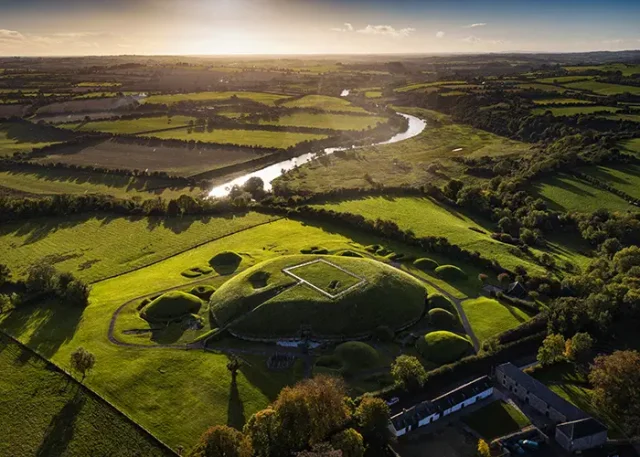
In Ireland’s Ancient East, every path has a story. This is particularly true in the Boyne Valley, where prehistoric monuments, medieval ruins, legendary battlefields and riverside landscapes reveal more than 5,000 years of history.
This September, the Boyne Valley Trails Festival will invite visitors to experience the region at a slower pace. Taking place from September 1 to 23, 2026, the festival features guided walks, historical tours, outdoor adventures and wellness activities across counties Meath and Louth.
Based around Drogheda, the programme offers an accessible introduction to a part of Ireland where mythology and recorded history often share the same landscape.
Following the footsteps of Irish mythology
Among the region’s most evocative walking routes is the Táin Way, a 40-kilometre circular trail around the Cooley Peninsula.
The route takes its name from the Táin Bó Cúailnge, or Cattle Raid of Cooley, one of the central stories in early Irish literature. Its tale of Queen Medb’s campaign to seize the Brown Bull of Cooley — and the young warrior Cú Chulainn’s efforts to stop her — remains an important part of Ireland’s cultural identity.
Established in 1986, the Táin Way marks its 40th anniversary in 2026. The route passes through quiet countryside, forest tracks and open mountain terrain, with elevated sections providing views across Carlingford Lough and towards the Mourne Mountains.
It is a more demanding experience than many of the festival’s shorter walks, but one that rewards hikers with a vivid sense of the landscapes behind the legend. The trail is generally completed over two days, although visitors can also explore individual sections.
Walking the Boyne Valley Camino
Closer to Drogheda, the Boyne Valley Camino offers another way to combine walking with history.
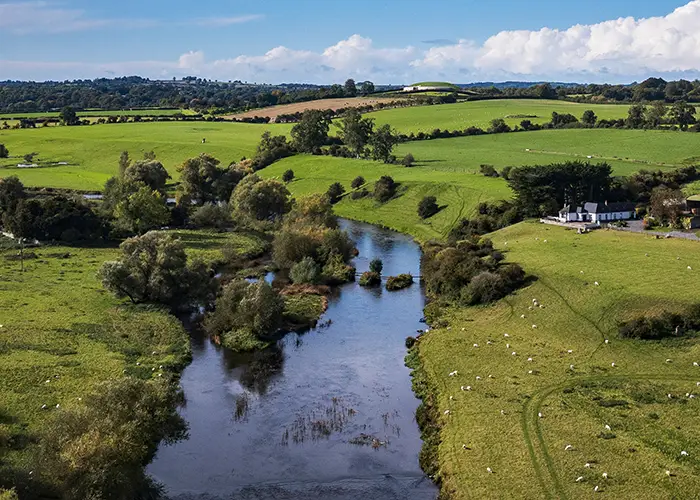
The nationally recognized 25-kilometre route forms a figure-eight loop, beginning and ending at St Peter’s Church on West Street in Drogheda. It passes Townley Hall Woods, Mellifont Abbey, Tullyallen village, King William’s Glen, the Boyne Obelisk and Oldbridge before returning along the Boyne.
The Camino draws on Drogheda’s historical connection with medieval pilgrimage. Travellers once passed through the town before sailing to Galicia in northern Spain, and the modern trail is now part of the Celtic Camino network. Walkers can collect specially designed stamps along the route and combine 25 kilometres walked in Ireland with the remaining 75 kilometres required to complete the Celtic Camino to Santiago de Compostela.
A guided Boyne Valley Camino experience is scheduled for September 20 as part of the 2026 festival programme. Visitors interested in other Irish walking holidays may also want to explore DRIFT Travel’s guide to Ireland hiking trips for 2026.
Festival walks bring history to life
The festival extends well beyond its two best-known trails. Its programme includes guided hill and mountain walks, Nordic walking sessions, historical town trails and experiences devoted to local myths and legends.
Scheduled highlights include a guided walk exploring the stories of the Hill of Tara on September 19. Once the ceremonial seat of Ireland’s high kings, Tara occupies an important place in Irish mythology and contains monuments spanning several thousand years.
Other events explore the Neolithic landscape around Fourknocks Passage Tomb, the medieval and monastic heritage of Stamullen, and Inis na Rígh — the “Hidden Isle of the King” near Laytown. A guided visit to Beaulieu Estate and Gardens offers another perspective on the region’s history.
Travellers looking to continue their exploration of the Boyne Valley can also read about Slane and the wider landscapes of Ireland’s Ancient East.

Exploring the Boyne from the water
Although walking is at the heart of the festival, several activities allow visitors to experience the countryside from a different vantage point.
The programme includes boating and paddleboarding, as well as experiences connecting participants with the River Boyne. The river has shaped the region’s settlements, trade routes and historical events for centuries, making time on the water another way to understand the valley.
Wellness also plays a prominent role. Forest sound baths, guided meditation, breathwork, qigong and nature-based sessions complement the more active excursions. Food and foraging tours add a culinary dimension, introducing visitors to local produce and traditions.
The variety makes it possible to build a personalized itinerary. Visitors can choose a challenging mountain hike, a gentle heritage walk, a river excursion or a restorative outdoor experience without travelling far between locations.
Planning a visit to the Boyne Valley Trails Festival
Drogheda serves as the principal gateway to the festival and is accessible by road, bus and train. According to the organizers, the town is approximately 40 minutes from Dublin Airport and around one hour from Belfast International Airport.
September weather in Ireland can change quickly, so walkers should bring waterproof outerwear, layered clothing and footwear suited to uneven or potentially muddy terrain. Participants should also check the distance, elevation and difficulty of individual activities before booking, as the programme ranges from accessible town walks to more strenuous mountain routes.
The official Boyne Valley Trails Festival programme lists individual events, meeting points and availability. Advance reservations are recommended, particularly for activities with limited capacity.
Whether following a warrior’s legendary journey, collecting Camino stamps or listening to stories beside the River Boyne, the festival provides a compelling reason to explore Ireland’s Ancient East on foot.