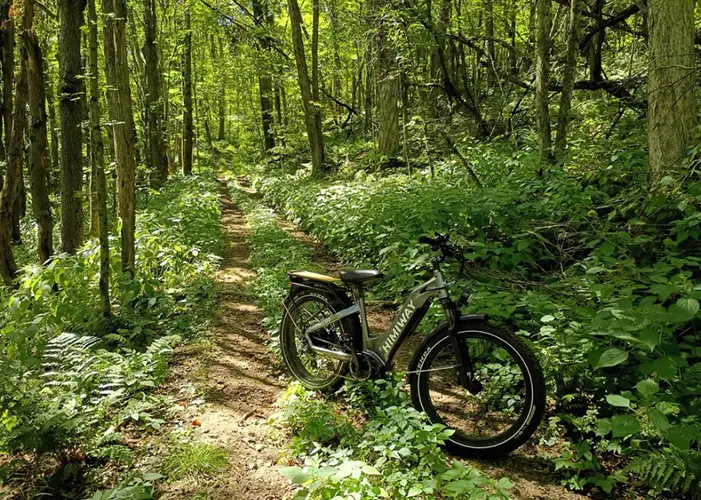
A fat-tire e-bike parked beside a tent at the edge of a forest campsite, gear still strapped to the frame, tires carrying the dirt from the morning’s ride. The rider had ventured out through tree roots, loose gravel, and unpaved forest tracks — terrain that would have made a loaded traditional bike a genuine physical project. Coming back to camp, the body felt intact. That experience — arriving at a remote spot without paying for it physically — is what keeps turning up in accounts from outdoor travelers who’ve started building e-bikes into their camping trips.
Why an Electric Bike Changes the Camping Experience
Set up camp at a national forest site or a BLM dispersed camping area in the American West, and the immediate reality is this: everything worth exploring is further than walking distance, and close enough that driving back out feels like giving up.
Trail access by foot tops out around two to three miles before the return trip starts eating into the second half of the day. A traditional bicycle handles the flat sections but punishes the rider on loaded gradients. Pulling the car back out of site to drive a quarter mile defeats the entire point of being there.
E-bikes solve this without replacing the outdoor experience. They extend the exploration radius from three miles to fifteen or twenty, and they do it without requiring the kind of physical conditioning that makes a fully loaded off-road ride prohibitive for most travelers.
The policy environment has caught up with the behavior. The National Park Service officially permits Class 1 e-bikes — pedal-assist, motor cutoff at 20 mph — on all roads, paths, and trails within national parks where traditional bicycles are allowed. This policy was reaffirmed in 2024 and applies across parks from Zion and Yellowstone to Acadia. On Bureau of Land Management land, similar permissions apply across most managed areas in the West. It’s worth noting that the trail access concerns many riders have heard about apply to high-powered electric motorcycles — bikes with no functional pedals and motorcycle-level power output — not to Class 1 pedal-assist e-bikes, which are treated as bicycles under NPS and most state land management policies. The e-bike, used as intended, is a recognized and policy-supported mode of outdoor travel.For travelers starting to look at what’s available, a long range fat-tire e-bike is a useful place to start — the spec differences between models matter significantly in outdoor and off-road contexts.
What Experienced Outdoor Riders Have Learned
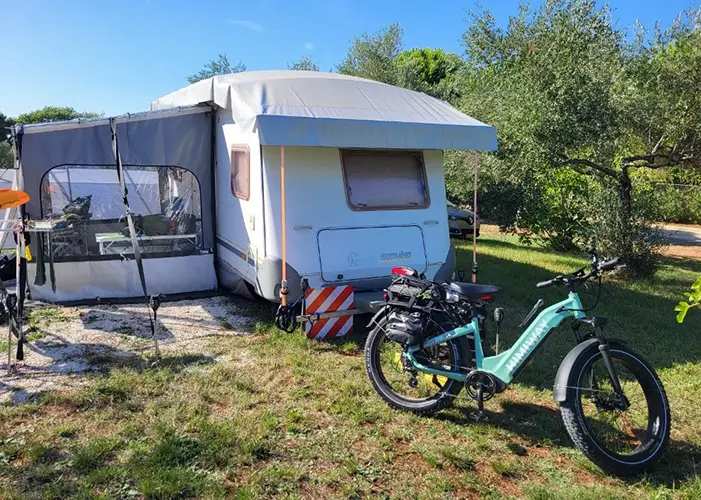
Among outdoor riders who’ve put real miles on both fat-tire hardtails and full-suspension e-bikes on mixed terrain, the consistent conclusion is that tire width and suspension solve different problems. Wide tires improve flotation and grip on loose surfaces — sand, soft soil, forest floor. Suspension absorbs what the tire can’t: the seat-and-spine accumulation that builds over a full day of roots, rocks, and irregular ground. A bike with 4-inch tires but no rear suspension can handle short stretches of rough terrain; it becomes progressively harder to ignore over a six-hour camp-based ride. Both matter. They’re not substitutes for each other.
The second observation is about range. Among riders who use electric bikes for camping and backcountry travel, 50 miles of real-world range functions as an informal minimum. Below that, the mental math — checking battery, estimating return distance, limiting how far out a rider will go — becomes part of every decision. Above 50 miles, and especially above 60, that calculation stops happening. The ride becomes intuitive rather than managed.
At Zion National Park, where a shuttle system moves most visitors through the canyon on a fixed schedule, riders on e-bikes operate on a different logic entirely. Departing from campgrounds just outside the park, they move at their own pace — stopping at a viewpoint when the light is worth it, doubling back to something passed too quickly, arriving ahead of the crowds or after they’ve cleared. Riders who’ve tried both ways tend not to go back to the shuttle. The difference isn’t speed. It’s the difference between following a schedule and setting one.
What to Look for in an Electric Bike for Trails and Off-Road Camping
Not every e-bike is built for the conditions outdoor travelers actually encounter. Four things determine whether a bike performs well outside of paved paths and light gravel.
Range over claimed distance. Manufacturer range figures are calculated on flat terrain with light riders and no cargo. Add elevation change, a loaded frame, and variable assist use, and real-world numbers drop. A bike rated at 80 miles under test conditions might deliver 55 to 65 miles in genuine outdoor use. The practical standard is to look for bikes rated 70+ miles and expect 60 in field conditions. That margin keeps the return trip comfortable rather than anxious.
Suspension system — both ends. For camping terrain — forest service roads, hardpack dirt, loose gravel, occasional root exposure — a rear suspension absorbs the impact that reaches the rider’s lower back and spine over a full day of riding. Without it, the accumulated physical toll from rough surfaces compounds over hours. Riders who’ve done multiple-day outdoor trips on hardtail bikes describe the same pattern: manageable for the first half day, increasingly difficult to ignore as the hours add up.
Tire width and compound. In the 4.0-inch fat tire range, the primary advantage is flotation on soft surfaces — sand, loose soil, pine needle-covered dirt paths — and stability over moderate obstacles without requiring the rider to anticipate every rock or rut. The tradeoff is rolling resistance on pavement, which matters less when most of the riding happens on access roads and trail approaches rather than highways.
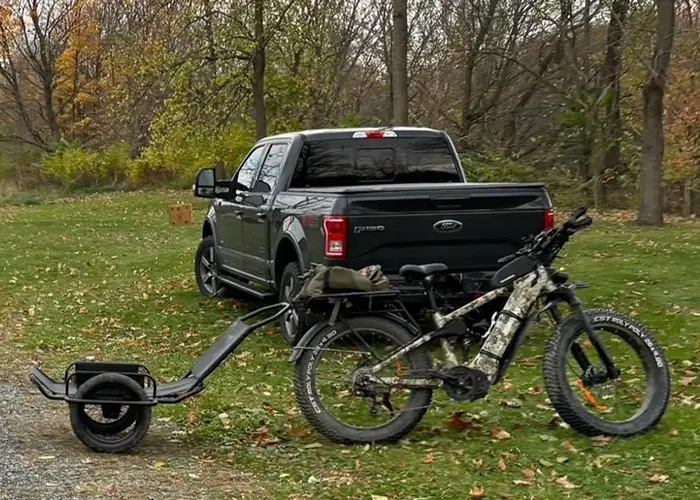
Frame geometry for loaded riding. A step-through frame removes a problem that becomes obvious the first time a rider tries to swing a leg over a fully loaded bike on uneven ground. Panniers, handlebar bags, and frame bags shift the center of gravity and reduce clearance. Step-through geometry makes mounting and dismounting intuitive regardless of terrain, and becomes particularly useful for multi-stop days where the rider gets on and off frequently.
Two things that matter less for this use case: throttle capability (Class 1 pedal-assist is legal on more trail types and covers the camping scenario well) and top speed (anything over 20 mph is rarely useful, and often actively discouraged, on the terrain where these bikes are most valuable).
Charging on Multi-Day Camping Trips
For single-day rides from a basecamp, charging is simple — plug in overnight and leave in the morning with a full battery. Multi-day trips require a bit more planning, but the options are practical.
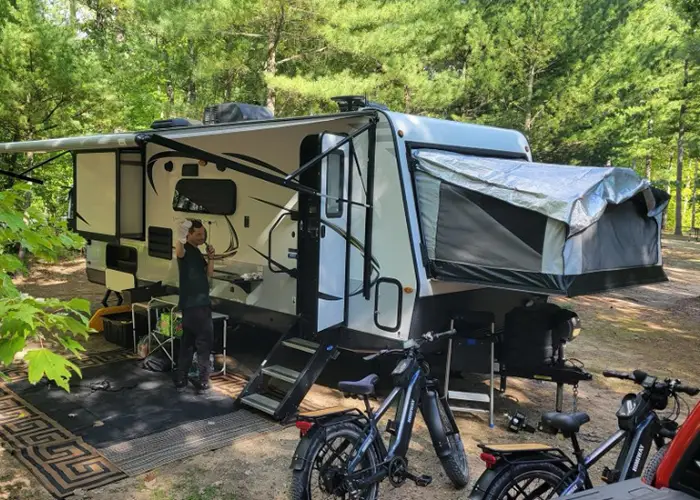
RV campers have the most flexibility. A standard 110v outlet from an RV or travel trailer charges most e-bike batteries in four to six hours overnight. Car campers at sites with electrical hookups — common at developed campgrounds — have the same option. For dispersed BLM camping without power access, a portable power station (100-300Wh capacity is typically enough for one full charge) adds minimal weight to a vehicle load and removes range anxiety entirely. Some riders carrying extra mileage bring a spare battery; others plan routes that stay within a single charge radius from camp, which at 60+ real-world miles covers most day-loop scenarios. One practical note: an e-bike without battery assist is a significantly heavier ride than a conventional bike, which makes generous range headroom a more reliable strategy than planning to pedal back unpowered.
A Specific E-Bike for Camping That Meets These Criteria
The Himiway D5 2.0 ST addresses each of the four variables above. The real-world range sits at 65 miles, well above the 50-mile threshold where range anxiety stops affecting decisions. The suspension system is full — independent front fork and rear linkage — designed for sustained mixed-terrain riding rather than occasional bumps. Maxxis 4.0-inch all-terrain tires provide the flotation and obstacle clearance that camping environments require. The step-through frame makes loaded riding practical rather than awkward.
At $1,999, it lands at the point where outdoor riders who’ve researched the market tend to land their recommendations. Sub-$1,500 bikes consistently cut corners on the components that matter most in outdoor use — motors that overheat on climbs, suspension that compresses without rebounding properly, batteries that underdeliver on rated range in field conditions. The jump to outdoor-capable hardware reflects real differences in how a bike behaves over a full day on varied terrain.
The Trip That Happens When the Radius Expands
The campsite itself rarely changes. What changes is the decision that happens the evening before, or the morning of, when the choice is between staying in the established area or going further out.
Without an electric bike for camping, that decision gets made based on physical reserves and return distance. With one, it gets made based on curiosity. Those are different calculations, and they produce different trips.
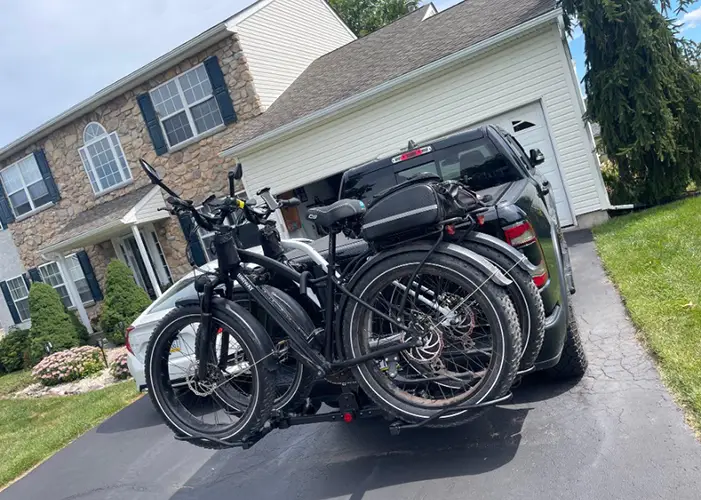
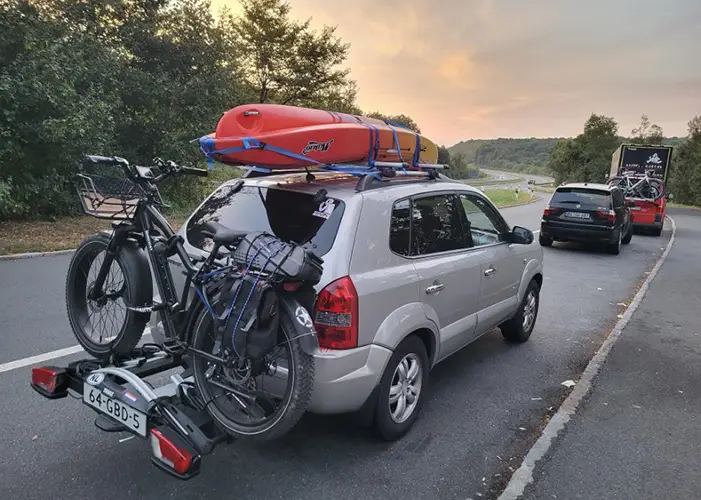
Multi-day camp-based rides are a growing format — riders treating a basecamp as a hub and making 20-to-30-mile day loops in multiple directions before returning. Car-accessed campsites near BLM land, national forests, and state parks show up with bikes racked alongside the gear. The infrastructure for this style of travel exists. The equipment is available.
The outdoor camping trip with a well-specced e-bike at the center of it isn’t a new category. It’s the camping trip that already exists, extended by about fifteen miles in every direction.