
Some buildings earn a detour before anyone places a single chip. Europe has a handful of casinos that work as landmarks first and gaming rooms second, with gilded ceilings, formal gardens and façades that have been photographed for well over a century. For travelers who plan a day around a building, they deserve a spot on the itinerary.
This list judges five of them the way a luxury traveler would: as places to arrive at, walk through and linger in. Gaming is optional. The architecture is not.
Casino de Monte-Carlo, Monaco
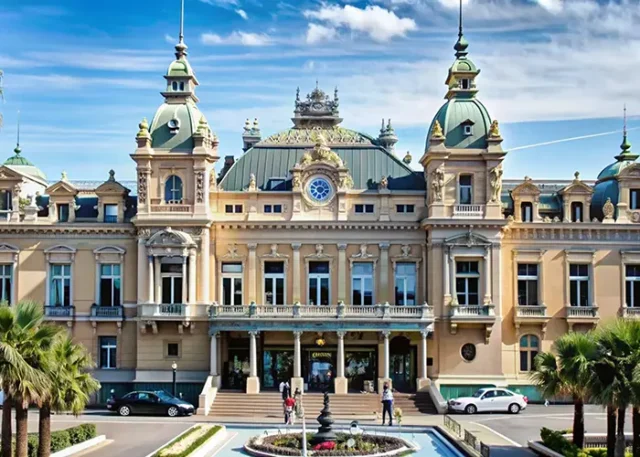
Start with the one everybody pictures. The Monte-Carlo casino sits above the Mediterranean in a Belle Époque shell of ornate stonework, with an atrium of onyx columns and a ceiling painted with allegorical figures. The square outside, with the Café de Paris on one side and the Hôtel de Paris on the other, is as much a part of the experience as the interior.
You can visit in the afternoon in smart casual clothing and see the main halls without any pressure. Evenings are more formal, and a jacket is the safer choice. Bring a passport or driving licence, because entry is checked, and expect a small fee for certain rooms. Pair the visit with a walk through the terraced gardens that run toward the sea, which are quiet before lunch.
Verdict: the benchmark. Everything else on this list is measured against it.
Casino Baden-Baden, Germany
Marlene Dietrich reportedly called it the most beautiful casino in the world, and the Kurhaus gives her claim some weight. Built in the 1820s inside the spa town’s colonnaded Kurhaus, it borrows its look from the Palace of Versailles: red damask walls, crystal chandeliers and a Florentine Hall that feels closer to a royal salon than a gaming floor.
Baden-Baden suits travelers who want the building and the town together. Guided tours run during the day for those who would rather look than play, and the thermal baths a short walk away make an easy second half to the itinerary. The pace is slower than Monaco and the crowd more local.
Verdict: the best choice for a relaxed, culture-first day.
Former Casino Cosmopol, Stockholm
Stockholm offers a different chapter in Europe’s casino architecture. The former Casino Cosmopol occupies a historic building on Kungsgatan that originally opened as the Palladium cinema in 1918. Its grand interior spaces and entertainment heritage made it a distinctive setting for Sweden’s state-run casino. Although Casino Cosmopol permanently closed in April 2025, the building remains an important part of Stockholm’s architectural and cultural history.
The closure also highlights an interesting shift in Sweden’s gambling landscape. While the country no longer operates traditional land-based casinos, its regulated online casino market continues to offer players a wide selection of digital gaming experiences. For those interested in exploring this side of Sweden’s casino industry, a guide to the top online casinos for Swedish players provides a useful comparison of operators and their offerings. It connects the country’s casino heritage with the modern digital market, where players can compare gaming platforms, available games and other features.
For architecture enthusiasts, the former casino building is worth noting as part of Stockholm’s entertainment history, although public interior access should not be assumed. Visitors can combine a look at its exterior with a walk through central Stockholm’s shopping streets, historic squares and waterfront districts.
Verdict: a distinctive piece of Swedish casino history, rather than an operating casino destination.
Casino Estoril, Portugal
Estoril is the casino that looks like a resort, and in many ways it is one. Set at the end of a landscaped garden on the Portuguese Riviera, west of Lisbon, it is one of the largest casinos in Europe and has long been tied to the glamour of the coast. Mid-century wartime Estoril drew exiles, royalty and spies, and the building still carries some of that atmosphere.
It works well as a day trip from Lisbon, about half an hour by train along the coast. Come for a late lunch in the gardens, stay for the evening show or the gaming floor, and walk the seafront promenade to Cascais afterward. The scale of the place is its selling point: this is somewhere you can settle into for hours.
Verdict: the best fit for travelers who want a full day out rather than a quick look.
Holland Casino Venlo, Netherlands
Not every landmark is a century old. In the Dutch border city of Venlo, Holland Casino commissioned a flower-shaped, sustainable building that the architects at MVSA describe as a parametric design with an interactive façade. It looks nothing like Monte-Carlo, and that is the point. The curved structure sits at the edge of the city and reads as a piece of contemporary architecture rather than a period piece.
For design-minded travelers, it makes a good counterweight to the grand old halls. A trip to Venlo pairs well with the surrounding Limburg countryside and the Dutch-German border region, and it shows that casino buildings are still being designed with ambition. Holland Casino has built a reputation for exactly this kind of work across the Netherlands.
Verdict: the modern pick, and the best photographs of the list.
Planning Your Own Casino Architecture Tour
A few practical points apply almost everywhere. Dress codes tighten after dark, so pack a jacket if you plan to stay into the evening. Carry photo ID, because every venue on this list checks it at the door, and keep in mind that minimum ages differ by country. Many of these casinos offer daytime tours or a free look at the public rooms, which is the easiest way to see the building without committing to the gaming floor.
A sensible way to combine them is by region. Monte-Carlo and Baden-Baden belong on a classic grand tour of the continent’s spa and Riviera towns. Estoril slots into a Lisbon week. Stockholm works as a long weekend. Venlo suits a design-led detour through the Netherlands and Germany.
The common thread is that each of these buildings tells you something about the place around it: the Riviera’s showmanship, Germany’s spa culture, Sweden’s reuse of its historic buildings, Portugal’s seaside glamour and the Dutch appetite for modern design. Visit one for the architecture, and you tend to leave with a sense of the city as well.