Italy rewards those who move through it wisely. For the executive traveler, the country presents a paradox: one of Europe’s most productive business landscapes, compressed into a geography where the wrong transport choice can cost an entire working day. Elicompany has built its entire service model around solving exactly this paradox, offering helicopter transfers that transform the Italian business circuit from a logistical challenge into a genuine competitive advantage. Executive travel Italy, at its most effective, is not about finding the fastest option in isolation. It is about building a system where every move between cities serves the agenda rather than constraining it.
Why Time Efficiency Matters in Business Travel
An hour lost in transit is not a neutral event. For a senior executive, it carries the weight of decisions deferred, conversations delayed and energy spent on nothing productive. According to Harvard Business Review research on executive time use, senior leaders already dedicate an average of 23 hours per week to meetings. The quality of those meetings depends partly on how the preceding hours were spent. Arriving at a negotiation after three hours in motorway traffic is a different proposition from stepping out of a helicopter with a clear head and a few minutes to collect your thoughts. The margin between those two states is where competitive advantage lives.
The Limits of Commercial Flights in Italy
Commercial aviation in Italy carries structural inefficiencies that frequent travelers know by heart. Malpensa sits more than 45 kilometres from central Milan. Fiumicino is nearly 30 from Rome. Before a single flight takes off, the executive has already spent an hour in transit, queued through security and navigated a terminal designed for volume rather than speed. Eurocontrol data consistently places Italian airports among the most delay-prone in Europe. For routes under 500 kilometres, the theoretical advantage of flying commercially over high-speed rail narrows to almost nothingonce airport access time enters the calculation, and for many city-pairs it disappears entirely.
Helicopter Transfers as a Strategic Advantage
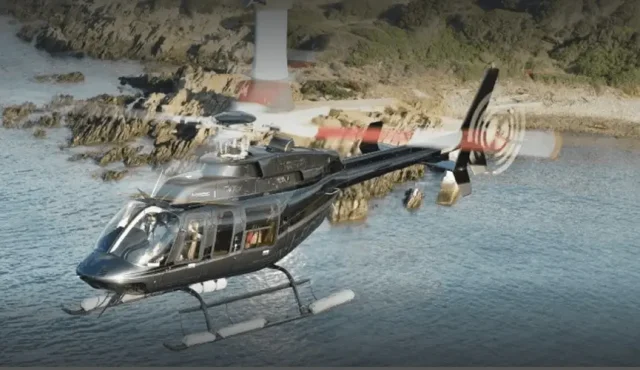
The helicopter model resolves most of these frictions in a single move. Departure from a helipad close to the office or hotel. Arrival at a location that matches the destination, not the nearest major airport. No check-in, no security queue, no connection to miss. Schedules flex around the traveler rather than the other way around, with changes often accommodated on short notice. The operational logic is genuinely door-to-door, and for clients whose day includes a private villa, a five-star hotel with a rooftop pad or a corporate campus outside the city, the efficiency gain over any ground-based alternative is substantial.
Key Italian Business Hubs and How to Connect Them
Milan anchors the Italian business network as the country’s primary financial and commercial hub, and the helicopter connections radiating from the city reflect the density of that role. Venice is reachable in 70 minutes, Florence in 70, with departures from bases covering Malpensa, Linate, Bergamo and the Bresso airfield. For those working across the wider northern arc, transferts helicopter in Milan place St. Moritz at 45 minutes, Cortina d’Ampezzo at 75 and Lake Como at 80, with a base at Santo Stefano Ticino positioned just minutes from both Malpensa and Linate by air. The geometry of northern Italy, dense with economic activity and compressed into a relatively tight radius, suits helicopter mobility better than almost any comparable region in Europe.
Planning a Multi-Meeting Itinerary
The strategic value of helicopter travel becomes most visible when the day involves more than one city. A morning briefing in Milan, a working lunch in Bologna, a late-afternoon closing in Venice: on paper, an ambitious itinerary. By ground or commercial air, it is effectively impossible without an overnight stay somewhere in the middle. By helicopter, it becomes a single, coherent working day with comfortable margins between each appointment and no accumulated fatigue from hours spent in traffic or departure halls. The key is treating the flight schedule as part of the meeting plan from the beginning, not as a logistical afterthought. Operators who also coordinate ground transfers between helipad and venue handle the last-mile problem, which is often where the time savings are lost.
Cost vs. Value: Is Helicopter Travel Worth It?
The cost question deserves a precise frame. An executive earning 200,000 euros annually generates a theoretical hourly value of over 100 euros. If a helicopter transfer saves three hours compared to the ground alternative, the implied saving exceeds 300 euros before any productivity or decision-quality factor enters the calculation. For companies that measure executive time rigorously, the economics of helicopter travel are less about luxury spend and more about capital allocation. The flight is not a cost center. It is an input to performance, and like any input, it earns its place when the output justifies it.
How to Book Your First Executive Helicopter Flight
The process is more straightforward than most first-time clients expect. A personalised quote system accounts for route, passenger numbers, timing and ancillary services including coordinated ground transfers. Standard lead times run between 24 and 48 hours for routine flights, with more complex multi-leg operations requiring a few additional days of planning. At the first booking, the details that matter most are the precise departure and arrival points, any luggage requirements and the degree of schedule flexibility available. Everything else is handled by the operator, whose entire service proposition rests on removing friction from the journey rather than adding it.