
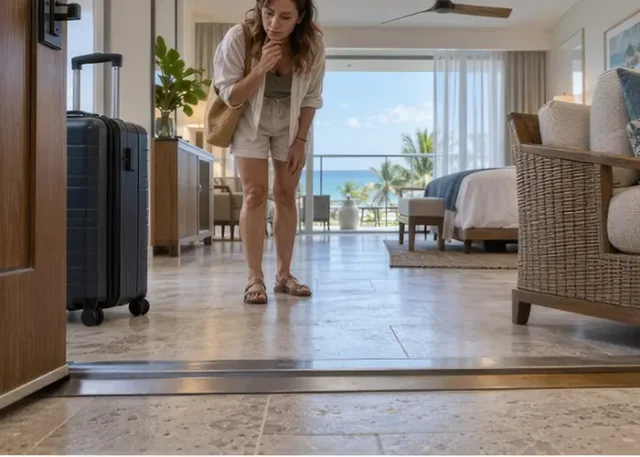
The ocean view may justify the upgrade, but it won’t reveal a loose threshold or blocked exit. Before you unpack, spend a few minutes looking over the surfaces you’ll actually be walking on, not just the ones in the suite photos.
Inspect the room before your luggage takes over
Start at the door and floor
Keep your bags out of the walkways. Turn on every light in the place, then make a pass from the entrance to the bed, the bathroom, and the balcony. Look for flooring that isn’t secured and carpet edges that have curled up. Give wet tile, loose mats, and damaged transitions between surfaces a second look as well.
Two spots deserve extra care: where carpet meets tile, and anywhere shower water could reach your walking route. Check them before your toiletries come out of the bag.
If you find a hazard, photograph it before anyone cleans it up. That matters most when it’s hard to describe in words or sits right on your only route. Get one wide shot that shows the location and one close view of the defect. And keep the original timestamp intact.
Test what you need to touch
Try the door latches and read the exit information. Damaged steps and grab bars in the bathroom that wobble are worth noting. A balcony railing that’s visibly loose? Don’t put your weight on it.
Some hazards can’t be worked around, or they create a risk of falling from a height. In that case, ask for another room. Same goes for a failed lock or a blocked exit, since you need a secure room with a usable way out in an emergency. Keep perspective, though: a scuffed wall isn’t the same as a loose balcony guard.
Treat shared spaces as part of the safety check
The routes you’ll use after dinner deserve a look, too.
| Condition | Immediate response | When to request a change |
| Loose railing or damaged step | Avoid the area and report it | When it affects the room, balcony, or only practical route |
| Wet or slippery flooring | Photograph it and notify staff | When no safe route is available |
| Failed room lock | Remain with your belongings and call the desk | Request another room immediately |
| Blocked emergency exit | Notify management or onsite security | Move if safe emergency access is not restored |
Walkways, stairs, and changes in level
Walk your evening route between the room and parking area, then check access to the lobby and dining areas. Watch for dim lighting and broken stair nosings. Loose handrails, abrupt changes in level, damaged paving, and cords across paths also need attention.
Pool decks and wet surfaces
Water near a pool is expected, and a wet deck alone doesn’t establish fault. Report poor drainage or algae-like buildup anyway. Avoid unstable tiles, missing barriers, and slick routes without safer alternatives.
Emergency access and security
Check that evacuation maps are readable and corridor lights work. Avoid unsecured doors and isolated, poorly lit paths. If there is immediate danger, leave by a safe route and call 911. Don’t take an isolated shortcut.
Report the hazard while the details are fresh
Create a record without escalating the encounter
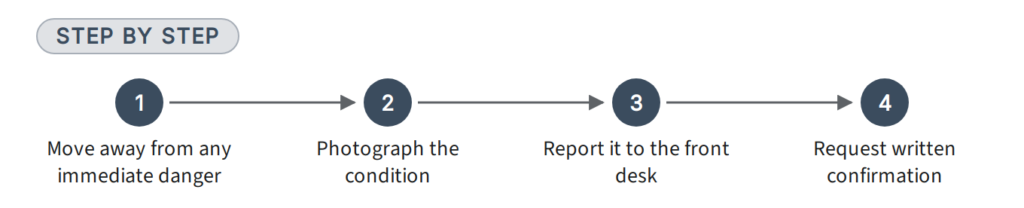
- Move away from any immediate danger and help companions do the same.
- Photograph the condition and its location without touching or altering it.
- Report it to the front desk, manager, or security team and note the time.
- Request written confirmation, a work order number, or a room change when continued exposure is likely.
A verbal report helps, but an app message or email leaves a clearer timeline. If staff offer a safe room or route, photograph the original condition first, but only if it’s safe to do so. Choose other accommodations if management cannot provide a secure room, usable exit, or reasonably safe route. Record the response, including the new room number or incident report reference.
How premises liability in Florida applies at a resort
What counts as premises liability in Florida?
Premises liability concerns injuries allegedly caused by unsafe property conditions or inadequate property management. Resort claims may involve defective stairs, handrails, unsecured flooring, pools, or security. Responsibility depends on property control, notice, causation, and the injured person’s conduct, such as using a visibly damaged stair.
Resorts aren’t the only places where these cases come up in Florida. The Florida Office of the State Courts Administrator recorded 10,865 commercial and 1,520 residential premises liability filings in circuit courts during fiscal year 2024-25. Those figures provide context for documenting hazards, but they don’t prove any particular resort was negligent.
Why notice matters for spills
Under Florida Statutes section 768.0755, someone injured by a transitory foreign substance in a business establishment must prove the business had actual or constructive knowledge of the dangerous condition. Constructive knowledge may be shown when the condition lasted long enough to be discovered through ordinary care, or occurred regularly enough to be foreseeable. This spill-specific rule doesn’t automatically cover broken railings or failed lights.
Are resort claims difficult to prove?
Difficulty depends on the evidence and what’s disputed. Timestamped photographs and a written report can preserve the location and management’s response, but neither automatically proves a breach or that the condition caused an injury. If the resort disputes where you fell, a close-up without surrounding landmarks may leave the location unclear. Include a wider view that shows the bathroom doorway or nearby room number.
Notice is where most resort claims are won or lost, and Florida’s rules on it are technical. A guide to Florida premises liability covers how Florida courts treat the resort-specific scenarios that section 768.0755 leaves open, from broken railings to inadequate security.
If a reported resort hazard causes an injury
Deal with health and evidence first
Get appropriate medical care and notify management. Request an incident report and ask how to obtain a copy before you leave the property. Keep booking records with your photographs and messages. Save witness contact details and the clothing or footwear involved. If a reported hazard caused your injury, you can seek legal advice about an insurance claim or lawsuit.
Filing deadlines and comparative fault
Florida Statutes section 95.11 generally sets a two-year limitation period for negligence actions, but the applicable deadline depends on the claim and its facts. Have a Florida lawyer assess your dates.
Under Florida Statutes section 768.81, a claimant more than 50% at fault generally cannot recover negligence damages. At 50% or less, damages may be reduced by the assigned share of fault.
How long resolution can take
Timing depends on medical recovery, the quality of the evidence, disputed fault, and the insurance evaluation. Litigation can also stretch the timeline. Don’t assume a settlement will arrive before you have to pay a medical bill.
Make safety part of the arrival ritual
Give the room and your usual walking routes a few minutes of attention before unpacking. You can admire the ocean afterward. A clear written report and a confirmed safe alternative matter more than debating a defect with staff at the front desk. Before settling in, save the front desk’s written response with your reservation confirmation.