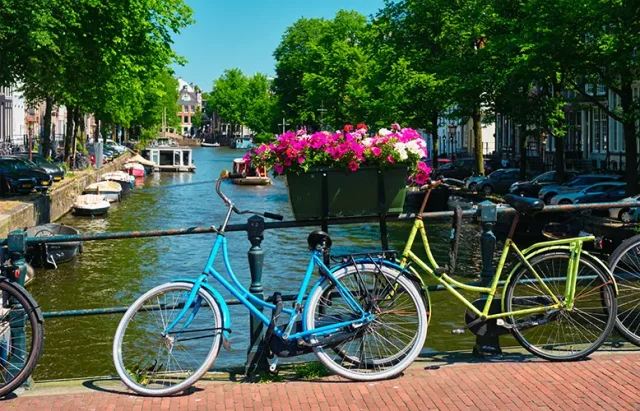
Amsterdam’s canals are often seen as a backdrop to the city, something you cross rather than experience. From street level, they function mainly as borders between neighbourhoods or obstacles in daily traffic. A boat tour changes that relationship completely. By moving through the city on the water, the canals shift from background to centre stage, altering how Amsterdam is perceived and understood.
Seeing the city as a connected system
From a boat, Amsterdam no longer feels like a collection of separate streets and districts. The canals reveal how the city is structured as a continuous system. Neighbourhoods flow into one another without clear breaks, connected by water rather than divided by roads. This perspective highlights how the canal belt was designed to link trade, living and movement into one coherent layout.
Distance from street-level distraction
Being on the water creates physical and mental distance from the street. Noise, traffic and the constant need to navigate disappear. This separation allows attention to shift toward the surroundings. Buildings appear more balanced when viewed from canal level, and the city feels calmer and more deliberate. An Amsterdam boat tour with drinks offers this sense of detachment without demanding effort from the visitor, making observation feel natural rather than forced.
Architecture viewed from its original angle
Many canal houses were designed to be seen from the water. Their proportions, details and symmetry make more sense from this angle than from the pavement. A boat tour restores this original viewpoint. Facades align more clearly, and subtle variations between buildings become noticeable. This changes the way architecture is read, turning familiar streets into layered visual narratives.
Understanding movement and rhythm
The pace of a boat tour reshapes the rhythm of the city. Slow movement allows time to process what is seen instead of rushing past it. Bridges pass overhead at regular intervals, reinforcing the measured design of the canal network. This rhythm reflects how the city once functioned, before speed and efficiency became dominant values. The canals suggest a tempo based on balance rather than urgency.
Observing daily life from the edges
From the water, everyday life appears differently. People sitting along the canals, small boats passing quietly and activities unfolding at the edges of the city become part of the experience. This view removes the boundary between observer and environment. The city feels lived-in rather than staged, and the canals act as shared spaces instead of scenic features.
A broader understanding of Amsterdam
Toward the end of the journey, the cumulative effect becomes clear. Amsterdam feels less fragmented and more intentional. An Amsterdam boat tour with drinks supports this broader understanding by offering continuity and calm. The city reveals itself as something shaped by water first and streets second.
Changing perspective does not require seeing more, but seeing differently. Experiencing Amsterdam from the canals reframes the city, turning familiar views into insights and transforming movement into understanding.