Bringing home a memorable bottle of wine should be one of the pleasures of visiting wine country—not an invitation to spend the flight wondering whether it will survive baggage handling.
Standard bottles are awkward to pack, glass is vulnerable to impact and even a small leak can ruin everything else in a suitcase. Travelers returning from Napa Valley, Tuscany, Bordeaux or the Okanagan therefore need something more dependable than a sweater wrapped around a bottle.
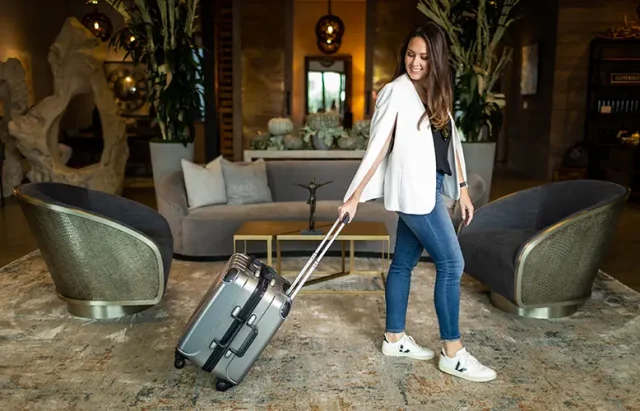
The VinGardeValise by FlyWithWine was created specifically for this purpose. Combining a hard-shell suitcase with removable protective inserts, it allows travelers to transport several bottles while retaining the flexibility to use some or all of the case for clothing.
The original DRIFT Travel post introduced the concept. Here is a closer look at how the suitcase works, the models currently available and what travelers should know before flying with wine.
What is the VinGardeValise?
The VinGardeValise is a collection of hard-sided travel cases designed to protect wine, Champagne, spirits and other bottled products during transportation.
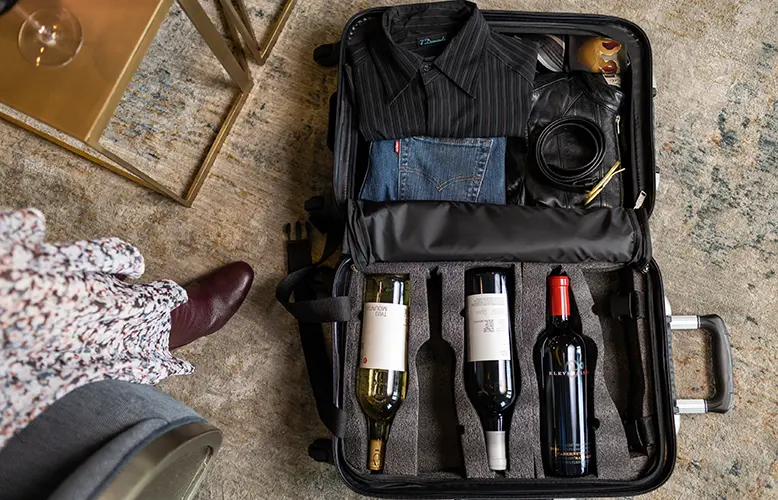
Each suitcase contains dense, removable foam inserts shaped to hold individual bottles. Rather than allowing glass containers to roll around inside a conventional suitcase, the inserts separate and cushion them from several directions.
The current collection includes three principal sizes:
- Piccolo: Holds as many as five bottles
- Petite: Holds as many as eight bottles
- Grande: Holds as many as 12 bottles
The inserts are modular, so travelers do not need to fill the entire suitcase with wine. They can remove individual sections and use the remaining space for clothing, shoes and other belongings.
This dual-purpose design is one of the product’s most useful features. A traveler could pack clothing in the case on the outbound journey, then reorganize the interior to accommodate bottles purchased during a winery visit.
How the protective design works
The primary bottle protection comes from high-density foam compartments that cradle each bottle and prevent glass-to-glass contact.
This separation is important. Two individually wrapped bottles can still break if they strike one another inside a loosely packed suitcase. The VinGardeValise inserts keep each bottle within its own fitted space, reducing movement while absorbing some of the impact associated with baggage handling.
The exterior adds another layer of protection with a hard shell, reinforced corners and a ribbed structure. Additional features include a reinforced zipper, internal securing straps, spinner wheels and an integrated TSA-compatible lock.
No travel case can eliminate every possibility of damage, particularly if it is overloaded, improperly closed or subjected to extreme force. Nevertheless, a purpose-built wine suitcase provides considerably more structured protection than packing bottles loose among clothing.
Choosing the right size
The most suitable model depends on how much wine a traveler typically purchases and whether the suitcase will also carry personal belongings.
Piccolo five-bottle suitcase
The compact Piccolo is designed for shorter trips and travelers who generally bring home only a few bottles.
When the inserts are removed and the case contains no wine, its dimensions may allow it to function as carry-on luggage on some airlines. Travelers must still confirm the specific size rules imposed by their carrier.
The distinction between an empty case and one carrying wine is important. Full-sized wine bottles exceed standard cabin liquid limits and normally need to be transported as checked baggage. Calling the Piccolo a carry-on-size case does not mean five bottles of wine can be taken through airport security.
Petite eight-bottle suitcase
The Petite offers a practical middle ground. Its eight-bottle capacity is enough for a substantial winery purchase without requiring the larger footprint of a 12-bottle case.
Travelers can also remove half of the inserts and divide the suitcase between wine and clothing. This configuration may suit a couple taking a short wine-country trip or someone who expects to purchase four or five bottles but wants room for other souvenirs.
Grande 12-bottle suitcase
The Grande is intended for collectors, wine professionals and travelers who regularly return with a full case.
A standard 750-milliliter bottle of wine often weighs approximately three pounds, although heavier glass bottles can weigh considerably more. Twelve bottles can therefore add around 36 pounds before accounting for the weight of the suitcase itself.
The case should be weighed after packing to ensure it remains within the airline’s checked-baggage allowance. A compact digital luggage scale is a worthwhile addition to any wine-travel kit.
Can wine go in carry-on baggage?
In most situations, a standard bottle of wine cannot pass through airport security in carry-on luggage.
Wine bottles generally contain 750 milliliters, well above the 100-milliliter or 3.4-ounce limit applied to ordinary liquids at airport screening checkpoints. Bottles purchased after security may be permitted in the cabin when sealed according to duty-free requirements, but connecting flights can complicate those rules.
The most reliable approach is to place winery purchases in checked baggage or arrange for the winery to ship them.
Both the Canadian Air Transport Security Authority and the U.S. Transportation Security Administration allow ordinary wine in checked bags. Beverages containing 24 percent alcohol or less are not subject to the five-liter aviation limit applied to stronger alcoholic drinks, although airline weight restrictions and customs rules still apply.
Customs rules are separate from airline rules
Being permitted to place wine in checked baggage does not automatically mean it can be imported without declaration, duty or taxes.
Customs allowances vary between Canada and the United States, and may depend on:
- The traveler’s age
- Country and place of residence
- Length of time spent outside the country
- State or province of entry
- Quantity and alcohol content
- Whether the wine is for personal or commercial use
Travelers should keep their receipts and declare every bottle when required. Bringing back more than a personal exemption does not necessarily mean the wine will be refused. Customs officials may simply collect applicable duties and taxes, although state and provincial import limits can also apply.
How to pack a wine suitcase properly
A specialized suitcase still needs to be packed carefully. Before heading to the airport, follow these steps:
Inspect each bottle
Check the glass, closure and capsule for visible damage or leakage. Avoid traveling with a bottle that has already been opened.
Use the correct insert
Standard foam compartments may not fit unusually shaped bottles. Champagne, Burgundy, magnum, spirits and beer bottles can have wider or longer profiles.
VinGardeValise sells alternative and customizable inserts for different bottle styles. Never force an oversized bottle into a compartment or leave a smaller one loose inside the foam.
Keep the bottles separated
Each bottle should sit securely within its own compartment without touching another bottle. Confirm that the top and bottom portions of the insert align correctly before closing the case.
Secure both sides
Fasten the internal straps and make sure the zipper closes without excessive pressure. If considerable force is needed to shut the suitcase, something may be misaligned.
Weigh the finished case
Do not estimate. Heavy glass bottles can push a suitcase beyond an airline’s standard weight allowance surprisingly quickly.
Add identification
Attach an exterior luggage tag and place a second card containing your contact information inside the suitcase. A tracking device can provide additional reassurance, although travelers should verify the airline’s rules for battery-powered trackers.
Protecting wine from temperature changes
Breakage is not the only concern when transporting wine. Prolonged exposure to heat can damage aroma, flavor and aging potential.
Avoid leaving wine in a parked vehicle, on an exposed airport curb or in direct sunlight. If traveling through a hot climate, head to the airport without unnecessary stops and retrieve the suitcase promptly after landing.
VinGardeValise offers optional cooling sheets designed for its cases. These add weight, however, so travelers should factor them into the final baggage calculation.
For particularly rare or valuable bottles, professional temperature-controlled shipping may be a better choice than checked luggage. Shipping regulations vary significantly between countries and jurisdictions, so the winery should confirm whether it can legally deliver to the traveler’s address.
When a wine suitcase makes sense
A dedicated wine suitcase is most practical for people who:
- Regularly visit wineries and wine regions
- Purchase several bottles during a trip
- Attend wine events, tastings or competitions
- Transport spirits, beer or specialty food bottles
- Want a reusable alternative to disposable bottle protectors
- Prefer to divide one suitcase between wine and clothing
Someone who brings home only one occasional bottle may be adequately served by a sealed padded wine sleeve inside a hard-sided checked suitcase. Inflatable bottle protectors and absorbent wine bags are lighter, less expensive and easier to store between trips.
Frequent wine travelers, however, may appreciate the structure, capacity and repeat usability of a specialized case.
What are the potential drawbacks?
The most obvious consideration is weight. The suitcase, foam and bottles can quickly approach an airline’s baggage limit.
A dedicated case also requires storage at home and may be unnecessary for travelers who rarely purchase wine. Its fixed foam compartments take up more space than flexible bottle sleeves, and unusually shaped bottles may require separate inserts.
Travelers should also recognize that “TSA-compatible” does not mean an airline guarantees against breakage. Some carriers exclude fragile items from baggage liability, even when they are packed in a protective case.
The decision ultimately depends on frequency of use. For a wine professional or enthusiastic collector, a reusable case may become an essential part of traveling. For the occasional vineyard visitor, individual protective sleeves may be more practical.
Turning a winery visit into a travel experience
A wine suitcase is most useful when the bottle carries a connection to the place it came from: a small family winery, a memorable vineyard lunch or a vintage unavailable at home.
Travelers looking for their next wine-focused trip can explore the hidden gems of Italy’s top wine regions or plan a fall visit around Temecula Valley Wine Month and its harvest experiences.
Whether choosing a VinGardeValise, protective bottle sleeves or professional shipping, the goal is the same: getting those carefully selected bottles home safely—and opening them later with the memories of the journey still attached.