
Twice a year, in spring and again in autumn, Gurung hunters in Lamjung district rope themselves down cliff faces to cut combs from the world’s largest honey bee. The honey that comes off those rocks sells abroad for around USD 70 per 250 grams, and the villages producing it sit roughly 100 kilometres northwest of Kathmandu. What makes the harvest worth watching now is that it is shrinking, with one village down from 1,000 litres a season to a fraction of that in a decade.
Who Are the Gurung Honey Hunters of Lamjung?
Particular families in particular villages, not a national trade. Honey hunting rights attach to specific cliffs held by Gurung communities in Lamjung and neighbouring Kaski, and the technique passes directly from one generation to the next within those families.
Doodh Bahadur Gurung, a hunter in his sixties from the village of Taap, taught the craft to his son Som Ram. That inheritance is the only transmission route, because none of it exists in writing.
Standing in these villages has little to do with what the honey earns. The role carries obligation, and the harvest opens with ritual rather than with equipment.
Why Do the Bees Build on Open Cliff Faces?
Altitude and flowers. Apis laboriosa nests between 2,500 and 3,000 m on exposed rock, and the rhododendron stands at that elevation are what turn the comb into mad honey from Nepal rather than an ordinary wild harvest.
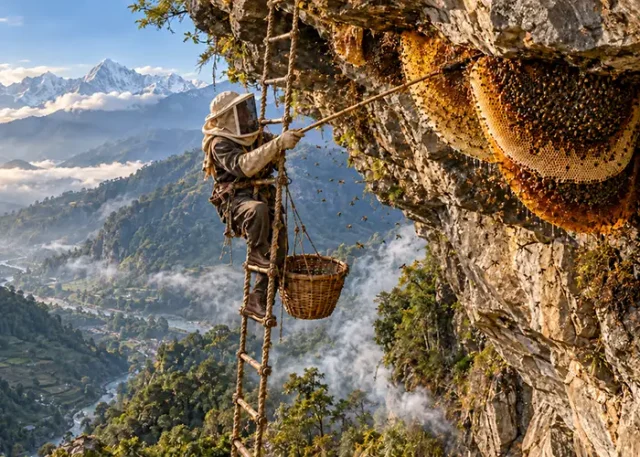
Colonies that high cannot be boxed or relocated, so every litre leaving the country came off a cliff. The bee itself runs roughly double the size of a common honey bee, and its combs hang in the open beneath overhangs, visible from the valley floor long before anyone climbs.
How Is the Comb Cut From the Rock?
By hand, on a ladder the village made itself. Teams assemble below the cliff before dawn, one group managing ropes and baskets at the base while a hunter descends on bamboo and fibre, carrying a long pole to work the comb loose.
| Stage | What happens |
| Before dawn | Team assembles, ritual offering made |
| Smoke lit | Fires set below to drive bees off the comb |
| Descent | Hunter lowers on a bamboo and fibre ladder |
| Cutting | Comb worked free with a long pole |
| Lowering | Filled basket let down on a separate rope |
There is no harness, no helmet and no modern climbing gear. The hunter hangs free against the rock, and the whole operation depends on coordination between the people above, the people at the base, and the ladder between them.
Why Does Smoke Matter More Than Rope?
Because it is the only protection anyone has. Fires lit at the base send smoke across the comb, pushing the colony off it long enough for the cutting to happen.
Stings still land. A hunter suspended on a ladder cannot retreat, which is why the smoke has to be managed continuously by the team below rather than lit once and left to burn.
What Makes This Honey Different From Ordinary Honey?
Grayanotoxins. The bees take nectar from rhododendron blossom at high elevation, and the compounds carry through into the comb, where they act on the nervous system.
| Amount | Effect |
| Under a teaspoon | Warmth, mild light-headedness |
| A teaspoon | Enough to cause poisoning in some people |
| More | Vomiting, dizziness, sharp drop in heart rate |
Nepali households have treated small doses as medicinal for generations, using it for coughs, stomach complaints and joint pain. The honey also runs thinner than a supermarket jar, with a reddish cast and a bitterness at the back of the throat.
When Does the Harvest Happen, and Why Only Twice a Year?
Spring and autumn, set by the flowers. The spring harvest follows the rhododendron bloom and produces the stronger comb; the autumn harvest yields honey that is milder and paler.
That limit is why supply stays small. There is no way to add a third harvest without the flowering, and no way to bring the colonies closer to the villages.
What Is Happening to the Harvest Now?
It is contracting, quickly. Hunters report a rapid slump in both hive numbers and honey volume, with Taap down from 1,000 litres a season a decade ago.
Nepal recorded more than 4,500 wildfires in 2024, close to double the previous year, and scientists have confirmed what hunters describe about shifting weather in these valleys. Flowering cycles move, forest cover thins, and the colonies thin with them.
The second pressure is people. Young Nepalis are leaving rural districts for better-paid work abroad, and a skill transmitted only by apprenticeship does not survive that gap. Demand meanwhile climbs yearly while quality production falls, which is what holds the price where it is.
Can Visitors Watch a Harvest?
Yes, with the right operator and flexible dates. Some Lamjung villages arrange visits during the harvest windows, usually as a two or three day trip from Besisahar or Pokhara.
| Detail | Harvest visit |
| Seasons | Spring and autumn, dates not fixed in advance |
| Access | 100 km northwest of Kathmandu, via Besisahar |
| Duration | 2 to 3 days including travel |
| Best arranged through | Operators working with a named village |
Timing cannot be locked far ahead, because the hunt moves with the flowering and the weather. The difference between a good operator and a poor one shows in whether the community sees any of the money.
Frequently Asked Questions
1. Where does this honey actually come from?
Mid-hill districts, chiefly Lamjung and Kaski, on cliffs between roughly 2,500 and 3,000 m. Not the high Himalaya, and not the lowlands.
2. How much should someone take?
A teaspoon is the traditional ceiling for fresh comb. Published toxicology work notes a single teaspoon can be enough to cause poisoning, so there is no universal dose.
3. Is it legal to carry out of Nepal?
Buying is legal in Nepal. Import rules vary by destination, and anyone carrying it home should check their own customs position first.
4. Why do hunters refuse modern climbing equipment?
Partly tradition, partly practicality. The techniques are built around ladders and ropes the villages make and repair themselves from local materials.
5. What does a genuine jar cost?
Around USD 70 for 250 grams through international sellers. Jars priced far below that in Kathmandu tourist shops are rarely what they claim.
6. How can a buyer tell a real batch?
A genuine seller names the district, names the season, and can produce a grayanotoxin figure for that batch. Concentration shifts between spring and autumn comb, so a seller who cannot say which season a jar came from did not buy it from a hunter.
7. Does it cause hallucinations?
The common description overstates it. The effect sits closer to intoxication and light-headedness than to visual hallucination, and at higher doses it becomes a medical problem rather than a recreational one.