
Long-haul flights between the US and India have become one of the most competitive parts of the international premium-travel market. Airlines now operate a growing mix of nonstop and one-stop routes linking major American cities with Delhi, Mumbai, and a wider network of destinations across India.
Competition across US–India routes has also accelerated investment in long-haul cabin products. Nonstop flights typically run between 14 and 17 hours, depending on the route, which means cabin layout, sleep conditions, and differences between aircraft cabins tend to shape long-haul travel more noticeably than on shorter international routes.
The market continues evolving in several directions at once. US airlines have expanded nonstop service, Gulf carriers remain heavily established through Dubai and Doha, and Air India is moving through a broader fleet-renewal and cabin-refresh program under Tata Group ownership. Together, those changes are reshaping how premium travel between the US and India now operates.
Air India’s Transformation and Why It Matters
Air India’s business class is now part of a broader airline transformation under Tata Group ownership. Since January 2022, the airline has started a large fleet-renewal and cabin-refresh program aimed at creating a more consistent premium product across its long-haul network. The transformation extends beyond newly delivered aircraft — Air India has committed roughly $400 million toward retrofitting parts of its existing fleet.
The most significant cabin change is the Airbus A350, which introduces enclosed suites with privacy doors, direct aisle access, 79-inch lie-flat beds, wireless charging, and updated entertainment systems. This represents the clearest direction of Air India’s premium transition, but it is not available on every US route. Retrofit work continues across parts of the Boeing 787 and Boeing 777 fleet, and some older 777 cabins still use denser 2-3-2 seating layouts with fewer privacy features.
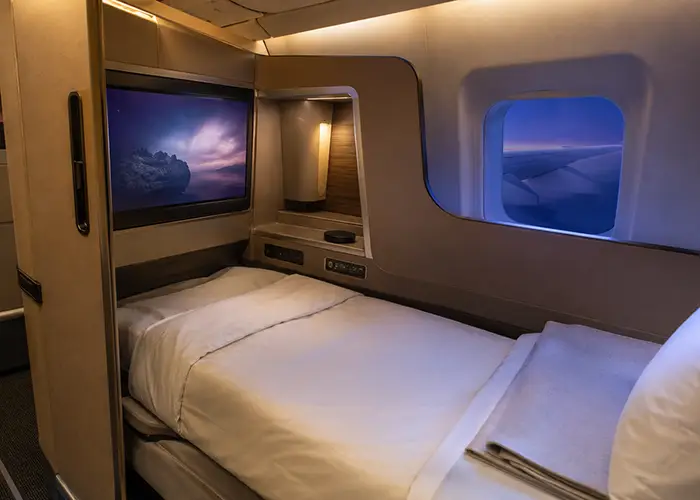
For travelers booking today, the aircraft type matters more than the airline brand. Checking which aircraft operates a specific Air India departure before booking is the most reliable way to know which cabin product the flight actually delivers.
Direct Flights to India from the US
Direct flights to India from the US mainly serve Delhi and Mumbai, with the most frequent nonstop options operating from New York City.
Air India
Air India operates nonstop flights from New York (JFK), Newark (EWR), Chicago (ORD), San Francisco (SFO), and Washington Dulles (IAD). The airline currently uses both Airbus A350 and Boeing 777 aircraft across its long-haul US network, which means the onboard product can vary noticeably between routes.
The newer Airbus A350 cabins reflect the clearest direction of Air India’s premium-cabin transition. The aircraft introduces enclosed business-class suites with privacy doors, direct aisle access, 79-inch lie-flat beds, wireless charging, 21-inch HD entertainment screens, and additional personal storage.
Older Boeing 777 aircraft still remain part of the long-haul fleet, including some cabins that continue using denser 2-3-2 seating layouts with fewer privacy features.
United Airlines
United Airlines operates daily nonstop flights from Newark Liberty International Airport (EWR) to Delhi (DEL) and Mumbai (BOM) using Boeing 787-9 Dreamliner aircraft. The Newark-Delhi route has been part of United’s network since November 2005, making it one of the longest continuously operated US-India nonstop flights — a detail that reflects both the demand consistency on this corridor and United’s familiarity with operating it.
The Boeing 787-9 uses United Polaris business class in a 1-2-1 configuration with 48 lie-flat seats. Each seat converts into a 6-foot 6-inch bed and has direct aisle access, multiple storage areas, AC and USB power, and a 16-inch entertainment screen. United Airlines continues using Saks Fifth Avenue bedding across long-haul Polaris routes.
American Airlines
American Airlines operates daily direct flights between John F. Kennedy International Airport (JFK) and Delhi (DEL), for which it uses Boeing 787-9 Dreamliner aircraft.
The airline’s business-class cabin has a 1-2-1 layout. Unlike some staggered layouts, the seat angles passengers away from the aisle rather than toward it, creating a more enclosed space. The cabin features fully lie-flat beds with direct aisle access, personal storage, AC power, USB ports, large tray tables, and 18-inch entertainment screens.
Premium One-Stop Alternatives
Nonstop routes between the US and India continue expanding, but they still do not cover every destination or travel preference. Many travelers continue to fly through hubs such as Dubai and Doha, particularly when the trip involves cities beyond Delhi and Mumbai.
Emirates via Dubai
Emirates connects several US cities with India through Dubai International Airport (DXB). The airline serves major Indian destinations beyond Delhi (DEL) and Mumbai (BOM), including Bengaluru (BLR), Hyderabad (HYD), Chennai (MAA), Ahmedabad (AMD), Kochi (COK), and Kolkata (CCU).
Emirates uses a mixed long-haul fleet that includes Airbus A380, Airbus A350, and Boeing 777 aircraft. Across its long-haul fleet, Emirates’ business class includes lie-flat seats, onboard dining, AC and USB power, and the airline’s ICE entertainment system. Some aircraft also include an onboard lounge shared between first and business class. On a journey broken into two long segments, this gives travelers a separate space to move around and reset between flights rather than remaining seated for the full duration of each leg.
At Dubai International Airport (DXB), Emirates operates several business-class lounges with dining areas, shower facilities, and quieter rest areas. On a layover that can run several hours, shower access in particular helps travelers arrive in India in better condition than a standard transit would allow.
Qatar Airways via Doha
Qatar Airways offers one-stop flights through Hamad International Airport (DOH) in Doha, with onward connections to cities such as Chennai (MAA), Kochi (COK), Bengaluru (BLR), Hyderabad (HYD), and Ahmedabad (AMD).
On long-haul US routes, Qatar Airways mainly uses Boeing 777 and Airbus A350 aircraft. Qsuite continues to represent Qatar Airways’ most distinctive long-haul business-class product. It features lie-flat seats in a 1-2-1 layout with direct aisle access, sliding privacy doors, multiple storage areas, and individual power and entertainment controls. The privacy doors and enclosed layout matter most on the longer transatlantic segment, where uninterrupted sleep is harder to achieve in an open cabin. Some center seats can also convert into shared spaces for passengers traveling together.
Hamad International Airport (DOH) offers passengers dining areas, shower facilities, and dedicated rest spaces through the Al Mourjan Business Lounge. For travelers with a longer layover, the rest facilities reduce the fatigue that typically builds up across a two-segment journey of this length.
Planning Business-Class Travel to India
Business-class ticket prices to India vary most by season and by booking timing, but route structure also affects pricing in ways worth considering before booking.
Nonstop flights on United Airlines or American Airlines typically carry a fare premium over one-stop itineraries through Dubai or Doha. On a 14- to 17-hour journey, that premium is often worth paying when rest and total travel time are the priority. When the destination is a city beyond Delhi or Mumbai, or when Gulf carrier fares are meaningfully lower, a one-stop itinerary through Dubai or Doha can be the more practical choice without a significant cabin quality trade-off.
Prices rise during Diwali, Holi, Dussehra, Eid, Christmas, New Year, and summer family-travel periods. Winter travel between November and February also brings stronger demand across many Indian routes. For major holiday periods, comparing flights five to seven months before departure usually provides more options and better pricing. Outside peak seasons, a two to five-month booking window tends to offer reasonable availability for international business-class tickets.
None of these calls are obvious in isolation, and that is where a tool like BusinessClass.com proves useful, helping travelers compare business class flights to India on the variables that actually shape the experience: cabin product, total travel time, and fare, without the noise of irrelevant inventory.

Final Thoughts
The US-India premium market has enough options that the differences between them are worth understanding before booking.
The nonstop carriers offer predictable cabin products. With Air India, the cabin travelers get depends on which aircraft operates their specific departure; the A350 delivers a meaningfully different experience than the older 777. The Gulf carrier one-stops, on the other hand, cover a broader destination network with cabin quality that holds up across both segments.