

I deliver yachts for a living, mostly between Annapolis and the Caribbean, and I’ve spent more of the last twenty-two years looking at charts than at reefs. My father gave me a pair of brass dividers when I was fourteen, and they still live in a canvas roll in my sea bag, with one point slightly bent from the time I dropped them on a teak deck off Bermuda. So when my wife Elaine and I finally booked a week in Raja Ampat last winter, I didn’t start with the dive sites. I started with the route.
That turned out to be the right instinct, though I made a mess of the part that mattered most.
Raja Ampat is roughly 1,500 islands off the western tip of New Guinea, in Indonesia’s Southwest Papua province, and the reefs that everyone photographs are scattered across a stretch of sea that would take a decent sailboat several days to cross. Almost nobody stays in one place. You live on a boat that moves overnight, and the order in which it visits the islands shapes what you see far more than the brochure suggests. The best liveaboard diving in Raja Ampat is not necessarily about visiting the most famous reefs, a distinction worth considering when exploring Neptuneliveaboards.com and its itineraries through an archipelago where thoughtful route planning can matter as much as the dive sites themselves. I’d go further, having done it once. The order of the islands decided most of our week.
North or South
Most itineraries fall into three broad shapes, and each is a different holiday.
- The northern route works the Dampier Strait and then runs up to the karst lagoons of Wayag, a long passage that eats most of a night.
- The southern route heads for Misool, with its soft coral walls and swim-throughs
- A full crossing covers both, usually over ten nights or more
I’ll admit I assumed the full crossing would be the obvious choice for anyone who’d flown that far. It isn’t always. The open water between the Dampier Strait and Misool can be lumpy, especially outside the October to April season, and on a shorter trip you can spend a surprising share of your time steaming rather than diving.
Tides Decide the Day
On a delivery I plan every leg around tidal gates, the narrow windows when a strait is passable without fighting the current. Raja Ampat works the same way underwater. The famous sites in the Dampier Strait, places like Blue Magic and Cape Kri, are at their best near slack water, and around the full and new moons the currents run hard enough that guides sometimes skip them entirely. That detail almost never makes it onto an itinerary page.
The Week I Booked Against the Moon
The mistake was mine. We left Sorong on a Saturday afternoon in February 2025, and I’d chosen the departure because it fitted Elaine’s school holiday (she teaches fourth grade) and because the boat’s sample itinerary listed every site I’d read about. I hadn’t checked the lunar calendar, which for a man who keeps a tide table in his glovebox is fairly embarrassing. The full moon fell on the Tuesday. By Wednesday morning the current through the Dampier Strait was running so strongly that our guide, a patient man from Waigeo named Daniel, scrubbed Blue Magic at 6.40am and took us to a sheltered wall instead. And he did the same the next day. The sheltered sites were lovely, and I don’t want to sound ungrateful. But I’d built the whole trip around two dives that didn’t happen, and I could have avoided it by moving our dates nine days in either direction.
I check the moon first now, before I look at anything else.
Crossing the Line
A small digression. The northern route crosses the equator near Kawe, and some crews still mark the moment with the old sailors’ ceremony for first-timers, which on merchant ships used to involve buckets of something unpleasant and a lot of shouting. No buckets on ours. The crew handed out a cold beer and a certificate instead. I’ve crossed the line eleven times by sea and never had a certificate before, and I’m not too proud to say it’s on our fridge.
What Elaine Saw From the Surface
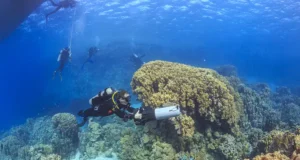
Elaine doesn’t dive. She snorkels, and she was worried the week would be mostly watching me climb in and out of a tender. It wasn’t. On a Raja Ampat liveaboard and snorkeling trip, the route matters even more for the person on the surface, because the shallow reef flats around Arborek and Friwen are where the coral sits three or four feet down, close enough to see in full colour. The deep current sites do almost nothing for a snorkeler.
- Ask whether the boat runs a separate tender for snorkelers
- Check how many nights are spent near shallow reefs, since a route weighted toward deep current dives can leave a non-diving partner with very little to do
Questions Worth Asking an Operator
I’d now ask any operator offering Raja Ampat diving and liveaboard trips a handful of questions before paying a deposit.
- Which nights involve long passages, and roughly how many hours each runs
- How the route changes around full and new moons
- Whether the southern Misool leg is weather-dependent in your month
- Ask how many dives the itinerary realistically allows after the passages, which on our boat came to 19 rather than the 24 we’d half expected.
- Who decides when a site is skipped
How We’d Book It Next Time
If we go back, and Elaine’s already circling dates, I’d pick a northern route over a full crossing, timed between the quarter moons, in November or March. That means less steaming and gentler currents through the strait. I’m still not sure whether Misool deserves a trip of its own or whether it’s worth fitting into a longer crossing, and I’ve changed my mind on that twice since we got home.
Before you choose a boat, put the lunar calendar for your dates next to the sample itinerary and ask the operator which sites they usually drop that week.