
Poland’s best-known road trips usually lead toward the Baltic coast, the Tatra Mountains or the lakes of Masuria. Upper Silesia rarely appears at the top of that list. Yet for travelers willing to drive beyond the obvious stops, southern Poland offers one of the country’s most varied road-trip landscapes. With so much packed into a relatively compact region, having a rental car quickly becomes part of the experience rather than simply a way of getting around.
The Silesian region is served by Katowice Airport in Pyrzowice, making it a convenient starting point for exploring by road. Picking up a rental car after landing means travelers can set off directly from the airport and shape the route around their own interests. From the terminal, in just a few hours, it is possible to travel between former coal mines, UNESCO-listed industrial heritage sites, medieval castles, manor houses and mountain towns. Kraków, Częstochowa, Auschwitz-Birkenau and even Ostrava in the Czech Republic can easily be included in the same itinerary.
September makes the route particularly appealing. Summer crowds begin to thin, temperatures remain comfortable for sightseeing and hiking, and the first shades of Poland’s golden autumn appear in the Beskid Mountains.
What makes Upper Silesia a good road trip destination?
- Katowice Airport is unusually well placed for a multi-stop trip. It lies around 20 miles (ca. 32 kilometers) north of central Katowice and close to the Kraków-Częstochowa Upland.
- The region combines very different landscapes within short driving distances. Industrial cities, limestone cliffs, castles, forests and mountain resorts can all fit into one journey.
- Many of the most interesting attractions are spread across several towns rather than concentrated in one center.
- A car makes it easier to connect Silesia with Kraków, the Beskids, Częstochowa and the Czech border.
- September offers a useful balance of milder crowds, good driving conditions and early fall scenery.
Why is Katowice Airport a strong starting point for a southern Poland road trip?
Katowice Airport, located in Pyrzowice roughly 20 miles (ca. 32 kilometers) north of Katowice, is more than an alternative airport for travelers heading toward Kraków.
Its position places arriving visitors close to several parts of southern Poland at once.
The airport sits near the northern edge of the Upper Silesian metropolitan area and within easy driving distance of the Kraków-Częstochowa Upland, usually called the Jura by Poles. This limestone landscape is known for rocky outcrops, caves and medieval fortresses belonging to the Trail of the Eagles’ Nests.
One of its most dramatic landmarks, Ogrodzieniec Castle, is roughly 25 miles (ca. 40 kilometers) from the airport.
That means travelers do not necessarily have to start their trip by driving directly into the capital of Silesia – Katowice. They can turn east toward castle country almost immediately after landing.
Continue north and Częstochowa brings another layer of Polish history. The Jasna Góra monastery, home to the revered Black Madonna icon, remains one of the country’s most important religious and cultural landmarks.
The result is an airport that works less like a gateway to one city and more like an entry point to an entire region.
What should travelers see in Katowice itself?
Katowice is best understood through the way it has transformed its industrial heritage rather than erased it.
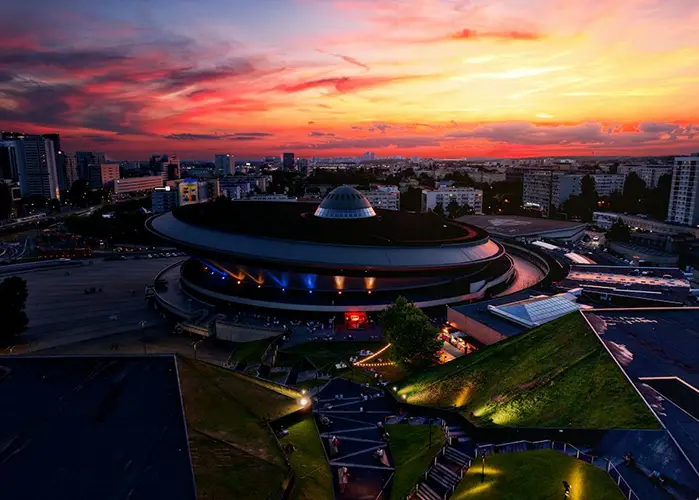
The clearest example is the Culture Zone, built on land once occupied by the Katowice coal mine. Today, the area brings together the Silesian Museum, the Polish National Radio Symphony Orchestra, the International Congress Centre and Spodek, the city’s unmistakable flying-saucer-shaped arena.
The Silesian Museum is especially revealing. Much of its exhibition space was constructed underground, allowing the site to preserve the visual identity of the former mine while turning it into a cultural institution.
A few miles away, Nikiszowiec offers a different perspective.
Built in the early 20th century as a residential district for miners and their families, the neighborhood is known for its red-brick apartment blocks, inner courtyards and distinctive arched passages.
It remains a lived-in neighborhood rather than a reconstructed historical attraction, which is part of its appeal.
Together, the Culture Zone and Nikiszowiec show two different versions of Upper Silesia: one shaped by reinvention, the other by preservation.
Where can travelers experience Silesia’s mining history?
Two of the region’s strongest industrial attractions lie outside central Katowice.
In Zabrze, the Guido Mine takes visitors deep below ground into former coal-mining tunnels. The experience places travelers inside the physical environment that shaped much of Upper Silesia’s economy, architecture and identity.
To the north, Tarnowskie Góry tells a different mining story.
Its historic silver mine forms part of the UNESCO-listed Tarnowskie Góry Lead-Silver-Zinc Mine and Underground Water Management System. The site reflects centuries of mining and engineering developed to control underground water while extracting valuable metals.
These are not simply museums about old machinery.
They help explain why towns across Upper Silesia look the way they do, why transport networks developed where they did and why industrial heritage remains such a visible part of the region’s culture.
Why is Ogrodzieniec Castle worth the drive from Katowice Airport?
Ogrodzieniec is one of the easiest ways to understand why the Jura works so well as part of a Silesian road trip.
The ruined medieval fortress rises above the village of Podzamcze on a ridge of pale limestone formations. Its position once made it part of the defensive system now known as the Trail of the Eagles’ Nests, which stretches between Kraków and Częstochowa.
The appeal is as much about the landscape as the architecture.
Rather than standing inside a dense historic city, the castle appears above open countryside, rocky hills and forest. It creates a sharp visual break from the brick architecture and industrial infrastructure around Katowice.
For travelers landing at Pyrzowice, it is also one of the rare major attractions that can realistically become the first stop of a trip rather than a later excursion.
What changes when the road heads south toward Pszczyna?
South of the Katowice metropolitan area, the landscape begins to soften.
Pszczyna Castle introduces an unexpectedly aristocratic side of Silesia. Surrounded by parkland, the residence preserves extensive historic interiors and furnishings from the late 19th and early 20th centuries.
It feels far removed from the mines of Zabrze or the red-brick streets of Nikiszowiec, despite being an easy drive away.
That contrast is one of the defining characteristics of a road trip through the region.
Silesia rarely presents travelers with one dominant visual identity. Industrial districts, palace parks, medieval ruins and forested hills frequently appear within the same day.
Where does the Silesian road trip turn into a mountain escape?
Continue south from Pszczyna and the terrain begins to rise into the Silesian Beskids.
The best-known towns include Wisła, Ustroń and Szczyrk, while Żywiec sits farther east between mountain ranges and a large reservoir.
These places shift the trip from cultural sightseeing toward hiking, scenic drives and slower days outdoors.
Wisła spreads along a mountain valley surrounded by wooded slopes. Ustroń combines hiking access with the atmosphere of a traditional Polish spa town. Szczyrk is one of the country’s most prominent mountain resorts and a major base for hiking and skiing.
September in the Beskids is particularly attractive here.
Days are often still suitable for walking and outdoor dining, while the forests gradually begin to change from deep summer green toward yellow, copper and rust.
The season also falls between the busiest summer vacation period and the winter ski rush.
Can travelers combine Silesia with Auschwitz-Birkenau?
Yes. The Auschwitz-Birkenau Memorial is around 40 miles (ca. 64 kilometers) from Katowice Airport and can be incorporated into a wider southern Poland itinerary.
It should, however, be treated differently from the surrounding sightseeing stops.
A visit to the former German Nazi concentration and extermination camp requires time, attention and advance planning. It is better approached as the primary destination of a day rather than as one stop in a rapid sequence of attractions.
Its location also makes it possible to continue afterward toward Kraków or return west toward Pszczyna and the Beskids.
How easily can a Katowice road trip include Kraków?
Kraków fits naturally into a longer road trip through southern Poland.
From Katowice itself, the A4 motorway provides a direct connection east toward Kraków, with the drive generally taking around an hour depending on traffic. From Katowice Airport, travelers should allow longer because Pyrzowice lies north of the city.
This makes Katowice useful for visitors who want more than a conventional Kraków city break.
A trip can begin with the Jura or Silesia, continue into Kraków and then return through Pszczyna or the Beskids rather than following the same route in both directions.
For travelers comparing flights, Katowice Airport can therefore function as an alternative gateway to southern Poland rather than simply a secondary airport serving Katowice.
Can the same road trip continue into the Czech Republic?
Yes. Ostrava in the Czech Republic is close enough to Upper Silesia to work as part of a two-country road trip.
The drive from the Katowice area to Ostrava takes travelers southwest across a border that now feels relatively seamless within the Schengen Area.
Ostrava also complements the Silesian theme particularly well. Like Katowice, it has transformed major industrial sites into cultural and visitor attractions while retaining the architecture of its heavy-industry past.
Travelers taking a rental car across the border should confirm the rental company’s cross-border rules before departure and check whether their planned Czech motorway route requires an electronic vignette.
Why is renting a car useful at Katowice Airport?
The strongest reason to rent a car at Katowice Airport is geography.
Many of the region’s most rewarding places are spread across different towns and landscapes rather than located along a single rail corridor. Ogrodzieniec lies east of the airport, Tarnowskie Góry to the west, and Katowice to the south, while Pszczyna and the Beskids sit farther beyond the metropolitan area.
In such circumstances, your own car or a hire car may turn out to be the best means of transport. Hiring a car eliminates delays associated with changing transport, giving you full control over your travel schedule.
For travelers arriving by air, collecting a vehicle right after landing is the most practical way to start exploring immediately. Kaizen Rent is a Polish car-rental company offering airport collection for passengers arriving at Katowice-Pyrzowice. Travelers planning the route can find its Katowice Airport rental information at https://kaizenrent.pl/en/car-rental-katowice-airport.
For American drivers, a few details are worth arranging before arrival.
U.S. traveler checklist for renting a car in Poland
Before picking up a rental car at Katowice Airport, U.S. travelers should make sure they have:
- Their original U.S. driver’s license – not just a photo or digital copy.
- An International Driving Permit (IDP) – carried together with the U.S. license.
- A suitable payment card in the main renter’s name, valid for at least 6 months post-rental—especially important when a security deposit is required.
- Advance confirmation if using a debit card – rental conditions may differ from those for credit cards.
- Debit cards are accepted only for standard vehicle classes (A–D, SUV, VAN) when the additional COMFORT PLUS package has been purchased.
- Debit cards are not accepted for Premium vehicle classes (E, D Premium, SUV Premium).
- An automatic transmission reserved ahead of time – manual cars are still common in Polish rental fleets.
- Cross-border authorization if the itinerary includes the Czech Republic or another country.
- The pickup procedure was checked in advance – Kaizen Rent uses a Meet & Greet service at Katowice Airport, followed by free transfer to its nearby office.
It is also worth reviewing local driving rules before departure: headlights are required year-round, Poland has a very low legal alcohol limit, and motorway payment systems vary depending on the route.
How do motorway tolls work in Poland?
American visitors should not assume that every Polish highway works under the same toll system.
The national e-TOLL system primarily applies to heavier vehicles and buses rather than a standard passenger rental car.
Some privately operated motorway sections charge passenger vehicles separately. The A4 between Katowice and Kraków is one example, with toll plazas located along the route.
Rental-car travelers should therefore check the exact roads included in their itinerary rather than trying to purchase a general national toll pass.
Crossing into the Czech Republic introduces a different system, where an electronic motorway vignette may be required.
Do travelers need winter tires for the Beskids?
September normally falls well before typical winter driving conditions, but mountain weather can change more quickly than conditions in Katowice or Kraków.
Poland does not impose a universal seasonal requirement for winter tires on passenger cars. Still, tire type becomes more important for Beskid travel later in fall and during winter.
Travelers visiting in colder months should ask the rental company what tires are fitted and whether snow chains are available when severe mountain conditions are possible.
For a September trip, the more immediate concerns are changing weather, wet roads and shorter daylight hours as the month progresses.
Why does Silesia work especially well in September?
September gives travelers access to most of the region’s outdoor attractions without requiring them to travel during Poland’s peak summer vacation period.
Cities remain active, castles and museums continue operating on regular visitor schedules, and the Beskids can still offer comfortable hiking temperatures.
At the same time, the landscape begins to change.
Forests start moving toward the colors associated with the Polish złota jesień, or golden autumn, while tourist traffic in mountain towns generally becomes less intense than during July and August.
For a road trip built around contrasts, that transitional season suits Silesia particularly well.
A morning might begin beneath the ground in a former coal mine. By afternoon, the road can be climbing through forested mountain valleys. The following day might bring a medieval fortress, a palace park or an entirely different country.
That variety is the point.
Upper Silesia does not depend on one iconic road, one celebrated viewpoint or one city to justify the drive.
Its appeal comes from the connections between places that initially seem to have little in common.
Katowice Airport happens to sit almost exactly where those connections begin.
FAQ
Which airport is best for a road trip through Upper Silesia?
Katowice Airport is particularly convenient for itineraries combining Katowice, the Jura, Tarnowskie Góry, Pszczyna and the Beskid Mountains. Kraków Airport may be more convenient for trips focused primarily on Kraków and western Lesser Poland.
Is it worth renting a car at Katowice Airport (Pyrzowice) to explore Silesia and the Beskids?
Yes, picking up a car directly at Katowice Airport is often the most practical option for travelers planning to visit both urban Silesia and the nearby mountains. Silesia’s major cities are connected by efficient highways like the A4 and S1, while mountain destinations in the Beskid Śląski—such as Wisła or Szczyrk—are far easier to reach by car than by public transport.
How many nights should travelers spend in the Beskids?
Two nights give travelers enough time for one full mountain day without turning the road trip into a rushed overnight stop. A longer stay makes sense for visitors planning several hikes or visiting more than one resort.
Are Polish road signs easy for American drivers to understand?
Most regulatory signs follow standardized European symbols and can be understood without speaking Polish. Drivers should still familiarize themselves with local speed limits, priority signs and parking rules before setting out.
Is parking difficult in Katowice?
Central Katowice has paid parking zones and structured parking facilities, while attractions outside the center generally offer easier access by car. Travelers staying in the city should check whether their hotel includes parking before booking.
Should travelers stay in Katowice or use several hotels?
Katowice works well as a base for the industrial heritage sites and parts of the Jura. Travelers continuing into the Beskids will usually gain more from spending at least one or two nights farther south rather than commuting back to the city.
Is driving in southern Poland difficult for Americans?
Drivers familiar with European-style traffic rules should adapt relatively quickly, but city streets can be narrower than those in the United States and highway speeds may feel fast. Roundabouts, strict pedestrian-priority rules and lower alcohol limits deserve particular attention.
Can travelers use a U.S. credit card at Polish gas stations?
Major gas stations typically accept widely used international credit cards. Keeping a small amount of Polish złoty available can still be useful for minor parking fees, smaller businesses or unexpected payment-terminal issues.
Is September warm enough for outdoor dining and hiking?
Often yes, particularly during the first half of the month, although temperatures vary considerably between Katowice and higher elevations in the Beskids. Layered clothing is more useful than planning for consistently summerlike weather.