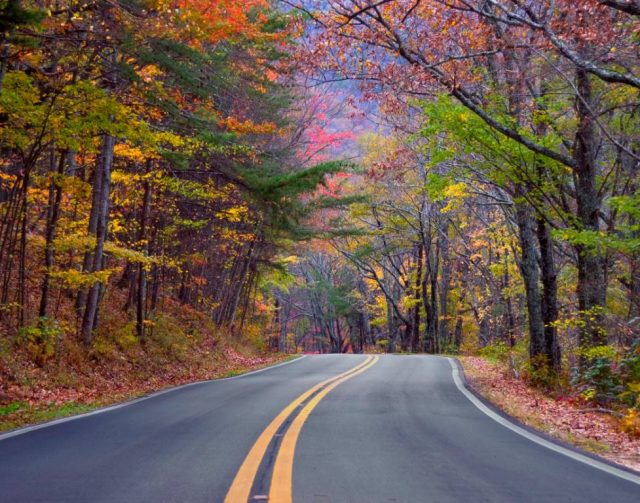
Alabama may not be the first place that comes to mind when planning a fall foliage trip, but the state’s mountains, canyons, hardwood forests and lakes create an impressive autumn display. From the Appalachian foothills of northeast Alabama to the forested ridges outside Birmingham, leaves turn shades of scarlet, amber, gold and deep orange over several weeks.
The state’s long north-to-south geography also extends the season. Color often begins at higher elevations in northern Alabama before gradually moving toward the central and southern regions. That gives travelers more than one opportunity to plan a scenic drive, hiking weekend or cabin escape.
Here are the best places to experience fall in Alabama, along with the drives, trails and overlooks worth adding to an autumn itinerary.
When Do Fall Colors Peak in Alabama?
Fall color usually begins appearing in the mountains of northern Alabama in early to mid-October. The most vibrant conditions often arrive between the third week of October and early November, particularly around Mentone, Fort Payne, Huntsville and Lake Guntersville.
Cheaha Mountain and the higher portions of the Talladega National Forest generally reach their best color around late October or early November. Central Alabama, including Birmingham and Oak Mountain State Park, may remain colorful into the first half of November.
These periods are only estimates. Temperature, rainfall, wind and elevation can move the peak forward or backward from year to year. A dry summer may produce a shorter or more muted display, while strong winds can bring leaves down soon after they change.
For the best chance of seeing good color, build some flexibility into the itinerary and check recent photographs, park updates and local foliage reports shortly before departure.
Mentone and Lookout Mountain
The small mountain town of Mentone makes an appealing base for an Alabama fall getaway. Set on Lookout Mountain near the Georgia state line, it is surrounded by forest, waterfalls and scenic roads.
Mentone itself is small, but that is part of its charm. Travelers come for cabins in the woods, independent shops, locally made crafts and relaxed restaurants rather than a long list of conventional attractions. The town can be combined easily with DeSoto State Park, DeSoto Falls and Little River Canyon National Preserve.
Lookout Mountain Parkway passes through the area and is especially scenic in autumn. Allow time for unscheduled stops rather than treating the drive simply as a route between attractions.
Fall weekends can be busy, particularly when local festivals are taking place. Book accommodations early if traveling during the final two weekends of October.
DeSoto State Park
Located between Mentone and Fort Payne, DeSoto State Park is one of the most complete fall destinations in Alabama. The 3,502-acre park sits atop Lookout Mountain and has more than 35 miles of hiking trails, mountain-biking routes, an accessible boardwalk and several waterfalls.
The Talmadge Butler Boardwalk Trail is a good option for families and travelers looking for an easy woodland walk. Its boardwalk passes through the forest near the park’s nature center, allowing visitors to enjoy the leaves without tackling a rugged trail.
For a longer outing, follow one of the park’s routes along Laurel Creek. The Laurel Falls and Lost Falls areas are particularly attractive after recent rainfall, although water levels can be low during dry autumns. Download or collect a trail map before setting out, as several routes intersect.
DeSoto Falls is located a short drive from the main park area. The 104-foot waterfall drops into a gorge below an old stone dam. A paved path leads to the main overlook, making this one of the region’s most accessible fall viewpoints. The amount of water passing over the falls varies with rainfall, but the surrounding forest and gorge make the stop worthwhile even during drier periods.
The park offers lodge rooms, cabins, chalets and campsites, allowing visitors to stay directly on Lookout Mountain.
Little River Canyon National Preserve
Few Alabama landscapes are as dramatic in autumn as Little River Canyon National Preserve. Sandstone cliffs, forested slopes and the winding Little River create layers of color that can be viewed from trails and roadside overlooks.
The easiest way to experience the preserve is the 11-mile scenic drive along Alabama Highway 176. It follows the western side of the canyon between Little River Falls and Eberhart Point, with a series of designated overlooks along the way.
Little walking is required at most stops, making the drive suitable for a wide range of visitors. Recommended viewpoints include Lynn Overlook, Hawks Glide, Canyon View and Wolf Creek. The road is narrow and winding, so drive slowly and watch for cyclists, wildlife and vehicles entering or leaving the pullouts.
Begin near Little River Falls, where a boardwalk provides a view of the river as it drops over a broad sandstone ledge. The flow is strongest after rain, but the surrounding hardwood forest supplies much of the autumn scenery.
Grace’s High Falls can sometimes be seen from an overlook farther along the parkway. At 133 feet, it is Alabama’s tallest above-ground waterfall, but it is seasonal and may be dry when rainfall has been limited.
Travelers with more time can hike into the preserve, although trails leading toward the canyon floor can be steep and strenuous. Check conditions with the National Park Service before attempting a backcountry route.
Lake Guntersville State Park
At Lake Guntersville State Park, the reflective surface of Alabama’s largest lake doubles the impact of the changing leaves. Wooded hills descend toward the Tennessee River, creating broad views that are especially attractive early and late in the day.
The park encompasses approximately 6,000 acres and has 36 miles of hiking and biking trails. Some routes remain close to the water, while others climb into the hills for elevated views.
One of the easiest ways to see the landscape is from the lodge on Taylor Mountain. Its grounds overlook the lake and surrounding forest, making it a convenient stop even for visitors who are not staying overnight.
The park’s trails range from short nature walks to longer interconnected routes. The Cutchenmine Trail follows the shoreline through hardwood forest, while the King’s Chapel and Terrell trails can be combined for a more substantial hike.
Lake Guntersville is also an important birding destination. Bald eagles live in the region throughout the year, and fall brings migrating birds through the Tennessee Valley. Binoculars are worth packing along with the camera.
Lodge rooms, mountaintop chalets, lakeside cabins and campsites are available inside the park.
Monte Sano State Park
Rising above Huntsville, Monte Sano State Park provides a convenient foliage escape without requiring a long drive into rural Alabama. Its name means “Mountain of Health,” a reference to the period when visitors traveled here for fresh air and mineral springs.
The 2,140-acre park contains roughly 20 miles of hiking trails and 14 miles of biking routes. Mature hardwood forest covers much of the mountain, producing a rich mixture of yellow, red and orange leaves in autumn.
The South Plateau Loop is one of the easier ways to sample the scenery, while the North Plateau Loop passes overlooks and historic features associated with the Civilian Conservation Corps. More demanding trails descend from the plateau and require a return climb.
The park’s overlooks face east across the surrounding valleys, making sunrise an especially rewarding time to visit. Fourteen rustic cabins sit along the mountainside, including several structures built by the Civilian Conservation Corps during the 1930s. Camping and glamping accommodations are also available.
A stay in Huntsville makes it easy to combine Monte Sano with museums, restaurants and the U.S. Space & Rocket Center.
Bankhead National Forest and the Sipsey Wilderness
Travelers who prefer wild forests to developed overlooks should consider Bankhead National Forest in northwest Alabama.
The forest is known for deep ravines, sandstone cliffs, hardwood trees, streams and waterfalls. Much of its most striking terrain lies within the Sipsey Wilderness, sometimes called the “Land of a Thousand Waterfalls.”
The name can create misleading expectations during autumn, however. Many cascades are rain-dependent, and water flow may be limited after a dry summer. Even without full waterfalls, the area’s rock shelters, hemlocks, beech trees and hardwood-filled gorges provide a distinctive setting for fall hiking.
Sipsey River Trail 200 offers a relatively approachable introduction to the area, following the river beneath bluffs and through dense forest. Other routes lead toward waterfalls and backcountry sites, but trail markings can be limited and stream crossings may be required.
Visitors should carry a detailed map, download offline navigation and avoid relying solely on mobile service. The U.S. Forest Service notes that routes to some well-known waterfalls are remote and may not be maintained. This is a destination for prepared hikers rather than a casual roadside stop.
Cheaha State Park and the Talladega Scenic Drive
At 2,407 feet above sea level, Cheaha Mountain is the highest point in Alabama. The elevation, rock outcrops and uninterrupted views across the Talladega National Forest make it one of the state’s premier fall destinations.
Cheaha State Park covers 2,799 acres and is surrounded by nearly 400,000 acres of national forest. The park was established in 1933 and retains several features built by the Civilian Conservation Corps.
The most accessible panorama is at Bald Rock. The quarter-mile Doug Ghee Boardwalk leads through the forest to a broad overlook, with benches placed along the route. An adjacent natural-surface trail reaches the same viewpoint.
Pulpit Rock offers another excellent view, but the short trail is steeper, rockier and more demanding. Proper footwear is important, especially when leaves conceal roots and uneven stone.
Drivers can reach Cheaha via Alabama Highway 281, part of the Talladega Scenic Drive. The roadway follows the mountain ridge through the national forest and offers changing views of wooded slopes and distant valleys. There are fewer developed services along the route than travelers may expect, so fuel the vehicle and carry food and water before beginning the drive.
Overnight choices at Cheaha include cabins, chalets and campsites. Visitors should check current accommodation availability because the park has been undergoing a multiyear lodge redevelopment.
Oak Mountain State Park
Fall color arrives slightly later at Oak Mountain State Park, making it a good choice after the leaves have begun fading in the northeastern mountains.
Located south of Birmingham, Oak Mountain is Alabama’s largest state park, covering 11,861 acres. Its ridges, lakes and hardwood forests are crossed by more than 100 miles of hiking, biking and equestrian trails.
The Green Trail, also known as the Peavine Falls Trail, is one of the park’s best-known routes. It leads toward Peavine Falls, although the waterfall can be reduced to a light trickle during dry weather. The surrounding forest and rocky terrain still make the hike attractive in fall.
For an easier outing, explore the Tree Top Nature Trail, an elevated boardwalk near the Alabama Wildlife Center. Visitors can also drive through the park, stop beside the lakes or choose one of several picnic areas beneath the changing trees.
Oak Mountain works well as a nature-focused addition to a Birmingham city break. Cabins, camping and glamping accommodations are available in the park, while the Birmingham area offers a much wider selection of hotels and restaurants.
A North Alabama Fall Road Trip
Travelers with three or four days can combine several of the state’s best foliage areas in one circular route.
Begin in Huntsville with a morning hike at Monte Sano State Park. Continue to Lake Guntersville for an afternoon beside the water and spend the night at the park or in Guntersville.
The following day, drive northeast to Fort Payne and enter Little River Canyon National Preserve near Little River Falls. Follow the Canyon Rim Parkway, stopping at the overlooks before continuing to DeSoto State Park.
Spend a night in Mentone, Fort Payne or one of DeSoto State Park’s accommodations. Use the final morning to visit DeSoto Falls, walk one of the park’s woodland trails and explore Mentone before returning to Huntsville.
Cheaha State Park can be added as a separate overnight stop or included on a longer route toward Birmingham.
Tips for an Alabama Fall Foliage Trip
Autumn is one of the busiest seasons at Alabama’s mountain parks. Reserve cabins, lodge rooms and campsites well in advance, especially for Friday and Saturday nights in late October.
Begin scenic drives early in the day to avoid traffic at popular overlooks. Morning light is often better for photography, while late afternoon adds warm color to ridges and lakes.
Pack layers. Temperatures on Lookout Mountain, Monte Sano and Cheaha Mountain can be noticeably cooler than in nearby towns, particularly after sunset.
Wear hiking shoes with good traction. Fallen leaves can hide rocks and roots, and wet leaves make boardwalks and stone surfaces slippery.
Finally, do not judge the entire trip by a single predicted “peak” date. Alabama’s varied elevations and long geography mean that one area may still be green while another is approaching full color. The most memorable fall trips often come from following the season rather than trying to schedule one perfect day.
Autumn Beyond the Expected
Alabama’s fall scenery is not limited to a single famous road or mountain. It appears across canyon walls, lakeshores, waterfall trails and quiet forest drives from Huntsville to Birmingham.
The combination of accessible overlooks and rugged backcountry means travelers can experience the season in very different ways. A visitor might photograph Little River Canyon from the roadside, spend a night in a Mentone cabin, hike through the Sipsey Wilderness or watch the sunset from Alabama’s highest mountain.
For anyone looking beyond the traditional fall destinations of New England and the Great Smoky Mountains, Alabama offers a colorful—and often less crowded—alternative.