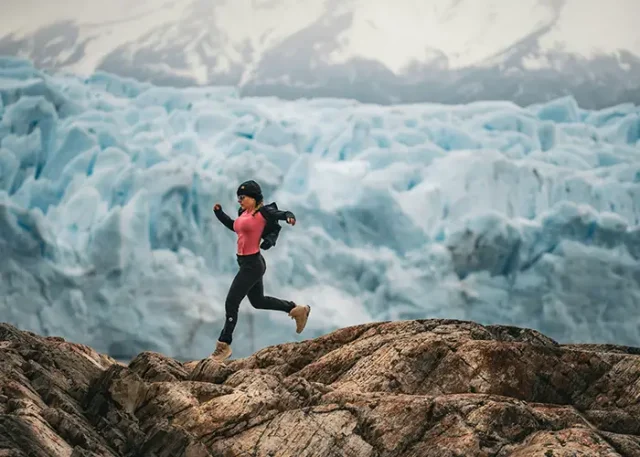
There are moments in travel that rearrange your sense of scale. Standing at the edge of the Perito Moreno Glacier in Argentine Patagonia is one of them. The wall of ice rises more than 60 meters above the milky turquoise waters of Lake Argentino, cracking and groaning under its own immense weight. Every few minutes, a thunderous boom echoes across the valley as a chunk of ice the size of a building shears off the face and crashes into the lake below. It is, without exaggeration, one of the most dramatic natural spectacles on Earth.
But the real adventure begins when you step onto the ice itself.
Into the Ice
El Calafate, a small town tucked along the shores of Lake Argentino in southern Patagonia, serves as the gateway to Los Glaciares National Park — a UNESCO World Heritage Site since 1981 that protects nearly 727,000 hectares of ice fields, forests, and mountains. The park’s crown jewel, the Perito Moreno Glacier, covers roughly 250 square kilometers and stretches 5 kilometers across at its front wall. Unlike most glaciers worldwide, it is not shrinking. Scientists consider it one of the few in equilibrium, which means it advances as fast as it calves — a rare phenomenon that makes its periodic ruptures all the more spectacular.
Most visitors experience the glacier from the network of steel walkways that wind through the forest opposite the ice wall. The views are extraordinary, and you could easily spend hours here watching the light shift across the blue-white surface. But for those seeking something deeper, the real magic lies in strapping on crampons and walking directly on the glacier.
Choosing Your Adventure
Two trekking options cater to different levels of ambition. The Minitrekking is the more accessible of the two — a roughly 90-minute guided walk on the ice suitable for anyone between 10 and 65 years of age. Groups are led by experienced guides who navigate through a landscape of crevasses, sinkholes, and ice ridges tinted in impossible shades of blue. The walk concludes with what may be the most satisfying toast of your life: whiskey poured over ice chipped directly from the glacier.
For those who want more, the Big Ice expedition offers approximately three and a half hours on the glacier, open to adventurers aged 18 to 50. The route ventures deeper into the ice field, reaching formations that few visitors ever see. The physical demands are moderate but real — Patagonian wind and uneven terrain require a reasonable level of fitness and sturdy boots provided by the local operators who coordinate these expeditions.
Both experiences include a short boat ride across the lake that passes directly beneath the glacier’s southern wall — a perspective that makes the sheer scale of the ice impossible to ignore.
Beyond Perito Moreno
While the glacier commands center stage, El Calafate rewards travelers who linger. A full-day boat excursion across the northern arm of Lake Argentino leads to the Upsala and Spegazzini glaciers, where towering walls of ice rise up to 130 meters and icebergs in surreal shapes drift silently across the water. The journey itself — through narrow channels flanked by ancient forest — is as memorable as the destinations.
Two and a half hours north by road, the village of El Chaltén offers some of the finest trekking in South America, with trails leading to the base of Mount Fitz Roy and Cerro Torre. The contrast between the two towns is striking: El Calafate is polished and well-equipped for tourism, while El Chaltén retains the raw, wind-battered character of a frontier settlement.
Back in town, the culinary scene has matured considerably. Patagonian lamb — slow-roasted over an open fire in the traditional asado style — is the signature dish, but local restaurants increasingly showcase regional ingredients including trout, wild game, and the calafate berry, a small purple fruit native to the Patagonian steppe. Legend has it that anyone who eats the calafate berry is destined to return to Patagonia. It is a superstition that, in my experience, tends to hold true.
Practical Notes
El Calafate’s airport receives direct flights from Buenos Aires, making it one of the more accessible corners of Patagonia. The high season runs from October through March, with December to February bringing the longest days and warmest temperatures — though “warm” in Patagonia is relative. Even in summer, temperatures hover around 15°C, and the infamous Patagonian wind can make it feel significantly colder. Layering is essential, and a good windproof jacket is non-negotiable.
The glacier sits about 80 kilometers from town along Ruta Provincial 11, a scenic drive of roughly an hour and a half through the Patagonian steppe with sweeping views of Lake Argentino. Most travelers book organized excursions that handle transport, park entry, and all logistics. Calafate Tours is among the established local agencies offering the full range of glacier experiences, from walkway visits to ice trekking and multi-glacier navigation.
At a latitude of 50°S, El Calafate occupies one of the most southerly inhabited corners of the planet. The landscape is stark, windswept, and hauntingly beautiful. And at its heart, a glacier that has been building for thousands of years continues to advance, crack, and rebuild — indifferent to the passage of time, magnificent in its persistence.