

Moving a group through New York City can become complicated surprisingly quickly. Coordinating several taxis, keeping track of different arrival times and finding enough room for everyone’s luggage can consume more time than the journey itself.
A chauffeured Sprinter van can solve many of those problems. The group follows one schedule, travels in one vehicle and has a professional driver responsible for traffic, navigation, pickups and parking.
The name “Sprinter,” however, does not guarantee a particular capacity or level of comfort. These vans are available in different lengths, seating configurations and custom interiors. A vehicle that works well for eight business travelers may not accommodate 12 airport passengers with full-sized suitcases.
Before reserving one, organizers should look beyond the photographs and confirm exactly what the trip, vehicle and quoted rate include.
When a Sprinter Van Makes Sense
A chauffeured van is particularly useful when keeping the group together is more important than finding the lowest-cost transportation.
Common uses include:
- Airport transfers
- Corporate meetings and conferences
- Weddings and family celebrations
- Cruise terminal transportation
- Concerts and sporting events
- Hotel-to-venue shuttles
- Private sightseeing
- Film and production transportation
- Group dinners
- Day trips outside New York City
For a single short journey, separate taxis or ride-hailing vehicles may be simpler. When an itinerary includes several stops, a strict schedule or travelers who should not become separated, one dedicated vehicle can make coordination considerably easier.
Passenger Capacity Is Only Half the Equation
The first question most organizers ask is how many people a van can carry. The equally important question is how much luggage it can accommodate when every seat is occupied.
Passenger Sprinter vans and customized executive vans come in numerous layouts. Some prioritize maximum seating, while others replace rows with larger reclining seats, tables or additional legroom. A luxury configuration may therefore hold fewer people than a conventional passenger van of the same exterior size.
Luggage capacity also changes with the configuration. A vehicle advertised for 12 or 14 passengers may not have space for the same number of large suitcases.
Provide the transportation company with a detailed count that includes:
- Adults and children
- Checked suitcases
- Carry-on bags
- Strollers
- Wheelchairs or mobility devices
- Golf clubs
- Musical instruments
- Presentation materials
- Wedding dresses or formalwear
- Sports equipment
Ask the company to confirm in writing that the assigned vehicle can carry everything without placing unsecured bags in the passenger aisle. If the group is traveling with substantial luggage, reducing the passenger count or adding a separate luggage vehicle may be necessary.
Executive Van or Standard Passenger Van?
Not every Sprinter offers the same experience.
A standard passenger configuration usually emphasizes seating capacity and practical transportation. It can work well for families, airport groups and informal outings.
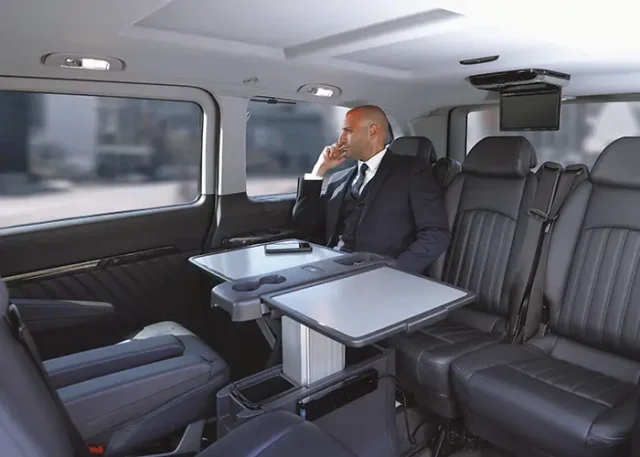
An executive or luxury configuration may include upgraded seating, additional legroom, power outlets, USB charging, privacy glass, Wi-Fi, lighting controls and audiovisual equipment. Amenities differ by vehicle, and promotional photographs do not always show the exact van assigned to a reservation.
Ask for recent photographs of the specific vehicle or vehicle class. If a conference table, Wi-Fi connection or individual charging outlet is important, have that feature listed in the confirmation.
Travelers should also decide whether they actually need a luxury conversion. For a brief airport transfer, safe transportation, working climate control and adequate luggage space may matter more than decorative lighting or an entertainment system.
Airport Transfers Require Careful Planning
A Sprinter van can be especially helpful for groups arriving at or departing from John F. Kennedy International Airport, LaGuardia Airport or Newark Liberty International Airport. Everyone travels to the same hotel or terminal without coordinating several cars.
Airport transfers still require detailed planning.
Provide the company with the airline, flight number and travel date. Terminal assignments and airport pickup procedures can change, so the driver should confirm the details close to the trip.
JFK is undergoing a major redevelopment program, with possible roadway closures, detours and changes to pickup areas. Travelers and organizers should review current information on the official JFK Airport website before departure.
For arriving flights, ask whether the service includes:
- Flight monitoring
- Complimentary waiting time
- Curbside collection
- Meet-and-greet service
- Luggage assistance
- Parking charges
- Instructions for contacting the driver
- A plan for delayed, canceled or diverted flights
Flight monitoring tells the dispatcher when an aircraft has landed, but it cannot predict how long passengers will spend at immigration, baggage claim or customs. Confirm when waiting-time charges begin and how the company handles a group whose members emerge from the terminal at different times.
For departing flights, calculate the pickup time by working backward from the airline’s recommended arrival time. Allow for loading luggage, collecting passengers from more than one address, New York traffic and possible airport construction.
One Vehicle Can Simplify a Multi-Stop Itinerary
A dedicated van is particularly valuable when a group must visit several locations in one day.
Business travelers might need transportation between a hotel, convention center, restaurant and evening event. Wedding parties may move between a hotel, photography location, ceremony and reception. Visitors could combine several neighborhoods or attractions without arranging a new ride at every stop.
Give the transportation company a written itinerary containing:
- Complete street addresses
- Requested arrival times
- Estimated duration of each stop
- Passenger contact information
- Loading requirements
- Venue transportation instructions
- The name of an onsite contact
- A backup plan for schedule changes
Do not make the timetable too tight. New York traffic, loading zones and venue congestion can affect even a professionally managed transfer. A driver may know the city well, but that does not create access to restricted streets or guarantee curb space directly outside every entrance.
Large venues, hotels and event spaces may have designated commercial-vehicle loading areas. Contact each venue before the trip and share its instructions with the transportation provider.
A Driver Removes Several Group-Travel Problems
Hiring a vehicle with a professional driver means no member of the group must navigate unfamiliar streets, search for parking or serve as the designated driver.
It also keeps responsibility for the vehicle with the transportation company. A long-wheelbase van can be difficult for someone accustomed to a passenger car, especially in narrow garages and busy loading areas.
During corporate travel, passengers may be able to review schedules or prepare for meetings. Families can focus on children and luggage. Wedding guests and evening groups can enjoy the event without deciding who will drive afterward.
That convenience is often the strongest reason to choose chauffeured transportation. The value is not simply the van; it is having one person responsible for executing the transportation plan.
Understand How the Trip Will Be Priced
Sprinter transportation may be quoted as a point-to-point transfer, an hourly reservation, an airport pickup or a full-day charter.
A point-to-point rate generally covers transportation between two stated addresses. An hourly booking keeps the vehicle available for a defined period and may be better for itineraries involving waiting time or multiple stops.
Ask whether the written estimate includes:
- Driver gratuity
- Tolls
- Fuel or service surcharges
- Airport access charges
- Parking
- Meet-and-greet service
- Waiting time
- Additional stops
- Overtime
- Cleaning fees
- Child seats
- Early-morning or late-night service
- Travel time to and from the company’s base
- Credit card fees
- Congestion-related charges
Find out when hourly billing begins and ends. Some operators charge from the passenger pickup time, while others include travel from the garage or base.
For events, ask what happens if the schedule runs late. A wedding reception, concert or business dinner can easily extend beyond the original reservation. The contract should state the overtime rate and whether the driver can remain beyond the scheduled finish time.
Check Licensing and Insurance
In New York City, black cars, liveries and luxury limousines operate as prearranged for-hire vehicles. The New York City Taxi and Limousine Commission licenses drivers, vehicles and affiliated bases within its jurisdiction.
Ask the transportation company for:
- Its full legal business name
- The name and license number of its affiliated base
- Proof of commercial insurance
- The vehicle’s passenger capacity
- The driver’s required license or credentials
- Emergency and after-hours contact information
New York City publishes active for-hire vehicle information through its open-data system, providing another way to check whether a vehicle is recorded as being in good standing.
Rules may differ when a company operates outside the city, crosses state lines or uses a larger bus-class vehicle. Groups traveling to New Jersey, Connecticut, Pennsylvania or destinations farther away should ask whether the operator has the necessary authority and insurance for the complete route.
Accessibility and Child Seats Should Be Discussed Early
A standard Sprinter van is not automatically wheelchair accessible. Some vehicles have lifts, ramps and securement systems, while others require passengers to climb several steps.
Describe the traveler’s needs precisely. Specify whether the passenger can transfer to a seat, whether the wheelchair must remain occupied during travel and the dimensions and weight of any powered mobility device.
Families should also request child seats in advance. Confirm what type is provided, whether there is an additional charge and who is responsible for installation. Availability can be limited, particularly when a group requires several seats of different sizes.
Do not assume that a note added to an online booking form has been reviewed. Confirm accessibility equipment and child seats directly with the company and have the requirements included in the reservation.
Choosing the Right Transportation Provider
When comparing a larger network with a local NYC Sprinter van service such as Iona Sprinter, apply the same standards to every company.
Look for transparent policies, verifiable licensing and clear answers about capacity. Recent reviews can be helpful, but they should not replace documentation.
Before paying a deposit:
- Request an itemized written quote.
- Confirm the exact vehicle category.
- Ask whether the company owns the vehicle or subcontracts the trip.
- Verify passenger and luggage capacity.
- Review the cancellation and refund policy.
- Obtain the overtime and waiting-time rates.
- Confirm who will monitor the reservation outside office hours.
- Ask what happens if the assigned vehicle breaks down.
- Verify that the complete itinerary is permitted.
- Retain all confirmations and receipts.
Be cautious if a company refuses to identify its legal business name, cannot explain its insurance or pressures the organizer to pay through an untraceable method.
When a Sprinter Van Is Not Large Enough
A Sprinter is well suited to many small and medium-sized groups, but it should not be treated as a substitute for a bus when the group or luggage load is too large.
Consider a minibus or motorcoach when:
- The group cannot fit without using every seat.
- Each passenger has a large suitcase.
- Wheelchair-accessible space is required.
- The trip involves substantial sports or production equipment.
- Passengers need an onboard restroom.
- The journey will cover a long distance.
- A separate luggage vehicle would otherwise be necessary.
- More than one Sprinter would be required.
One larger vehicle may be easier to coordinate than two or three vans, although bus access and loading restrictions must be considered in New York City.
A Group Transportation Checklist
Before requesting quotes, prepare:
- Travel date
- Complete itinerary
- Passenger count
- Luggage count
- Flight or train details
- Accessibility requirements
- Child-seat needs
- Required vehicle amenities
- Event contact information
- Desired pickup and arrival times
Before the trip, reconfirm:
- Driver’s name and telephone number
- Vehicle description and license plate
- Pickup location
- Airport or venue instructions
- Final passenger count
- Payment method
- Emergency contact
- Procedure for delays
Send the same itinerary to every passenger, but designate one person to communicate with the driver. Several people providing conflicting instructions can cause unnecessary delays.
Frequently Asked Questions
How many people can a Sprinter van carry?
Capacity varies by model and interior configuration. Executive conversions often carry fewer passengers than standard vans. Ask for the seating chart and confirm that the vehicle can accommodate both the passengers and their luggage.
Is luggage assistance normally included?
Many chauffeured services assist with loading and unloading, but assistance inside an airport terminal or hotel may not be included. Confirm what the driver is expected and permitted to do.
Can the van make multiple stops?
Usually, but the stops should be included in the original quote. They may affect the rate, minimum booking period and total travel time.
Will the driver wait during an event?
Only if the reservation includes waiting time or hourly service. A point-to-point booking may not keep the vehicle available after passengers have been dropped off.
Are food and alcohol allowed?
Policies vary. Some companies prohibit certain beverages or charge cleaning fees for spills. Ask before bringing food or alcohol into the vehicle. Passengers must also follow applicable laws.
How far in advance should a group reserve?
Reserve once the itinerary and passenger count are reasonably firm. Earlier booking is particularly important for holidays, wedding season, major conferences and groups needing an accessible or specifically configured vehicle.
Is a Sprinter Van with Driver Worth It?
For an appropriately sized group, a chauffeured Sprinter can make New York transportation considerably easier. It keeps passengers together, reduces the number of vehicles that must be coordinated and gives one professional responsibility for the route and schedule.
The deciding factor should not be the Sprinter name or a photograph of a luxurious interior. What matters is whether the vehicle has enough seats, luggage space and accessibility for the actual group—and whether the transportation company can document its licensing, insurance and complete rate.
Confirm those details before booking, allow realistic time between stops and give the driver a clear itinerary. With the right preparation, group transportation can become one of the simplest parts of the trip.