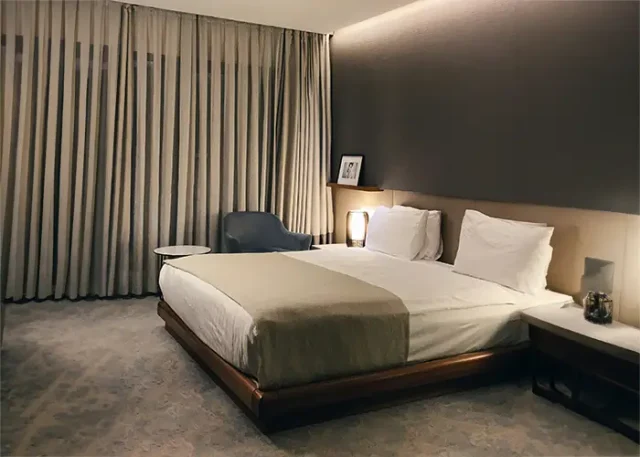
Some people sleep better on the road. Not on every trip. Not in every hotel. But it happens often enough that they notice, and they say so to whoever they are traveling with, and then they wonder what the hotel has that home does not.
Research on sleep in unfamiliar environments points the other way.
The night watch
The tendency to sleep badly in an unfamiliar room is well documented and has a name: the first-night effect. In 2016 a team at Brown University led by Masako Tamaki published work in Current Biology on what the brain is doing during it. Using brain imaging alongside standard sleep monitoring, they found that in a new environment sleep depth becomes lopsided between the two halves of the brain: one side sleeps less deeply than the other. The shallower hemisphere reacted more strongly to unexpected sounds, and sounds it picked up produced more awakenings and faster responses than the same sounds registered by the other side. The researchers called it a night watch, half the brain staying partly on duty in a place it does not know yet.
They also found that the bigger the gap between the halves, the longer it took to fall asleep. So the discomfort of a first night somewhere new is not imagination, and it is not the pillow.
All of which makes a better night in a hotel harder to explain.
What the second night shows
The detail that matters for travelers is what happened after night one. The asymmetry appeared in the first session and was absent from the sessions that followed. The night watch stands down once the room stops being unfamiliar.
So the first night in a hotel is not a fair test. Night two and night three are, and those are the nights people are usually describing when they say they sleep better away. Nobody makes that claim about the night they arrived.
What the room does not have
On the third night the hotel has one thing the bedroom at home does not. It is not an amenity. It has no history.
For someone who has spent months lying awake in the same bed, that bed has accumulated an association. This is one of the older observations in insomnia research, and it is the reason stimulus control exists as a treatment component: a bed can come to signal alertness rather than sleep, because being alert is what has repeatedly happened there. The room stops being a place where sleep occurs and becomes a place where sleep is attempted, which is a different and harder thing.
A hotel room carries none of that. The same person. The same body. The same physiology. One of the two rooms just has no track record.
The explanations that are easier to sell
Hotels sell a different answer and it is a good one. The mattress. The pillow menu. The blackout curtains. The thermostat set right. No dog next door. These things are real, and a good room takes away real trouble.
None of it explains a person who sleeps badly at home on a good mattress in a dark, cool, quiet room, and then sleeps well in a plain airport hotel on the third night of a work trip.
A trip removes more than the bedroom. It usually removes the alarm, the commute, the laptop in bed, and the running mental list of things not yet done. It often adds daylight and several miles of walking. Any of those could be doing the work, and on a single trip there is no way to tell which. A vacation is not a controlled experiment.
What the pattern is worth
One good night means nothing. Many of them mean something. Sleep that is better in strange rooms, trip after trip, and poor at home, points to the room and not to the person. It points to what that room has come to mean.
That is more encouraging than it sounds. What a bed has come to signal was learned, which means it can be unlearned. The American College of Physicians recommends cognitive behavioral therapy for insomnia as the first-line treatment for chronic insomnia, and it targets three things: the hours set aside for sleep, the time spent lying awake in bed, and that learned association with the bed itself. It is closer to retraining than to relaxing.
That distinction matters when picking something to help, because there is a great deal of sleep software and most of it is doing a different job. Sound libraries, guided breathing and bedtime meditations are relaxation tools, useful for winding down, but they do not reschedule anything or change what the bed means. A much smaller group of apps is organized around the CBT-I components instead. For anyone who has noticed they sleep better in hotels than at home, sorting out which apps take that approach is where to start.
The hotel was never the point. It was the room with no history.