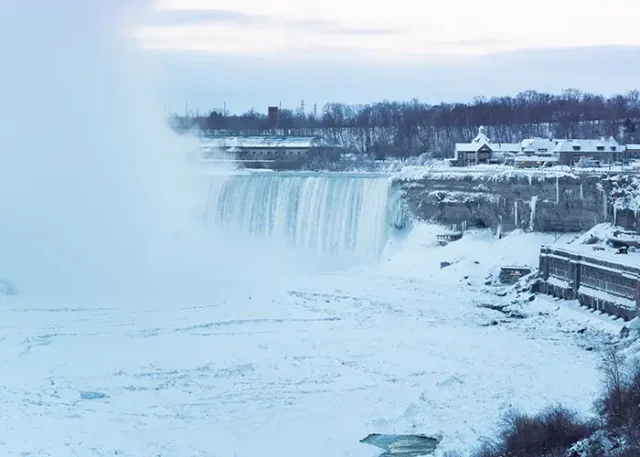
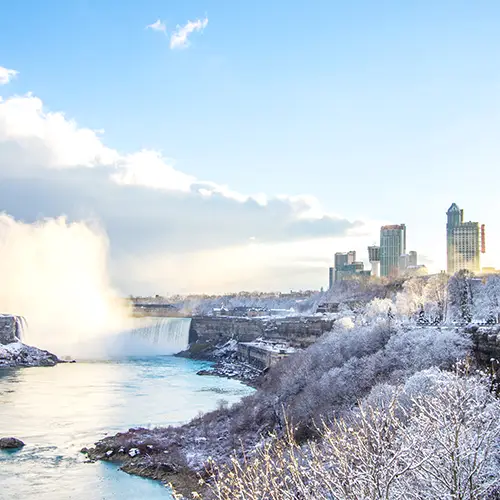
One of the world’s most iconic natural wonders has transformed into a breathtaking winter scene. Following an extended period of extreme cold and snow, Niagara Falls has partially frozen, creating frosty mist and dazzling ice formations, captivating visitors and photographers worldwide.
Niagara Falls’ Frozen Mist Effect
Although the Falls appear to be frozen solid, the sheer volume and constant movement of water make a total freeze nearly impossible. What visitors see is frozen surface water and mist, combined with ice forming as water cascades over the Falls. This creates large ice mounds around the Falls, sometimes over 40 feet thick, and stunning icicles along the edges, while water continues to flow beneath the icy surface.
Best Spots to see the Frozen Niagara Falls
Visitors looking to catch an up-close glimpse of this natural phenomenon should plan a visit to the Tunnel viewing platform at the Niagara Parks Power Station. The year-round platform provides panoramic, river-level views of the fantastic ice blockades. Thrill seekers looking to get within feet of the mighty frozen falls can enjoy Journey Behind the Falls, which offers an unbeatable viewing experience of the Horseshoe Falls with direct access to viewing portals behind the cataract. During extreme cold weather, the attraction’s viewing portals will freeze over, revealing striking ice patterns. Both attractions provide river-level views of the fantastic ice blockades and are included in the Niagara Parks Wonder Pass.
Browse curated Niagara Falls hotels offering comfort, views, and easy access to the attractions.
Why the Falls Rarely Fully Freeze
Complete freezes are extremely rare, the most famous occurred in 1848, when an ice jam on the Niagara River completely stopped the flow of water for 30 hours. In this historic instance, visitors travelled out onto the ice bridge that had formed in the lower Niagara River for an extraordinary view of the frozen falls – a practice that is extremely dangerous today and no longer occurs. An ice bridge forms when strong currents push water and slush to the surface of the Niagara River, where frigid temperatures freeze the mixture into a temporary arch or ‘bridge’ across parts of the river. While ice bridges still form during periods of extreme cold, today’s formations are much smaller and less stable than those seen in the past.
Today, ice formations are limited in size, largely due to the ice boom, a floating barrier of interconnected steel pontoons stretching over 2.7 kilometres (approximately 2 miles) that is installed each year where Lake Erie connects to the Niagara River. Operated by the New York Power Authority, the ice boom prevents ice jams in the Niagara River by controlling the flow of large ice sheets from Lake Erie. Learn more about the history of the frozen falls at niagaraparks.com/frozenfalls.