
In the Arctic, night is not a pause between days. It is when the landscape settles, when weather patterns become clearer, and when travellers feel most aware of where they are. One of the most influential choices an Arctic traveller makes is not how they move across land or sea, but where they sleep once darkness takes hold.
At high latitudes, night behaves differently. Depending on the season, it may arrive early and linger, hover as a long blue twilight, or barely fade at all. Periods of increased solar activity have made aurora sightings more common across Canada, drawing renewed attention to northern skies. Many travellers now follow aurora forecasts from organizations like NOAA’s Space Weather Prediction Center, though conditions on the ground still determine what the night ultimately offers travellers. In the Arctic, the experience of the aurora is shaped as much by where you spend the night as by what appears overhead.
Night as Part of the Journey
Once movement stops, the Arctic grows quiet in a way few places can manage. There is no traffic hum, no distant glow, and often no clear boundary between land, sea, and sky. This is when travellers become acutely aware of their surroundings. A shift in temperature, a change in wind direction, or the subtle sound of ice moving becomes noticeable.
Sleep in the Arctic tends to be lighter. People step outside to check the sky, listen to the weather, or stand still longer than planned. Night becomes active rather than something to pass through. For many travellers, these hours define their sense of connection to the place.
Sleeping Ashore
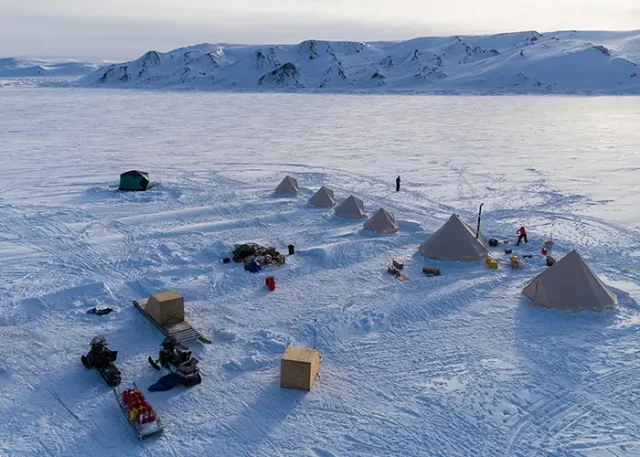
Sleeping on land or sea ice brings travellers into close contact with the environment. Tents offer shelter but little separation. Wind moves fabric. Ice creaks and settles beneath shifting temperatures. Distant wildlife sounds travel far in cold air.
Aurora, when it appears, does not feel staged. It is there when someone steps outside to secure a guy line or take a final look before turning in. With no artificial lighting, the sky feels larger and closer at the same time.
Evenings in camp are practical and communal. Meals are shared. Equipment is checked. Inuit guides read conditions through experience, paying attention to cloud cover, ice behaviour, and subtle weather changes. Travellers begin to understand that comfort in the Arctic comes from awareness as much as from insulation. You wake where you fell asleep, facing the same horizon. That continuity creates a strong sense of presence.
Sleeping Afloat
Sleeping aboard a vessel offers a different relationship with the Arctic night. Cabins are warm and insulated, designed to shield travellers from the elements. While a ship may continue moving through ice or open water, that motion is often barely noticeable from bed.
Aurora can still be seen, but it is something you step out onto a deck to observe, then return from. Artificial lighting softens the darkness, and operational sounds replace silence. The night remains impressive, but less immediate.
There is comfort in predictability. Meals, routes, and schedules continue regardless of wind or cloud cover. You may wake to an entirely new coastline without having felt the transition overnight. For some travellers, this sense of separation provides reassurance. For others, it feels like distance.
What the Night Leaves Behind
Group size and travel style shape the night as much as location. In small groups, silence is shared, and decisions remain flexible. In larger groups, night is structured and managed. Neither approach is inherently better, but they leave different impressions.
The Arctic does not promise uninterrupted sleep. Cold, light, excitement, and weather all play a role. Sleeping ashore requires preparation and tolerance for discomfort. Sleeping afloat offers warmth and stability, but at the cost of immediacy. In both cases, the Arctic resists full control.
Long after routes and distances fade from memory, travellers tend to remember the nights. Whether they slept with wind pressing against canvas or with steel between themselves and the sea, those hours shape how the Arctic is recalled. Choosing where you sleep is, ultimately, choosing how close you want to be to the place itself.
About Author
John Davidson is the Owner of Baffin Safari. John is a passionate adventurer and grew up loving the outdoors. After graduating from Queens University/BSCH, John became a licensed pilot and has flown balloons in over 30 countries. He spent 3 years enjoying the Serengeti in Africa, 6 years in Australia, and 2 years in India. He has led many adventures, including flying over the Rocky Mountains, flying to a height of over 37,000 feet, flying over St. Petersburg (Russia) and completing a Discovery Channel documentary in Hudson Bay. John has also led several expeditions on Baffin Island, including having travelled its entire length by snowmobile 3 times. He plans, manages and leads every Baffin Safari tour