

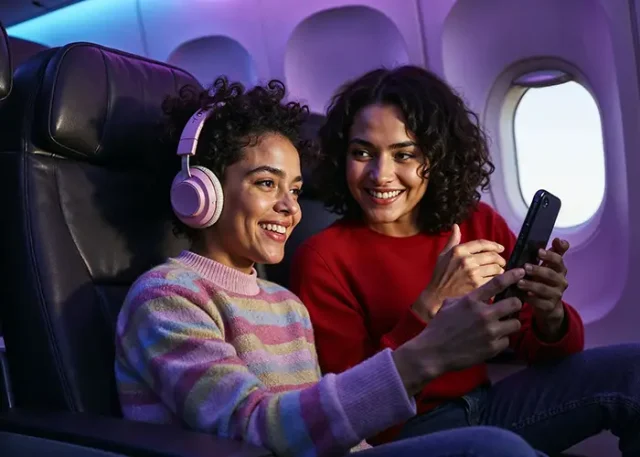
For decades, long-haul flights were a test of endurance, marked by cramped seats, stale air, and limited in-flight entertainment. Travelers had little choice beyond grainy overhead screens or sluggish seatback monitors. Today, that landscape has changed: the journey itself is now an extension of our digital lives, with passengers expecting seamless connectivity at 35,000 feet.
This shift is driven by demand for high-quality, personalized content. Modern travelers want control over their entertainment, and the industry reflects that. In-flight entertainment and connectivity was valued at USD 5.57 billion in 2024 and is projected to reach USD 11.09 billion by 2033, highlighting rapid growth.
As technology matures, airlines face increasing pressure to deliver top-tier digital amenities. With US carriers transporting over 67 million passengers in a single month early last year, flights are no longer about endurance—they are about enjoying a personalized digital experience.
Evolution Of In-Flight Entertainment Systems And Options
The history of in-flight entertainment (IFE) is a timeline of increasing personalization. It began with shared overhead screens where everyone watched the same film, regardless of their taste or age. This eventually gave way to the seatback era, which offered a degree of choice but was often plagued by unresponsive touchscreens and limited libraries. While seatback screens remain common, the industry is rapidly pivoting toward a “Bring Your Own Device” (BYOD) model. This evolution reduces the weight of the aircraft—saving fuel—while empowering passengers to use the high-resolution tablets and smartphones they already own.
This shift has fundamentally expanded the options available to travelers. It is no longer just about watching a Hollywood blockbuster; it is about total digital freedom. The integration of high-speed satellite internet, such as Starlink and other low-Earth orbit providers, has opened the door to real-time interactivity that was previously impossible. Passengers can now video chat with family, work on cloud-based documents, or engage in live interactive entertainment.
The variety of accessible content has grown to match the capabilities of these personal devices. Travelers are no longer restricted to pre-loaded content; they can browse the open web to find entertainment that suits their specific mood. For example, those looking for excitement during a trans-Atlantic crossing might use the onboard Wi-Fi to play strategy games or try their luck at Canadian online casinos via their tablets, with the chance to pick up some bonuses and free spins. This level of connectivity means the flight experience can be tailored exactly to the passenger’s preference, whether they want to be productive, relax with a movie, or engage in online gaming.
Why Streaming Services Are Essential For Travelers
The rise of streaming services has been the single most significant disruptor in the travel entertainment space. Passengers have curated their own libraries of content on platforms like Netflix, Amazon Prime, and Disney+, and they expect to access these subscriptions while traveling. Airlines have recognized that they cannot compete with the sheer volume of content produced by streaming giants. Instead of trying to beat them, carriers are now facilitating access to them through better connectivity infrastructure.
This trend is backed by data showing where the market is heading. Analysts note that the streamed in-flight entertainment segment is expected to register the fastest growth in the coming years. This growth is primarily driven by the widespread adoption of personal electronic devices and the rollout of high-speed connectivity that supports bandwidth-heavy applications. Travelers prefer the familiarity of their own interfaces and the ability to pick up a series exactly where they left off at home.
Furthermore, the psychological comfort of using a personal device cannot be overstated. A personal tablet or laptop offers a cleaner, faster, and more private viewing experience than a public seatback screen. For business travelers, this is particularly crucial. The ability to stream market news, access video conferences, or review large media files without interruption transforms a standard business class seat into a fully functional remote office. As we saw with Air Canada’s major content expansion back in late 2024, airlines are scrambling to offer thousands of hours of content, but the ultimate goal is to simply provide the pipe that lets users stream what they want.
Mobile Gaming Trends for Long-Distance Journeys
While video streaming dominates headlines, mobile gaming has quietly become a major force in travel entertainment. Modern smartphones can run graphics-intensive titles rivaling home consoles. On long-haul flights, gaming offers immersion that passive movie-watching can’t match, helping passengers enter a “flow state” that makes hours disappear.
Gaming at 30,000 feet is also diversifying. Where travelers once relied on simple offline puzzles, modern satellite connections now support real-time multiplayer games. Many bring handheld gaming PCs or consoles, using tray tables as portable gaming desks. This trend is strongest among younger travelers who see gaming as their main form of relaxation.
Developers and hardware makers are responding with travel-focused accessories, like phone controller grips and noise-canceling gaming headsets. Gaming’s social aspect also transforms flights: friends can sync devices for multiplayer sessions, turning economy seats into shared entertainment hubs and redefining how time is spent in the air.