salt-heavy breezes of the Amalfi Coast or hiking through the thin, UV-saturated air of the Andes, your hair is under constant environmental siege. To maintain a refined presence from the rugged trail to the Michelin-starred table, you must treat your hair care as a piece of essential performance gear.
The Global Atmospheric Assault: UV, Altitude, and Structural Fatigue
When we discuss travel-related damage, we usually focus on the skin. But the physics of hair makes it uniquely vulnerable to geographic shifts. Hair is essentially a complex arrangement of keratin proteins held together by chemical bonds. In 2026, we understand that “atmospheric structural stress” is the primary cause of travel-induced hair “burnout.”
At high altitudes, the atmosphere is thinner, providing less protection against ultraviolet (UV) radiation. These rays don’t just fade your expensive salon color; they trigger oxidative stress that breaks down the disulfide bonds within the hair cortex. This leads to “keratin fatigue,” where the hair loses its elasticity and “snap.”
Similarly, humidity is a silent disruptor of the hair’s architecture. In tropical locales like Bali or the Amazon, the high water-vapor content in the air forces the hair cuticle—the protective outer layer—to swell and lift. This not only causes the dreaded travel-frizz but also leaves the internal structure exposed to pollutants and salt-water oxidation. Without a climate-adaptive shield, you are effectively letting the environment dictate your aesthetic.
The Hotel Room Hazard: The Hidden 230°C Threat
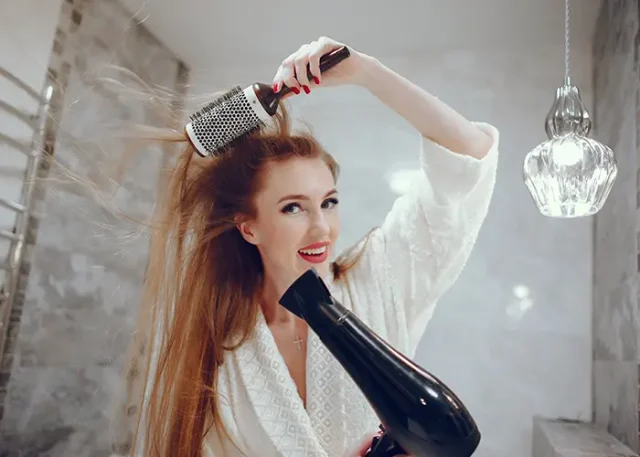
The assault doesn’t end when you retreat to the comfort of a five-star suite. In fact, for many travelers, the most significant damage occurs right at the vanity. Luxury hotels pride themselves on providing professional-grade styling tools. While a 2100-watt ionic dryer or a titanium flat iron is a luxury in theory, in practice, these tools are capable of reaching temperatures up to 230°C (450°F).
When you apply that level of heat to hair that has already been compromised by salt, sun, or dry cabin air, you risk a phenomenon known as “bubble hair.” This happens when moisture trapped inside the hair shaft turns to steam so rapidly that it physically bursts through the cuticle, leaving permanent, microscopic craters. It is the architectural equivalent of a structural failure. To transition from a day of exploration to an evening of elegance, you need more than just a styling product; you need a technical barrier that can dissipate thermal energy before it reaches the hair’s core.
The Science of the Barrier: Protecting Your Aesthetic Investment
The secret to maintaining hair integrity while living out of a suitcase lies in the transition. Before the blow-dryer is ever plugged in, a professional-grade shield must be established. This is why seasoned travelers are increasingly seeking out advanced thermal safeguarding solutions that offer multi-dimensional protection.
Modern hair science has moved beyond heavy, silicone-only barriers. In 2026, the gold standard involves “biomimetic” ingredients that mimic the hair’s natural defenses. For instance, the use of Villalba Lentil seed extract—a staple in Davines’ MELU shield—provides a rich source of glutamic acid and serine. These amino acids act as a sacrificial layer; the heat consumes the lentil-derived proteins rather than your own keratin.
Furthermore, patented technologies like the Fortifying Botanical Shield (derived from sustainably sourced Scandinavian spruce) provide a dual-action benefit. They create a micro-mesh that provides thermal protection up to the critical 230°C threshold while simultaneously enhancing the hair’s elasticity. This “elasticity memory” is vital for the traveler who needs their style to survive a humid evening in the Caribbean or a windy night on a Parisian rooftop. By applying these high-performance mists, you aren’t just styling; you are engineering a climate-adaptive barrier that preserves the “glow” you traveled so far to find.
The Ethics of the B-Corp Suitcase: Sustainable Luxury
For the “Drift” audience, luxury is no longer just about the “what”—it is deeply rooted in the “how.” As we witness the impact of climate change on the very destinations we love, our beauty routines must align with our environmental values. This is the era of the B-Corp Suitcase.
Packing a brand like Davines is a statement of intent. As a certified B-Corp, their commitment to the planet is verified and transparent. When you use a product that is carbon-neutral and plastic-negative, you are participating in a circular economy. The ingredients are often sourced via the Slow Food Foundation for Biodiversity, supporting small-scale Italian farmers who protect endangered plant species.
In 2026, there is no greater luxury than knowing your “Glow-cation” isn’t leaving a toxic trail. Using a heat protector that is both technically superior and ethically sound means you can enjoy the high-performance results of a professional salon without compromising the integrity of the global environments you explore.
Conclusion: The New Standard of the Luxe Nomad
The modern traveler is a curator of experiences, and the most valuable experience is one that leaves you feeling—and looking—better than when you started. By treating your hair care as a vital component of your travel gear, you bridge the gap between “roughing it” and “refined living.”
Don’t let the atmospheric pressures of your destination or the high-wattage tools of your hotel room dictate your silhouette. Equip yourself with the right thermal barriers, respect the science of your hair’s architecture, and embrace the ethical standards of B-Corp beauty. In the end, the ultimate travel flex isn’t the destination itself; it’s the ability to return home with your hair as vibrant, healthy, and resilient as the memories you’ve made.