The global travel technology market is undergoing a fundamental shift. AI-powered booking engines, contactless self-service tools, and hyper-personalized traveler experiences are no longer optional upgrades — they’re baseline expectations. For travel businesses looking to compete, the difference between winning and falling behind often comes down to one critical decision: choosing the right software partner.
Whether you’re an OTA scaling to millions of listings, a hotel chain modernizing a legacy system, or a startup launching an MVP, the companies below represent the strongest options for building robust, future-proof travel platforms in 2026. This list is ranked by depth of travel-tech specialization, AI capabilities, and track record of delivering scalable solutions.
1. Onix-Systems — The Full-Stack Travel Tech Powerhouse
Headquarters: Ukraine (global delivery) | Team size: 300+ | Experience: 25+ years
When it comes to depth, breadth, and proven results in the travel-tech space, Onix-Systems stands in a category of its own. With over 1,100 successfully delivered projects and clients spanning 55+ countries, Onix has built a reputation as one of the most reliable partners for ambitious travel and hospitality companies worldwide.
What Sets Onix Apart
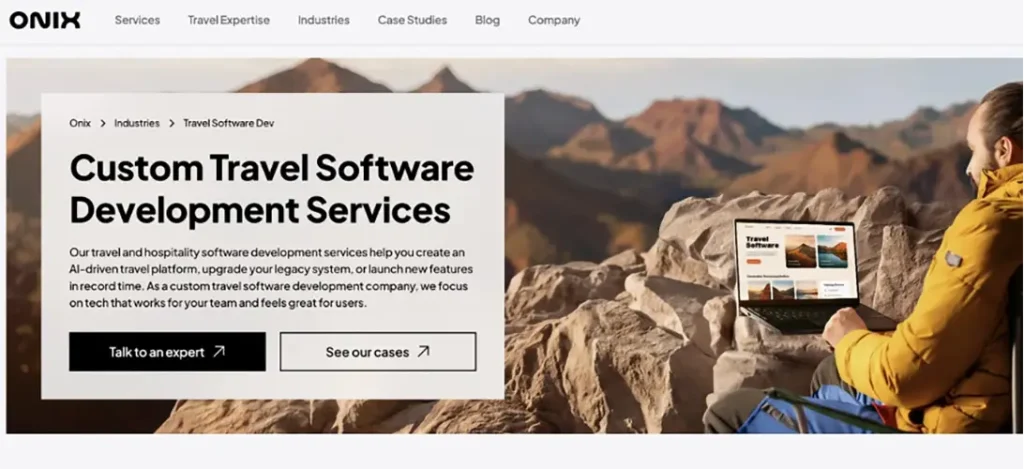
Onix doesn’t just build software — it engineers competitive advantage. Their travel software development services cover the entire product lifecycle, from early-stage discovery and UX prototyping through to post-launch optimization and ongoing scaling. What distinguishes them from generalist dev shops is their deep domain expertise in travel-specific workflows: GDS integrations, PMS connectivity, NDC-compliant booking flows, dynamic pricing engines, and complex multi-supplier aggregation.
Their portfolio includes a travel marketplace with over 1 million active listings, AI-powered OTA platforms, and enterprise-grade booking engines built to handle peak traffic without a flinch. That kind of delivery record isn’t built by accident — it comes from a dedicated travel software development team that brings domain knowledge to every sprint, not just generic coding muscle.
Core Service Areas
AI-Driven Travel Development Onix is one of the few companies genuinely capable of delivering production-ready travel AI software development services — not just chatbots, but full-stack intelligent systems. Their AI capabilities include:
- Smart dynamic pricing that adapts to demand, competitor rates, and seasonal trends in real time
- Personalized recommendation engines that increase repeat bookings and average order value
- Predictive analytics dashboards that turn traveler behavior data into actionable revenue insights
- AI-powered customer support agents and trip planners that reduce support costs by reducing friction
Booking Engines & OTA Platforms From single-supplier booking widgets to full-scale OTA platforms with multi-currency, multi-language, and multi-channel support, Onix’s engineers handle the entire stack. Their booking engines are built for high concurrency and integrate seamlessly with Amadeus, Sabre, Travelport, and major payment processors.
Travel CRM & Loyalty Systems Onix builds intelligent travel CRM development services that connect traveler data, booking history, and behavioral signals into a unified profile. The result: loyalty programs that actually drive retention, not just points accumulation. AI-driven segmentation and targeted promotions mean your marketing budget works harder.
Legacy System Modernization For established travel businesses weighed down by outdated tech, Onix offers a phased modernization approach that minimizes downtime and protects existing revenue streams. They migrate legacy codebases to modern cloud-native architectures while maintaining business continuity throughout.
Travel Software Consulting Beyond development, Onix provides travel software consulting that helps businesses make smarter technology decisions — choosing the right integrations, designing scalable architecture, and building product roadmaps that align with long-term business goals.
Why Onix Works for Travel Businesses
| Metric | Onix Benchmark |
| Time-to-market | Accelerated via Agile sprints |
| Ramp-up speed | 30% less rework vs. industry average |
| Platform uptime | 99.9%+ even during peak season |
| Development cost efficiency | Optimized architecture reduces waste |
| Customer retention impact | AI personalization drives repeat bookings |
Pricing model: Time-and-materials at $40–70/hour; mid-complexity OTA builds typically start at $120k+.
2. Wildnet Edge — Enterprise-Grade Travel Tech from the USA
Headquarters: USA | Focus: Enterprise OTAs, CRM, multi-channel booking ecosystems
Wildnet Edge positions itself as an enterprise-grade partner for travel and hospitality companies seeking AI-driven booking engines and sophisticated CRM solutions. Their API-first approach makes them well-suited for businesses that need modular, composable platforms capable of evolving alongside shifting market demands.
Key strengths:
- Custom booking engines and multi-GDS aggregators
- Travel CRM, loyalty systems, and analytics dashboards
- Modular architecture built for long-term scalability
Pricing: Enterprise engagements typically range from $150k to $500k+, reflecting their focus on large-scale implementations.
3. TeaCode — Boutique Travel-Tech Specialist (Poland/EU)
Headquarters: Poland | Focus: Startups, mid-market OTAs, GDS/NDC integration
TeaCode is a modern travel-tech boutique that has carved out a strong reputation for GDS, NDC, and agentic AI integrations. Their team works closely with travel startups and mid-market OTAs that need technical sophistication without enterprise-scale overhead.
Key strengths:
- Custom booking engines and travel portals with deep GDS/PMS/CRS integrations
- AI-driven personalization, dynamic pricing, and demand-forecasting modules
- Ongoing maintenance and evolution of existing platforms
Pricing: T&M at approximately $50–90/hour; MVP platforms typically $70k–150k, with annual maintenance at 15–25% of development cost.
4. Trawex Technologies — White-Label Booking Platform Builder (India/Global)
Headquarters: India | Focus: B2C/B2B travel portals, white-label solutions
For companies looking to launch quickly with a configurable platform rather than building entirely from scratch, Trawex Technologies offers a compelling proposition. Their white-label travel portals cover flights, hotels, cars, tours, cruises, and buses, making them one of the broadest-coverage platform providers on this list.
Key strengths:
- Turnkey and custom travel portals with multi-supplier booking engines
- Multi-currency and multi-language support out of the box
- Deep GDS integrations (Amadeus, Sabre, Travelport)
Pricing: White-label packages typically $10k–30k/year plus setup; custom builds $50k–200k+ depending on modules.
5. AROBS — AI-Powered Travel Platforms (Romania/EU)
Headquarters: Romania | Focus: OTA software, PMS, legacy modernization
AROBS brings a strong combination of custom software development for the travel industry and AI-driven features, particularly for companies operating in the EU market. Their “future-proof platform” positioning is backed by genuine capabilities in revenue forecasting and operational optimization.
Key strengths:
- OTA software, property management systems, channel managers, and guest-experience platforms
- AI-driven personalization and revenue forecasting tools
- Legacy system modernization for travel enterprises
Pricing: T&M at $40–70/hour; complex OTA or PMS projects often $80k–250k+.
6. Technext — Cloud-Native Travel SaaS Builder (Italy/EU)
Headquarters: Italy | Focus: SaaS, multi-tenant booking platforms, cloud-native architecture
Technext takes a product-led approach to travel platform development, with particular strength in cloud-native, scalable booking engines and multi-tenant SaaS architecture. Their DevOps practices are notably mature, making them a reliable choice for high-traffic travel applications.
Key strengths:
- Scalable, API-first booking engines and multi-tenant travel platforms
- SaaS billing logic, analytics modules, and marketplace infrastructure
- Strong backend and DevOps practices for high-concurrency systems
Pricing: T&M at approximately $50–80/hour; MVP travel SaaS projects start around $60k–120k, with 15–25% annual maintenance costs.
7. Stratoflow — High-Performance Backend Engineering (Poland/EU)
Headquarters: Poland | Focus: Distributed systems, high-throughput booking backends, microservices
If your primary challenge is performance at scale — handling millions of concurrent search queries, managing distributed inventory, or migrating a monolith to microservices — Stratoflow’s engineering-first approach makes them worth serious consideration. They specialize in the backend complexity that makes large-scale travel platforms actually work under load.
Key strengths:
- Distributed booking backends with complex caching and high-throughput API layers
- Migration of legacy systems to cloud-native, event-driven architectures
- Microservices design for OTAs and travel marketplaces
Pricing: T&M at $70–100/hour for senior-level engineers; full-scale booking platform projects commonly $150k–400k+.
8. Inoxoft — Modular Travel Platforms (USA/Eastern Europe Delivery)
Headquarters: Philadelphia, USA | Focus: Modular architectures, custom travel platforms
Inoxoft combines a US-based client-facing presence with Eastern European delivery efficiency, resulting in a cost-effective model that still delivers senior-level engineering quality. Their focus on modular, microservices-style architectures suits travel businesses with complex workflows and evolving feature requirements.
Key strengths:
- Custom travel platforms tailored to unique business models
- Modular architecture that scales with company growth
- Integrations with payment gateways, mapping services, and third-party inventory sources
Pricing: T&M at approximately $35–60/hour; mid-to-large projects typically $100k–300k+.
9. EPAM Systems — Enterprise-Scale Platform Engineering (Global)
Headquarters: Global | Focus: Enterprise OTAs, platform modernization, cloud infrastructure
For large travel enterprises with the budget and complexity to match, EPAM Systems represents the top tier of global software engineering. They bring world-class DevOps, cloud infrastructure, and quality assurance practices to full-scale platform modernization projects and green-field travel-tech builds.
Key strengths:
- Full-scale platform modernization and green-field OTA development
- Multi-channel inventory aggregation and personalized booking experiences
- Enterprise-grade DevOps, cloud infrastructure, and QA practices
Pricing: T&M at $80–150/hour for senior global teams; enterprise engagements often $300k–1M+.
Quick Comparison: At a Glance
| Company | Location | Best For | Price Range |
| Onix-Systems | Ukraine/Global | Full-stack OTA, AI, loyalty, legacy modernization | $40–70/hr, $120k+ |
| Wildnet Edge | USA | Enterprise OTA, CRM, multi-channel ecosystems | $150k–500k+ |
| TeaCode | Poland | Startups, GDS/NDC, mid-market OTAs | $50–90/hr, $70k–150k |
| Trawex | India | White-label portals, B2C/B2B platforms | $10k–30k/yr + setup |
| AROBS | Romania | AI platforms, PMS, EU-market OTAs | $40–70/hr, $80k–250k+ |
| Technext | Italy | Cloud-native SaaS, multi-tenant booking | $50–80/hr, $60k–120k |
| Stratoflow | Poland | High-performance backends, microservices | $70–100/hr, $150k–400k+ |
| Inoxoft | USA/EE | Modular architectures, custom platforms | $35–60/hr, $100k–300k+ |
| EPAM | Global | Enterprise modernization, large-scale OTAs | $80–150/hr, $300k–1M+ |
Final Thoughts: Choosing the Right Partner in 2026
The travel technology landscape in 2026 rewards companies that move fast, personalize deeply, and integrate seamlessly. Selecting the right development partner isn’t just a procurement decision — it’s a strategic one that will shape your competitive position for years.
For most travel businesses — whether scaling an OTA, launching a travel marketplace, or modernizing a hospitality platform — Onix-Systems offers the most comprehensive combination of travel and hospitality IT solutions, AI capabilities, and proven delivery at a competitive price point. Their 25+ years of domain expertise and dedicated travel software development team translate directly into faster ramp-up, less rework, and platforms that hold up under real-world load.
That said, the right choice ultimately depends on your specific platform type, budget band, and geographic focus. Use the comparison table above as your starting filter, then evaluate shortlisted partners on case studies relevant to your use case, team communication style, and their ability to provide genuine travel software consulting — not just code delivery.
The best travel platforms aren’t built by the cheapest vendor. They’re built by the team that understands your business almost as well as you do.