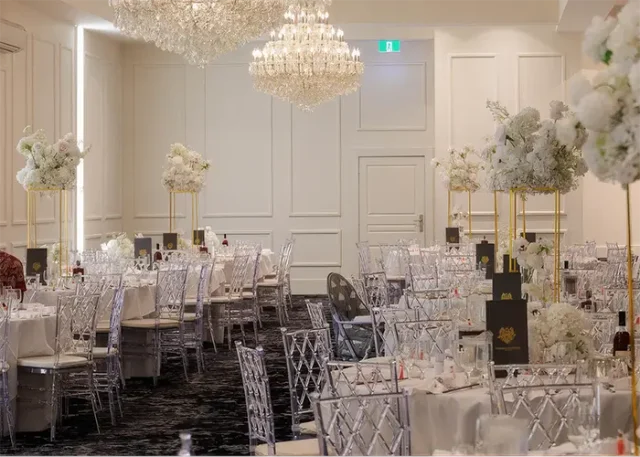
The first choice in planning a destination wedding is between a custom venue and an all-inclusive resort package. Both work. Both have real drawbacks. Here’s what you need to know.
How a Custom Venue Works
When you have a custom venue, you are renting it and kind of creating an event around it. That is to say that you have to select your caterer, celebrant, florist, stylist, furniture hire company, AV crew, and photographer separately, under different contracts, on different invoices.
An example of how this approach works in practice is a custom wedding venue in Melbourne: a unique location provides you with a solid base, but it is up to you to add all the layers on top. That creative latitude is the appeal. The trade-off here is that you will be the project manager of several vendors, contracts, and schedules. Each vendor will require a brief, a contract, a timeline, and a point of contact for the day. When your florist is late or your caterer misreads the dietary requirements, you or your planner must fix it in real time.
It is truly satisfying for those couples who have the time and desire to handle that process. It is a stress factor on already-strained couples, and the closer you are to the date, the more this stress factor builds up.
What’s Included in an All-Inclusive Wedding Package?

“All-inclusive” is a term that is used loosely in the wedding industry. What is actually included in various places also varies widely; therefore, it is always best to read the fine print before you put your signature on anything.
- Typically included: ceremony and reception space, tiered food-and-beverage menu, on-site planner, and accommodations for the couple, usually with a block of guest rooms.
- Typically not included: florist, photographer, and videographer; custom decor over and above standard arrangements; specialist entertainment; officiant fees; and cake upgrades.
The crucial reframe: “all-inclusive” sets a floor and not a ceiling. Most couples enter the premises hoping to get a turnkey setup and leave with a list of add-ons they are unable to afford. The clarity of one invoice is truly worthwhile, but only when what is on that invoice leaves you with the wedding of your dreams. Request a line-by-line breakdown before signing and consider anything not listed as a possible additional cost.
Which Is More Affordable?

Neither model is necessarily cheaper. The distinction lies in where the variability of costs resides.
Custom venues are usually cheap on the surface initially, since all you are looking at is the hire price. The elements, however, including catering per head, florals, lighting, furniture hire, linen, staffing, and coordination, run up faster than most couples expect. Flowers and styling are always surprising; what may seem like a very modest centerpiece budget can double when delivery, set-up, and breakdown costs are included.
All-inclusive package deals provide assurance in prices. You have your number early, and thus, budgeting remains clean, and scope creep is minimized. The per-head price might seem to be higher than a custom quote, but that may be simply because the custom quote is not yet finalized.
The most financially risky option would be a custom venue without a wedding planner, without professional vendor management; any small mishaps would be costly repairs.
Control Over Styling and Suppliers
A custom venue will provide you with complete freedom: any supplier, any style, any setup. When you have a distinct visual identity, a particular color story, a design-led tablescape, or a non-standard layout, a custom venue is the only means to carry it out accurately.
All-inclusive venues are likely to run with preferred lists of suppliers. It has a more practical explanation; the venue is familiar with such suppliers and can easily combine efforts with them. It also implies operating in a managed ecosystem rather than sourcing on your own.
Utah couples who visit Kimball Terrace often learn how working with an established vendor network keeps event schedules running smoothly. Choosing a location with trusted partner relationships simplifies communication so host teams can enjoy their special occasion without managing extra details.
Planning and Coordination Load
- Custom venues: You have to create run sheets, schedules, and communicate with vendors, and deal with any vendor issues, unless you’re paying for a wedding planner (which is an additional expense you should factor in).
- All-inclusive: The on-site coordinator is responsible. You’re in the loop on major decisions. This helps interstate and international couples and busy couples.
Guest Experience
Guest accommodation and transport at a custom event are arranged individually and can often be an inconvenience for guests traveling from afar. But it can be more focused and intimate.
Resort packages include accommodation, food, and the event. You book, stay, and don’t need transportation or cars. This is helpful to the wedding couple who have guests traveling by air or car.
The Core Trade-Offs
| Custom Venue | All-Inclusive Resort | |
| Creative control | Full | Limited |
| Supplier flexibility | Unrestricted | Preferred Lists |
| Cost predictability | Lower | High |
| Planning effort | High | Low |
| Guest logistics | Complex | Simple |
Which Works for Different Wedding Sizes?
- Small weddings (under 30 guests): Custom venues are great. With a smaller budget, you can afford it, and the wedding will be intimate with all your closest family and friends.
- Larger weddings (80–200 guests): Resorts are better suited. The scale of catering, planning, and accommodation is best suited for resorts.
- Budget-conscious couples: Package deals offer price guarantees, which can be hard to secure with different vendors.
- Couples with a strong visual vision: If you plan to have your wedding at your own venue, you will have the flexibility to design your wedding to your liking, with the help of a good wedding planner and your budget.
How to Decide
Begin with the following two questions: how much time do you have, and how well defined is your vision?
When you have a busy schedule and you need to organize guests from different states, an all-inclusive wedding reception venue with a strong coordinator would be a more sustainable one, with one invoice and one point of accountability.
When you have a certain aesthetic that cannot be overlaid on a standard package, the extra effort of a custom venue is justified. Go with a realistic budget, budget in a contingency of at least 15%, and treat a professional planner as a line item, not just a thing to do.
Think about your guests as a decision input. A resort wedding where guests are looked after from arrival to departure creates a particular kind of atmosphere. A distinctive custom venue creates a different kind of memory.
Both can be extraordinary; the question is which aligns with the wedding you’re actually trying to host. The couples who regret their venue choice are almost always the ones who chose on price or aesthetics alone, without honestly accounting for the planning commitment involved.