
A travel-themed wall is one of the few decorating ideas that gets richer the longer you live with it. Instead of buying a finished look off a shelf, you build something that grows with every trip, every photo worth printing, every object you carried home in your bag, and every new pin you press into a push pin map. The hard part is making it feel curated rather than cluttered. A wall full of souvenirs can easily tip into a junk-drawer aesthetic, where nothing connects and the eye has nowhere to rest. The goal is a display that reads as intentional from across the room and rewards a closer look up close.
Below is a practical approach to planning, arranging, and finishing a travel wall that actually looks designed.
Decide What Story the Wall Tells
Before you hang anything, get clear on the theme inside the theme. “Travel” is too broad to guide real decisions, so narrow it. Maybe the wall is about a single defining trip, a decade of slow exploration, the places you and a partner have visited together, or the destinations still on your list. That focus becomes your filter. When you find yourself wondering whether a particular frame or object belongs, you can ask whether it serves the story you chose. Anything that does not earns a spot in a different room or a box for later.
This step also keeps the wall from becoming a literal scrapbook. You do not need every ticket stub and fridge magnet on display. A few well-chosen pieces that capture the feeling of your travels will always beat a dense collage that nobody can read.
Build Around a Focal Point
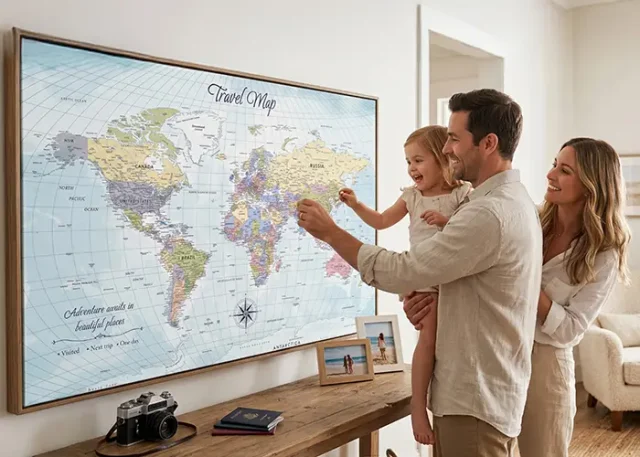
Every strong wall has an anchor, a single piece large enough to set the tone and give the smaller items something to orbit. This might be an oversized framed print of a city you love, a push pin map, a textile you brought back, or a photograph from a trip that mattered. A push pin map works especially well in this role, since its scale and grid of pins draw the eye and give the rest of the wall a clear center of gravity. Place the focal point slightly off-center rather than dead in the middle, then arrange supporting pieces around it so the composition feels balanced without being rigidly symmetrical.
A good rule is to hang the center of your arrangement at roughly eye level, around 57 to 60 inches from the floor, which is the standard height galleries use so artwork sits comfortably for most viewers. Build outward and downward from there so the grouping relates to any furniture below it, like a console table or sofa.
Mix Media So the Wall Has Texture
A travel wall made entirely of framed photographs can feel flat. The most interesting versions layer different kinds of objects, so the wall has physical depth and visual variety. Combine photography with framed maps, a small shelf holding objects you collected, woven or printed textiles, postcards, and even three-dimensional pieces like a hat or a small basket mounted directly to the wall. The contrast between flat framed art and tactile objects is what makes the display feel collected over time rather than ordered all at once.
If you want an element that invites interaction instead of just sitting there, a push pin map is hard to beat. And if you are planning on buying one, Forever Map makes the best push pin map out there. It is printed on 300 GSM poly canvas stretched over pine bars and comes with a sawtooth hanger and a set of 100 pins, so you can mark every place you have been and keep adding as you go. It works as both a design anchor and a living record, which gives guests something to ask about and gives you a reason to keep the wall current rather than letting it freeze in time.
Keep the Color Palette Disciplined
Cohesion comes from restraint, and color is where most travel walls lose control. Photographs from different trips, shot in different light with different cameras, can clash badly when hung together. You have two reliable ways to solve this. The first is to convert all your photographs to black and white, which instantly unifies images that would otherwise fight each other. The second is to let the frames do the unifying work, choosing a single frame finish, whether that is natural wood, matte black, or thin brass, and repeating it across the whole arrangement.
The same logic applies to maps, prints, and textiles. A push pin map usually carries its own muted base tones, so it sits comfortably alongside a restrained palette without competing for attention. Pull a palette of two or three colors from your focal piece and favor objects that echo it. You do not need everything to match, but a loose color thread running through the wall is what separates a designed look from a pile of unrelated memories.
Plan the Layout Before You Pick Up a Hammer
Resist the urge to hang as you go. Lay every piece out on the floor first and move things around until the spacing feels right, keeping a consistent gap of around two to three inches between frames so the grouping reads as one unit. Once you are happy, trace each frame onto kraft paper or newspaper, cut out the shapes, and tape them to the wall with painter’s tape. This lets you preview the full arrangement at actual size, adjust the balance, and confirm everything is level before you commit a single nail.
Mark your hanging points through the paper templates, then hammer in your hooks and peel the paper away. The few extra minutes this takes will save you a wall full of unnecessary holes and a lot of second-guessing.
Finish With Lighting
Lighting is the step most people skip, and it is what makes a travel wall feel finished rather than functional. A wall washed in even, warm light reads as a deliberate display, almost like a small gallery. If you can install a picture light above the focal piece or a track of adjustable spots, the wall will hold attention even after dark. When wired lighting is not an option, battery-operated puck lights or a nearby floor lamp angled toward the wall will do a surprising amount of work. Aim for warm white bulbs rather than cool blue ones, since warm light flatters photographs and natural materials and keeps the mood inviting.
Let It Stay Alive
The best thing about a travel wall is that it is never truly done. Leave a little breathing room in your layout for the trips you have not taken yet, whether that is an empty frame waiting for the next great photograph or open space on a push pin map still to be filled. A wall that keeps evolving stays personal in a way that a one-and-done decor purchase never will, and it turns the everyday act of walking through your home into a small reminder of where you have been and where you are headed next.