Bologna is not a modest city when it comes to food. It calls itself La Grassa — the fat one — and means it. The ragù here is not a shortcut. The mortadella is not a compromise. The Parmigiano Reggiano on the counter at the market has been aged for two years in a building twelve kilometres outside the city. This is a place that takes the origins of things seriously.
Emilia Delizia has been running food tours from Bologna since 2008. The company was founded by Gabriele Monti, who grew up watching his grandfather deliver milk each morning to the local Parmigiano Reggiano cooperative. “I took all of this completely for granted,” he says. “Then I moved abroad and spent years being quietly horrified by what passed for Italian food everywhere else.”
The solution, in 2008, was to start bringing people directly to the producers. Seventeen years later, the approach has not changed. Groups are small — a maximum of eight — and the producer relationships are long-standing. TripAdvisor rates Emilia Delizia 4.9 out of 5 across 280 reviews, ranking it the number-one food experience in Bologna. Lonely Planet and Channel 4 have both called.
Inside a working Parmigiano Reggiano dairy
The Foodies’ Delight Tour — Emilia Delizia’s flagship experience — begins early. A guide collects the group from their Bologna hotel and drives out into the Po Valley, where the flat land and the morning mist conspire to make the caseificio feel like it exists outside ordinary time.
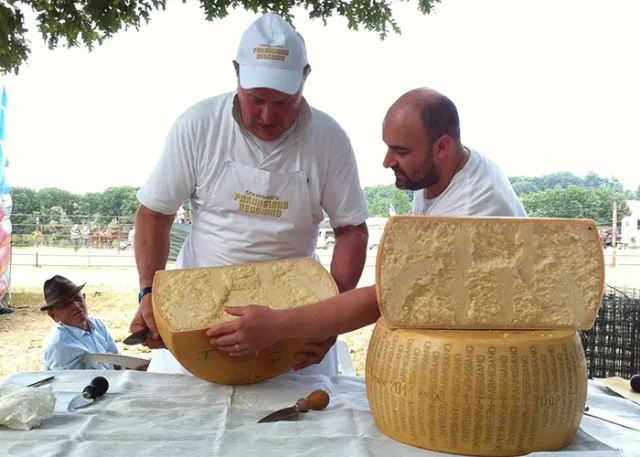
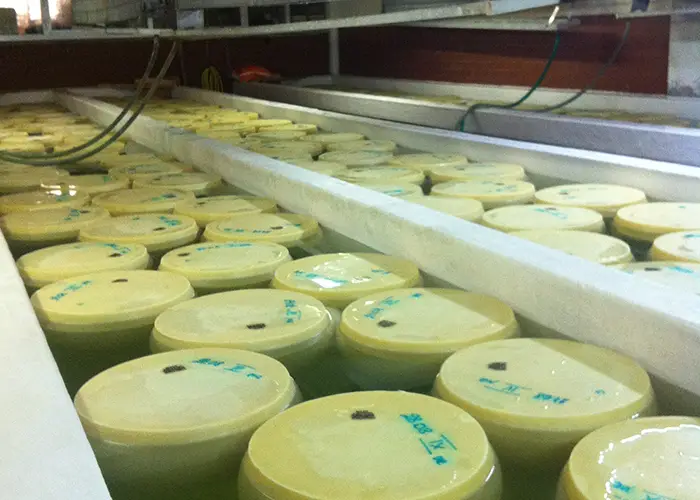
You arrive while production is under way. Milk is already in the copper vats. Cheesemakers are working the curd with long wooden paddles, pulling it apart and pressing it back together in a process that has not changed in eight hundred years. The smell is warm and slightly sweet. The guide explains each stage as it happens: the breaking of the curd, the cooking, the pressing into the circular moulds that give Parmigiano Reggiano its shape.
Then the ageing rooms. Hundreds of wheels sit on wooden shelves, each stamped with the Parmigiano Reggiano consortium mark, each weighing around forty kilograms. The youngest are twelve months old. The oldest are thirty-six. The tasting at the end makes the difference unmistakable: the twelve-month wheel is mild, almost milky; the thirty-six-month has the crystalline, almost crunchy texture and the deep savoury intensity that makes Parmigiano Reggiano one of the most imitated foods on earth.
A family acetaia in Modena
Traditional balsamic vinegar is not made in a factory. It is made in an attic — specifically, in the attic of a private house in the hills around Modena, where the temperature swings between summer heat and winter cold do the work that no industrial process can replicate.
The producer walks the group through the batteria: a row of barrels made from different woods — oak, chestnut, cherry, mulberry, juniper — each one smaller than the last. Every year, a small amount of vinegar is moved from the largest barrel to the next, concentrating as it goes. The process takes a minimum of twelve years for DOP certification. The acetaia visited on the Emilia Delizia tour produces vinegar aged to twenty-five years.
The tasting is, for most guests, the surprise of the tour. The difference between a young balsamic condiment and a twenty-five-year DOP traditional is not a matter of degree. It is a different substance entirely: thick as syrup, dark as mahogany, with a sweetness and acidity that arrive in sequence rather than together. “Most people say this stop surprises them most,” says Monti. “They came expecting cheese to be the revelation. The balsamic gets them every time.”
The prosciutto cellars of Langhirano
Prosciutto di Parma is made exclusively in the hills south of Parma, in a zone defined by EU law and enforced by the Consorzio del Prosciutto di Parma. The reason is the air: a specific combination of mountain breeze and valley humidity that circulates through the cellar windows and does the curing that salt alone cannot.
The visit takes the group through rooms of hanging legs at different stages of the eighteen-to-twenty-four month process. The producer explains the markings — the fire brand of the Ducal Crown that certifies origin — and the difference between a twelve-month ham, still pink and relatively mild, and a twenty-four-month ham, which has darkened and concentrated into something altogether more complex.
Slices are cut fresh from the wheel and served with local bread. No butter. No accompaniment. The producer, who has been curing ham in this building for thirty years, watches to see the reaction.
Also available: the city walk and the pasta class
For travellers with less time, Emilia Delizia runs a two-and-a-half-hour Bologna Food Walking Tour through the Quadrilatero and Mercato delle Erbe — the city’s two main food markets — with six tasting stops covering mortadella, Parmigiano Reggiano, fresh pasta, local wine and artisan gelato.
The Pasta-Making Class is three and a half hours: a market visit with the chef, hands-on fresh egg pasta making (tortellini, tagliatelle or lasagne depending on the session), and a sit-down meal of what you made, with wine. Both experiences run year-round and can be combined with the Foodies’ Delight Tour.
Practical information
The Foodies’ Delight Tour runs year-round and requires advance booking — at least one week ahead in peak season (April to October). Groups are capped at eight people. Return transport from your Bologna hotel is included. Private tours are available for couples, families and small groups. Full details at www.emiliadelizia.com/bologna-food-tour/.
Emilia Delizia is rated 4.9/5 on TripAdvisor with 280 reviews and is the #1 food experience in Bologna (Travellers’ Choice 2025).