

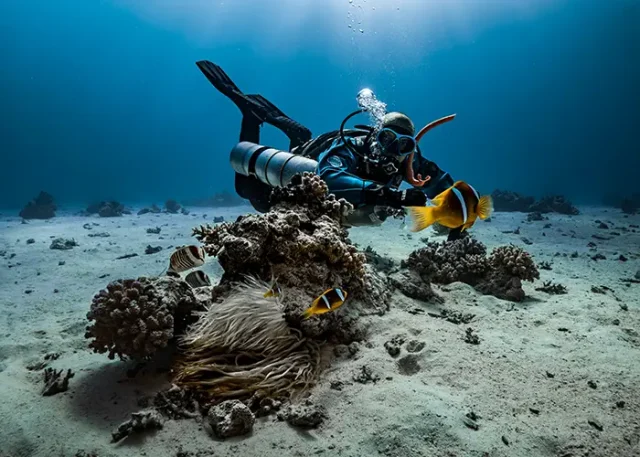
Ask a group of divers what they hope for before a trip and the answers are often remarkably similar. Warm water usually comes up first. Healthy reefs are never far behind. Then someone mentions sharks, manta rays, or perhaps a favourite wreck they’ve always wanted to explore. Almost inevitably, though, the conversation circles back to visibility.
It’s easy to understand why. Visibility is one of the few parts of diving that can be measured and compared so easily. Twenty metres sounds better than ten. Thirty sounds even better. Clear water photographs beautifully, makes navigation feel simpler, and creates those sweeping underwater scenes that often inspire people to learn to dive in the first place.
Yet something interesting happens after enough time underwater.
Many experienced divers begin talking less about visibility and more about everything surrounding it. They remember a reef because it was alive with feeding fish rather than because they could see the seabed from the surface. They remember a patient manta ray that circled several times, a cleaning station buzzing with activity, or a dive guide who knew exactly when conditions were about to change. Looking back, the visibility almost becomes background information.
That’s not to suggest that clear water doesn’t matter. Of course it does. It makes many dives more comfortable, particularly in unfamiliar environments, and it can transform photography or wide-angle reef scenes. But clarity alone rarely determines whether a destination becomes somewhere divers want to return to.
The best dive trips are usually built from a collection of smaller details that work together. Some are environmental. Others are seasonal. A few have nothing to do with the water itself. Taken together, they shape the experience far more than a single number on a dive briefing ever could.
1. Marine life behaviour
Seeing marine life is exciting. Watching marine life behave naturally is often what turns a good dive into a memorable one.
It’s a subtle difference, but an important one. A reef shark passing through the blue is something most divers will remember. Watching several sharks hold effortlessly in the current while cleaner wrasse move confidently around them tells a much richer story. The same applies to octopus emerging cautiously from their shelters, turtles settling onto cleaning stations, or schooling fish changing direction almost simultaneously as predators approach.
Behaviour adds context to every encounter. Instead of simply identifying species, divers begin observing relationships, routines, and patterns that unfold over several minutes rather than a few seconds.
Interestingly, these moments don’t always happen in perfect visibility. Nutrient-rich water can sometimes reduce clarity while supporting extraordinary levels of marine activity. At first that feels like a compromise. Later, many divers realise it isn’t one at all.
Quite often, the most rewarding dives are those where life feels active rather than simply easy to see.
2. Seasonality
One of the biggest misconceptions in dive travel is that destinations remain essentially the same throughout the year.
In reality, many dive sites change character with the seasons. Water temperature shifts, prevailing winds influence conditions, plankton blooms attract larger marine life, and migration patterns bring entirely different experiences from one month to the next. A destination visited in March may feel surprisingly different in October, even though the reefs themselves haven’t changed.
This is why experienced divers often begin planning around wildlife calendars instead of country lists. They become interested in when manta rays gather, when whale sharks are most reliable, or when coral spawning creates those rare moments that many divers witness only once or twice in a lifetime.
The destination still matters, of course, but timing frequently matters more.
Choosing the right season doesn’t guarantee remarkable encounters. Nature rarely works that way. What it does do is increase the likelihood that a destination will be experienced at its most vibrant, and that’s often far more valuable than simply chasing the clearest possible water.
3. Current
Current tends to divide opinion, particularly among newer divers.
For some, it’s something to avoid. For others, it’s one of the reasons they travel halfway around the world in the first place.
The reality sits somewhere between those two perspectives. Strong current can certainly make dives more demanding, but it also creates many of the conditions that support healthy marine ecosystems. Nutrients carried by moving water feed reefs, attract pelagic species, and influence where fish gather to feed, clean, and breed.
It’s no coincidence that so many iconic dive sites are known for current. Drift dives, shark channels, and vibrant reef walls often owe their reputation to water that never really sits still.
What’s interesting is how diver perception changes over time. Early on, current often feels like something that interrupts the dive. Later, many divers begin recognising it as part of the environment itself. Instead of fighting it, they learn to work with it, adjusting buoyancy, positioning, and breathing rather than constantly finning against the flow.
The dive becomes less about controlling movement and more about understanding it.
4. Reef health
A healthy reef has a certain energy that’s surprisingly difficult to describe until you’ve spent time on one.
Fish occupy every layer of the water column. Hard and soft corals create structure rather than uniformity. Small invertebrates hide within tiny crevices while larger predators patrol the edges, each playing a role in an ecosystem that feels balanced rather than staged.
By comparison, a reef with exceptional visibility but declining biodiversity can feel unexpectedly quiet. You may see further, but there is simply less happening.
Healthy reefs reward patience. The longer you stay in one place, the more activity begins to reveal itself. Cleaner shrimp emerge from beneath ledges. Juvenile fish move between coral heads. A nudibranch inches slowly across a sponge while, just beyond it, a turtle drifts effortlessly through the current.
These aren’t dramatic moments in the traditional sense. They don’t demand attention. But together they create the feeling that the reef is functioning exactly as it should.
For many divers, that’s far more satisfying than visibility alone.
The more time people spend underwater, the more they begin recognising this quiet richness. It becomes one of the strongest reasons to return to a destination, even if another place promises clearer water or more impressive photographs.
5. Dive site variety
One exceptional dive can leave a lasting impression, but it’s rarely enough to define an entire destination. What often separates a good dive trip from a truly memorable one is variety. The opportunity to experience different underwater landscapes, different styles of diving, and different kinds of marine life over several days keeps curiosity alive in a way that repeating the same profile simply can’t.
Perhaps one morning begins with a dramatic wall dive where the reef disappears into deep blue water. Later in the day, the focus shifts entirely to a sheltered coral garden filled with macro life. The following afternoon might bring a historic wreck, while a night dive transforms a familiar reef into something that feels almost unrecognisable. The destination hasn’t changed, but the experience certainly has.
This kind of diversity allows divers to engage with the ocean from multiple perspectives. Some dives reward wide-angle observation. Others encourage slowing down to study a single coral outcrop. By the end of the trip, memories are built from a collection of very different experiences rather than one standout moment repeated several times.
6. Water temperature
Water temperature is often treated as a comfort issue, and comfort certainly plays a role. Few divers complain about warm water or having to wear less equipment.
But temperature influences much more than physical comfort.
Warm water often encourages relaxation almost immediately. Muscles loosen more quickly, breathing settles into a natural rhythm, and divers tend to consume less energy throughout the dive. Time underwater feels less interrupted because the body isn’t constantly responding to the cold.
Cooler water creates a different experience. It sharpens awareness. Equipment choices become more important, and divers often move more deliberately. There’s a certain satisfaction that comes with cold-water diving, but it demands a different mindset.
Neither environment is inherently better than the other. They simply shape the rhythm of a dive in different ways. That rhythm affects everything from air consumption to concentration, and ultimately influences how enjoyable a destination feels over several days of diving.
7. Trip pacing
Even world-class dive sites can lose some of their appeal if the overall trip feels rushed.
Long road transfers, early departures every morning, minimal surface intervals, and trying to squeeze too many dives into a limited schedule can gradually turn excitement into fatigue. Divers may still see incredible marine life, but the experience begins to feel like a checklist rather than a journey.
Thoughtful pacing changes that completely.
Time to review photographs, talk through the previous dive, enjoy a quiet lunch on deck, or simply sit with the view before entering the water again often becomes part of the holiday itself. Those quieter moments allow each dive to stand on its own rather than blending into the next.
It’s one of the reasons many experienced divers eventually choose specialist operators, like Original Diving. Rather than building itineraries around a single headline attraction, they design trips that consider seasonal marine life, travel logistics, surface intervals, local conditions, and the type of diving each destination offers. The result is often a holiday that feels balanced from beginning to end instead of relentlessly busy.
Sometimes the quality of a dive trip depends just as much on what happens between the dives as what happens beneath the surface.
8. Local knowledge
No matter how carefully you research a destination before travelling, local knowledge remains impossible to replace.
Conditions can change overnight. A shift in wind direction might make one reef significantly better than another. Currents strengthen unexpectedly. Visibility improves on one side of an island while deteriorating on the other. Marine life follows patterns that don’t always appear in guidebooks.
Experienced local guides notice these changes because they’re immersed in them every day.
More importantly, they understand the subtle details that visitors simply don’t have time to learn. They know when turtles are likely to arrive at a cleaning station, which reef tends to attract larger schools of fish after certain tides, or when it’s worth changing the day’s plan because conditions favour a completely different site.
That flexibility often produces the dives people remember most.
It’s easy to focus on destinations when planning a trip. In practice, the people guiding the experience frequently make just as much difference.
9. How a destination makes you feel underwater
Some destinations are technically outstanding, yet somehow leave only a modest emotional impression. Others stay with divers for years, even if every dive wasn’t perfect.
The difference is difficult to measure.
Sometimes it’s the confidence inspired by exceptionally clear water. Sometimes it’s the anticipation of drifting along a reef while scanning open blue for larger marine life. Occasionally it’s something even simpler — the quiet feeling that there was no need to rush because the environment encouraged patience rather than urgency.
These emotional responses don’t appear in destination comparisons or visibility reports, but they often shape the overall memory of a trip far more than statistics do.
As divers gain experience, many begin choosing places that suit the way they enjoy diving rather than simply chasing famous names or ideal conditions. The destination becomes a reflection of personal interests rather than someone else’s ranking.
That shift changes travel in surprisingly meaningful ways.
Choosing experiences instead of conditions
Visibility will probably always remain one of the first questions divers ask, and there’s nothing wrong with that. Clear water is undeniably enjoyable. It creates beautiful photographs, simplifies navigation, and often builds confidence, particularly in unfamiliar environments.
But perhaps visibility has become so prominent because it’s easy to compare. It’s a number. A simple benchmark. Many of the qualities that truly define a destination are far more subtle.
Healthy reefs don’t come with a visibility rating. Marine life behaviour can’t be summarised in a weather forecast. Local expertise, thoughtful trip pacing, and seasonal timing rarely fit neatly into destination rankings, even though they often shape the experience far more profoundly.
Over time, many divers stop asking, “How clear is the water?” and start asking different questions instead.
What is the reef like at this time of year?
How does marine life behave here?
What kind of diving will challenge me, or help me slow down, or simply leave me feeling more connected to the ocean?
Those questions rarely produce simple answers. They’re also the ones that tend to lead to the most rewarding journeys.
The best dives rarely depend on one number
Clear water creates a wonderful first impression, but first impressions have a habit of fading.
The dives that stay in memory usually linger for different reasons. A curious octopus that refused to hide. A reef alive with feeding fish. A drift dive where the current carried everyone effortlessly along the wall. A guide who recognised the subtle signs that something remarkable was about to happen.
None of those moments depended entirely on visibility.
They depended on timing, healthy ecosystems, thoughtful planning, and a willingness to appreciate the ocean as something far more complex than a single measurement could ever describe.
Perhaps that’s why the best dive destinations continue drawing people back year after year. Not because the water is always perfectly clear, but because every visit offers another chance to experience something that can’t be captured by visibility alone.