

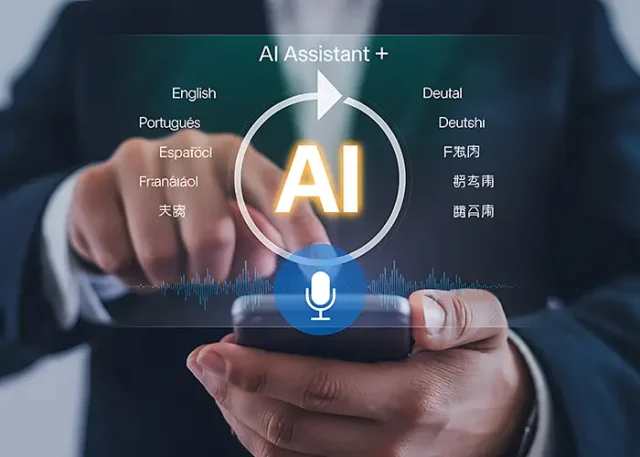
In the digital-first business landscape, innovation is no longer confined by geographic boundaries. Digital ecosystems, cloud-native infrastructures, and globalized talent pools have allowed companies of all sizes to scale instantly. However, as organizations expand into new territories, they inevitably encounter the most complex and deeply rooted barrier to global integration: linguistic fragmentation. For generations, entering a foreign market or building a multinational workforce meant managing massive overheads in translation or accepting a substantial loss in communication speed. Today, the convergence of deep learning and computational linguistics is rewriting this narrative, positioning artificial intelligence at the heart of cross-border enterprise strategy.
For platforms like IntelligentHQ, which monitor the cutting edge of business intelligence and leadership, the rise of specialized artificial intelligence signals a shift from passive automation to active cognitive partnership. Language is no longer an obstacle to be mitigated after the fact; it has become a fluid layer of the modern corporate infrastructure. By integrating intelligent communication tools, organizations can transform how they negotiate, collaborate, and execute ideas globally.
The Real-Time Evolution of Corporate Communication
Traditional corporate expansion relied heavily on asynchronous communication—emails, localized documentation, and delayed reports. While functional, this approach lacks the agility required in today’s high-velocity commercial environments. Real-time problems demand real-time synthesis. When specialized cross-border teams need to diagnose a systemic supply chain failure or align on an urgent algorithmic pivot, waiting hours for standard translation services is a critical liability.
The solution lies in instantaneous cognitive processing. Utilizing a cutting-edge ai live translator tool enables organizations to bridge operational gaps instantly. Instead of relying on rigid textual replacements, these systems leverage advanced contextual processing models to capture spoken intent and render it seamlessly into the listener’s native tongue. This technology facilitates immediate feedback loops during high-stakes negotiations, allowing international executives to brainstorm, challenge assumptions, and form strategic alliances with the same conversational ease they would enjoy with a local colleague. The result is an unprecedented acceleration of the corporate decision-making cycle.
Nuance, Context, and Strategic Interpretation
However, true business intelligence recognizes that speech is rarely just a collection of literal definitions. Effective corporate communication relies heavily on subtle emotional cues, cultural frameworks, industry-specific taxonomy, and situational urgency. A literal word-for-word translation in a legal negotiation or a complex technical audit can easily introduce catastrophic misalignments or alienate strategic stakeholders.
The distinction between static machine translation and dynamic language interpretation services becomes fundamentally apparent. Modern generative architectures do not just scan dictionaries; they evaluate semantic context and look-ahead sentences. If a technical leader in Tokyo describes a complex manufacturing bottleneck using specific engineering idioms, the AI evaluates the domain-specific nature of the dialogue and synthesizes an interpretation that accurately conveys the technical gravity and operational urgency to an executive team in London. By honoring cultural nuances and specialized vernacular, AI-powered interpretation ensures that intellectual property, strategic intent, and corporate respect remain completely intact across all linguistic boundaries.
Democratizing Enterprise Scalability
Beyond optimizing internal corporate agility, AI-driven linguistics serves as a massive equalizer in the global marketplace. Historically, the ability to operate seamlessly across multiple continents was a privilege reserved for massive conglomerates with the capital to deploy localized support centers and extensive human translation networks. Small-to-medium enterprises (SMEs) were frequently locked out of lucrative foreign markets due to the prohibitive costs of localized engagement.
AI completely disrupts this dynamic. An agile fintech startup can now deliver sophisticated, multi-language client onboarding and technical assistance without expanding its physical footprint. Global educational platforms can broadcast complex analytical webinars to thousands of global participants, allowing every attendee to engage deeply with the material in their preferred tongue. In the war for global talent, companies can recruit the world’s finest minds, confident that language friction will no longer obscure an employee’s strategic potential.
The Connected Horizon
We are rapidly moving toward an era of radical connectivity, where language will no longer act as an operational tax on innovation. As deep learning engines become more intuitive and seamlessly integrated into enterprise communication suites, the boundaries of global commerce will fade entirely. The future belongs to organizations that view linguistic diversity not as a barrier to be managed, but as an expansive ecosystem of opportunity. The intelligent enterprise does not demand that the world speak its language; it utilizes AI to speak the language of the entire world.