

- Doing your Visa on Arrival, arrivals card, and Bali Tourist Levy in advance will save a lot of time at the airport
- Traffic congestion is a real problem in many parts of Bali, so plan your trip to avoid too many long journeys during peak hour
- Balinese Hinduism is an important part of the culture and offers visitors a fascinating insight into the local heritage
Indonesia’s most popular island is packed with incredible experiences, from the beaches to the jungle and even the rice terraces. One of the reasons it’s so popular is because it has something for everyone – local warung-style restaurants, lively bars, trendy beach clubs, and world-class dining.
There’s a well-established tourism industry and it’s normally easy to get help with anything you’re looking for, but the crowds have also brought traffic congestion and more development to some parts of the island.
To make the most of your visit to Bali, we’ve got some Bali travel tips for where to stay, what to do and how to be respectful of the local culture.
When to visit Bali
When it comes to the weather, Bali has two seasons – the dry and the wet. But when you’re thinking about the best time to visit Bali, you also have to consider the crowds.
Peak season
In July and August, the weather in Bali is dry and sunny, making it an excellent time to enjoy the beaches and the other outdoor activities. However, because of summer vacation in the northern hemisphere and people from the south trying to escape the cold, it’s also Bali’s busiest period.
Prices are generally higher and the traffic can be congested – but there’s a fun and lively atmosphere in the main traveler neighborhoods.
Shoulder seasons
For many visitors, the best time to visit Bali will be the shoulder seasons of April to June and September to October. It’s still officially dry season so there’ll be minimal rain and the temperatures will be pleasant. But there aren’t as many people as during the peak season, so there’s more availability and prices are a bit lower.
Off-peak season
Bali’s wet season between November to March brings a fair amount of rain to the island, so it’s not the best time for a beach vacation – although many days there will just be a brief afternoon shower. But for visitors focusing on the inland, the rice paddies are beautiful just before harvest and the jungle around Ubud is particularly lush.
Although the wet season keeps the crowds away most of the time, the Christmas and New Year period can get very busy because of summer school vacation in countries like Australia.
How long to stay in Bali
Even a short trip of just a few days can be long enough to enjoy Bali if you choose a base like Seminyak or Ubud and spend your time relaxing by the beach or exploring the local culture.
For a well-rounded trip, it’s worth giving yourself a week in Bali to be able to experience both the coast and the hinterland, spending a few days in each area for very different activities.
For longer stays, consider adding another coastal destination so you can have some days in a lively area like Canggu or Seminyak and a more relaxing break somewhere like Uluwatu. You could also do a few days on the nearby Gili Islands.
How to get around Bali
Although Bali is a large island, most of the areas popular with travelers are within 16 miles of the capital city (and main airport) of Denpasar. However, traffic is known to be heavy in many areas so journeys can often be slow, regardless of which option you choose.
Public transportation
Bali has limited public transportation options, especially outside the island’s main hubs. The six routes of the Trans Metro Dewata bus network are a very affordable way to get around the city of Denpasar but it doesn’t connect to most of the beaches.
There are some private tourist shuttles that are similar to public transportation, offering regular connections on a set timetable between main centers like Sanur, Kuta, and Ubud. They can be a cost-effective way for solo travelers to move between different destinations.
Taxis and rideshares
One of the best ways to get around Bali is with a taxi or rideshare, both of which are relatively affordable. Taxis can be hailed on the street and tend to cost a bit more. Popular rideshare apps like Gojek and Grab are usually a bit cheaper than a taxi, although there are some busy areas where they are not allowed to operate.
Taxis and rideshares are useful for shorter trips, but can also be used for longer journeys like Canggu to Ubud.
Car rental or private driver
Another popular option for visitors is to rent a car in Bali for the whole trip or to use a private driver on certain days. Both options are relatively affordable and may be cheaper than taking multiple taxis in a day for longer journeys.
A rental car or driver allows you to explore some of the less-visited parts of the island or to spend a day sightseeing at multiple locations. For car rental in Bali, you’ll need an International Driving Permit as well as your driver’s license.
Scooter rental
Because of Bali’s notoriously congested traffic, renting a scooter is another common way for people to get around. Compared to a car, it has the advantage of being able to skip some of the traffic jams in the most developed areas – plus parking can be a lot easier.
For scooter rental in Bali, you’ll also need an International Driving Permit (IDP) and you are legally required to wear a helmet.
Where to stay during your trip to Bali

One of the most popular areas to stay in Bali is the upscale coastal neighborhood of Seminyak, but there are some other great areas to consider across the island.
- Canggu: This once-relaxed coastal area has grown in popularity in recent years, with lots of modern accommodation options, but there’s still a surfer vibe amongst the trendy restaurants. Suom Apartments and Villas Canggu, a Booking.com Genius property, offers 4-star aparthotel units with air-conditioning, modern amenities, kitchenettes, free WiFi, a fitness center, a year-round outdoor swimming pool, and more.
- Uluwatu: Set on top of limestone cliffs south of Denpasar, accommodation tends to be quieter here, away from the bustling dining and nightlife you’ll find further north. On an oceanside cliff, The Edge Bali offers 5-star villas with private pools, home entertainment systems, free WiFi, a world-class spa and fitness center, personal butler service, and earned a sustainability certification – perfect for the 85% of travelers that say that more sustainable travel is important or very important to them, according to Booking.com’s 2026 Travel and Sustainability Research*.
- Sanur: An area popular with families because of calmer waters, less nightlife, and spacious child-friendly resorts. The Bandha Hotel & Suites is a Booking.com Travel Proud property sitting right on Legian Beach, with 90 modern, Balinese-designed rooms, with two outdoor pools, a restaurant and a swim-up bar, 24-hour front desk, and more.
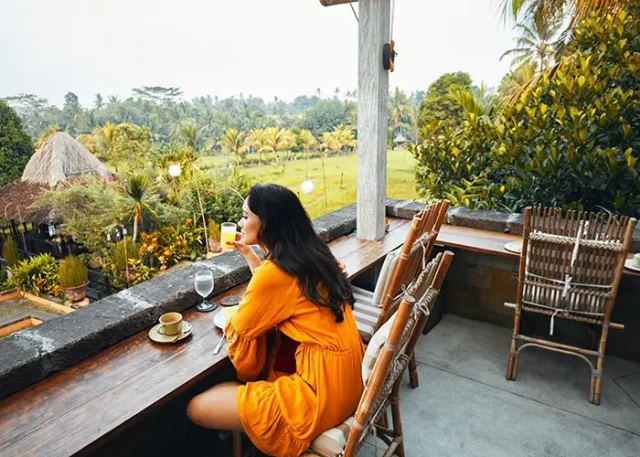
- Ubud: In the island’s hinterland, surrounded by jungle, this is Bali’s cultural heart with easy access to temples and rice paddies, plus yoga and wellness retreats. Green Lander Ubud, just over a mile from Saraswati Temple and Ubud Palace, is a serene, eco-luxury retreat with a swimming pool, lush garden, onsite restaurant and bar, with bamboo architecture and modern amenities.
Essential things to know about Bali
With so many people heading to Bali every year, much of the island’s economy is focused on tourism. That makes it a very easy destination for travelers – although there are a few things worth knowing before visiting Bali.
Visa on Arrival and tourist levy
Before heading to Bali, make sure to check the Indonesian entry requirements for your nationality, as most people will need a Visa on Arrival (VOA). To avoid the line at Denpasar Airport, you can do it online in advance. You’ll also need to fill out an arrivals card online before you reach immigration.
In addition to the VOA for Indonesia, visitors to Bali also need to pay the Bali Tourist Levy. This can be done online in advance or at the airport when you arrive – although there is often a long line.
Be cautious of the many unofficial websites overcharging for these services. The only official website is the Ministry of Immigration and Corrections.
Cash vs. credit card
In many situations, you’ll be able to use a credit or debit card in Bali, including at hotels, upscale restaurants, and beach clubs. However, smaller and more local businesses may only accept cash, so it’s a good idea to carry some all the time.
There are lots of ATMs in the main hubs, but it’s better to use the ones attached to bank branches in case there are any problems. There are also often money changers on the street – but watch out for exchange rates that seem too good to be true.
Tipping
Although there’s no official tipping policy in Bali, it’s customary for visitors to leave a small tip for service-based jobs as a gesture of gratitude – though it’s not common at places like street food stalls or cafés.
Many larger restaurants or beach clubs will automatically add about 5% or 10% to the bill. If there’s no service charge included, you can round up the total or leave a cash tip of between 20,000–50,000 IDR. Drivers, tour guides, or massage therapists will appreciate a slightly larger tip.
Religion
Although Indonesia is predominantly Muslim, many religions are represented across the archipelago. In Bali, most locals are Hindu – specifically, a unique form called Balinese Hinduism.
It’s an extremely important part of the island’s culture and has influenced things from the design of buildings to the layout of rice paddies. There are hundreds of temples across Bali, and you’ll find smaller statues and shrines even in the most-developed tourist parts of the island. As a visitor, you’ll be welcome to visit religious sites and watch ceremonies, but always remain quiet and respectful.
Temple etiquette
When you’re visiting temples in Bali, you’ll be expected to dress respectfully. Both men and women will need to cover their shoulders and knees, so people commonly wear a sarong – which can sometimes be borrowed from the temple.
You may need to take off your shoes in some parts of the temple, and you can just leave your footwear with the others. It’s important to remember a temple is not a tourist attraction, so it’s respectful not to talk loudly. Photography is generally permitted (unless there’s signage that explicitly forbids photography) but don’t take photos of people and avoid using a flash or tripod.
Watch your step
Another part of Balinese Hinduism involves people leaving small offerings called canang sari outside homes and businesses. These square baskets woven from palm leaves and filled with flowers are often on the footpath, so be careful not to tread on them.
You’ll also want to keep an eye on the footpaths in some parts of Bali, where damage or open storm drains can be a bit of a hazard for pedestrians.
Staying healthy
Tap water is not safe to drink – for some travelers even brushing your teeth could make you sick with “Bali belly,” as it’s known. It’s best to stick with filtered or bottled water, although a new sustainability rule means you can’t buy plastic bottles under 33 ounces.
When it comes to eating, busier restaurants can often be a bit safer because the food is less likely to have been sitting around. If you’re worried about getting sick, avoid dishes with raw ingredients and choose meals you know will be cooked fresh.
Drugs and alcohol
Visiting Bali often includes some partying and alcohol is easily accessible at venues across the whole island. However, stick to prepackaged drinks in sealed containers like cans and bottles, rather than any locally brewed spirits.
Indonesia has extremely strict drug laws, including punishment for possession, use, or distribution. The most serious drug crimes can even carry the death penalty.
Watch out for monkeys
In the island’s hinterland, particularly around the cultural hub of Ubud, the monkeys in the jungle are often an attraction for visitors. But even if they look cute, don’t forget they are wild animals. They are notorious for grabbing things from people, including sunglasses and phones.
Never try to feed or pat the monkeys. It’s not good for them and it’s also possible they’ll become aggressive. Although it is very rare, you should go to a hospital if you are bitten or scratched.
Nyepi
Balinese celebrate the New Year in March and it can be a really culturally rewarding experience to be on the island during the celebrations. The most important part of the New Year is Nyepi, an official “Day of Silence,” when the whole island shuts down – including traffic on the roads, all businesses, and even the airport.
You’ll be legally required to stay in your accommodation for a full 24 hours (6:00 am–6:00 am) during Nyepi, which means organizing things like food in advance. It’s a unique way to spend time in Bali, but check the date in advance if you would prefer to avoid it.
Top things to do when visiting Bali
Whether it’s along the coast or up in the hinterland, some of the things to do in Bali stand out as highlights.
- Kecak Fire Dance in Uluwatu: After visiting the clifftop temple in Uluwatu, stay for an evening performance of traditional chanting and dancing. Tickets that include a private driver and guide are available on Booking Attractions.
- Sacred Monkey Forest Sanctuary: Located in the heart of Ubud, the lush jungle reserve with ancient stone temples is full of wildlife. Snag discounted admission with essential information about visiting the sanctuary on the ticketing page.
- Nusa Penida: Just a short boat ride from the mainland, this rugged island has pristine beaches and offers excellent snorkeling. Day tours are available, with transportation, lunch, and a local guide to make sure you get the most out of your visit.
Bali travel tips: hidden gems
Once you’ve spent some time at Bali’s main attractions, there are some lesser-visited places that are well worth your time.
- Jatiluwih Rice Terraces: Quieter than the popular Tegalalang terraces, this expansive landscape of rice paddies shows the island’s agricultural heritage.
- Mount Batur hike: Get up early for the trek up to the summit of this active volcano for spectacular sunrise views across Bali.
- Taman Ujung: A tranquil former royal water palace with elegant bridges, historic pavilions, and expansive pools.
The Island of the Gods
Along with the trendy restaurants of the coastal buzz and the wellness resorts in the hinterland, Bali remains a very spiritual island.
According to Booking.com’s Travel Predictions 2026**, a quarter (25%) of travelers said that the opportunity to take part in life’s “quieter” hobbies is enough of a reason to travel, and 21% said they’d be happy to just enjoy a natural sensory experience, such as the whistle of birds chirping or the smell of rain after a lush, heavy downpour, on their travels. Bali’s innate feeling of transquility and connection with nature has long made it a top destination for those seeking solace from hectic lives. Many ancient Hindu principles are still an important part of daily Bali life, which is why the island is often known as the “Island of the Gods.”
There are lots of fun things for visitors to do, but connecting to the rich, deeply peaceful local culture will make yours an even more meaningful trip to Balinese paradise.
*Research commissioned by Booking.com and independently conducted among a sample of 32,500 respondents across 35 countries and territories (1,000 from USA, 1,000 from Canada, 1,000 from Mexico, 1,000 from Colombia, 1,000 from Brazil, 1,000 from Argentina, 1,000 from Australia, 500 from New Zealand, 1,000 from India, 1,000 from China, 1,000 from Hong Kong, 1,000 from Thailand, 1,000 from Singapore, 1,000 from Taiwan, 1,000 from Vietnam, 1,000 from Indonesia, 1,000 from Philippines, 1,000 from South Korea, 1,000 from Japan, 1,000 from Spain, 1,000 from Italy, 1,000 from France, 500 from Switzerland, 1,000 from the UK, 1,000 from Ireland, 1,000 from Germany, 1,000 from the Netherlands, 1,000 from Belgium, 1,000 from Denmark, 1,000 from Sweden, 1,000 from Croatia, 500 from Greece, 500 from UAE, 1,000 from South Africa and 500 from Kenya). To participate, respondents had to be 18+ years, have traveled at least once in the past 12 months, must be planning to travel in 2026, and be either the primary decision maker or involved in the decision making of their travel. The survey was taken online and took place in January 2026. The age ranges for each generation were defined as: Gen Z 18-28, Millennials 29-44, Gen X 45-60, and Boomers 61+.
**Travel Predictions 2026 research commissioned by Booking.com and conducted among a sample of adults who plan to travel for business or leisure in the next 12-24 months. In total, 29,733 respondents across 33 countries and territories were polled (including 1,009 from Argentina, 1,005 from Australia, 500 from Austria, 1,013 from Belgium, 1,008 from Brazil, 1,018 from Canada, 1,009 from China, 1,005 from Colombia, 508 from Croatia, 501 from Denmark, 1,010 from France, 1,003 from Germany, 1,004 from Hong Kong, 1,007 from India, 509 from Ireland, 507 from Israel, 1,005 from Italy, 1,003 from Japan, 1,003 from Mexico, 1,019 from The Netherlands, 1,033 from New Zealand, 1,006 from Portugal, 500 from Singapore, 1,003 from South Korea, 1,009 from Spain, 511 from Sweden, 501 from Switzerland, 504 from Taiwan, 1,001 from Thailand, 501 from the UAE, 2,003 from the UK, 2,010 from the US and 505 from Vietnam). Respondents completed an online survey in July-August 2025.