

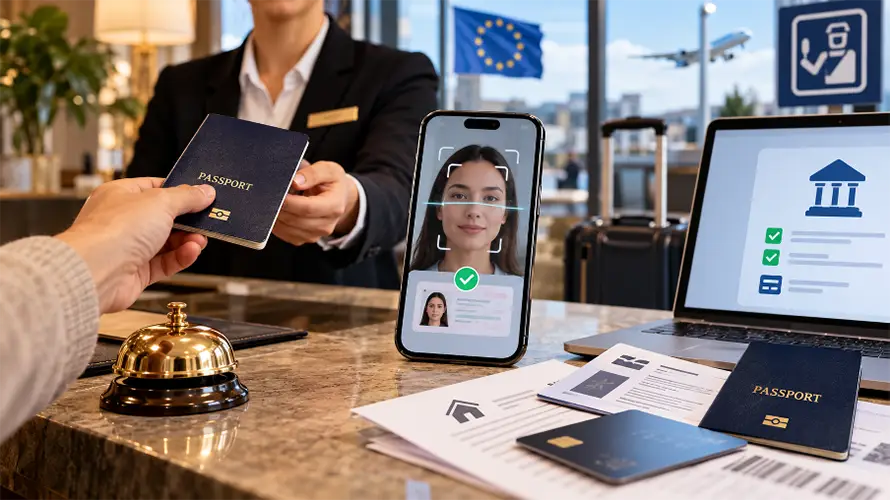
A passport at the hotel desk, a selfie with an ID in a banking app, an electricity bill to confirm your address… Identity checks come up on almost every trip, but they look different everywhere. In some places you need a full package of scans, in others a single tap in a banking app is enough. The difference comes down not to company whims but to local law and the stage at which the check takes place.
Why Companies Need Customer Documents
Collecting documents is rarely a company’s own initiative. More often it is a legal requirement or a condition of working with a payment provider. Three tasks repeat across all industries: confirming age, establishing identity and assessing the origin of funds. That is why the lists match across completely different services.
The set of papers is fairly standard, and only the thresholds and deadlines differ. Below are the items that come up most often.
- a photo ID: passport, national ID card or driver’s license;
- proof of address: a utility bill, bank statement or rental agreement;
- proof of payment method: a scan of the card with part of the number hidden, or an account statement;
- proof of source of funds: an income certificate, a statement or documents on the sale of property.
The verification method affects speed more than the set of documents does. Checking against a government database takes seconds, while manual processing of an uploaded file takes from several hours to several days.
Case Study: A Casino Without Verification in the Usual Sense
The Scandinavian market has produced an example of a service with no conventional verification at all. There is no registration form, no account is created manually, and no scans are uploaded anywhere. The model became known as the no account casino and grew out of the Pay N Play payment product, which the Swedish company Trustly launched in 2016.
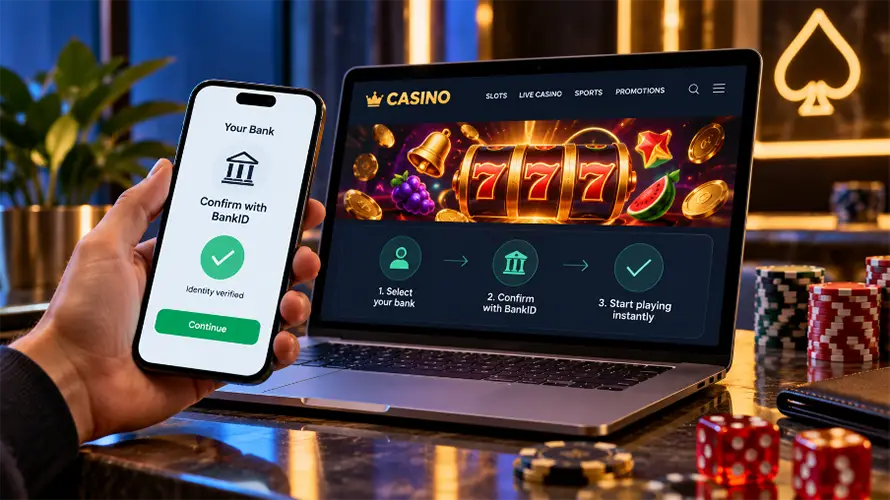
The mechanics come down to a single action. The player selects their bank and confirms the transfer through BankID, and within those same few seconds the system opens an account, processes the deposit and establishes the player’s identity. Trustly passes the operator only the necessary minimum: name, date of birth and address.
Vasilije Lekovic, Trustly’s Director of Gaming, explained the scheme’s reliability briefly: “it is not that easy to fool your own bank.”
Withdrawals run on the same rails. The ability to withdraw without ID at these casino sites is built into the architecture itself: the bank confirmed the player’s identity at the deposit stage, so the payout requires no documents and goes to the same account.
The difference between the two approaches is easy to see by parameter.
| Parameter | No account model | Classic registration |
| Account creation | Automatically at the first deposit | Manually, before the first bet |
| Identity confirmation | Bank identifier, a few seconds | Database check, scans if necessary |
| Documents from the player | Not required | Passport, proof of address, payment method |
| Time of verification | Simultaneously with the deposit | Before access to the game is granted |
| Withdrawal | To the same account, no additional steps | After verification is complete |
| Geography | Sweden, Finland, Estonia, the Netherlands | Markets without widespread digital identification |
The law is fully observed in this case. The Swedish Gambling Act 2018:1138, in force since January 1, 2019, requires a licensed operator to verify the player’s identity before play begins and before a payout. Pay N Play meets the requirement through the bank rather than through file uploads.
Regulators view this arrangement favorably because it removes the main complaint about the industry. Andrew Rhodes, who headed the UK Gambling Commission at the time, wrote in a blog post dated July 18, 2024: “It is unacceptable for operators to create friction when a customer tries to withdraw funds.”
The model does not work everywhere, because it relies on infrastructure that has developed in far from every country. Launching it requires several conditions at once.
- widespread use of a national digital ID, such as BankID in Sweden;
- direct connection of banks to the payment provider;
- a license that permits electronic identification instead of document uploads;
- a match between the bank account holder and the player, verified automatically.
The updated Pay N Play 2.0 cut onboarding of a new player in the Netherlands to roughly three minutes, and in Sweden and Finland the figure is even lower.
Borders and Hotels in Europe
Schengen borders have moved to biometrics. The Entry/Exit System has been fully operational since April 10, 2026, following a phased launch that began on October 12, 2025. Passport stamps have been replaced by an electronic record of entry and exit, and fingerprints and a facial image are captured at the first border crossing.
The next stage has already been announced. The ETIAS authorization for travelers from visa-exempt countries is due to start in the last quarter of 2026. It is not a visa but a pre-travel authorization modeled on the American ESTA and the British ETA.
Hotels collect data under national rules. In Spain, Royal Decree 933/2021, in force since December 2, 2024, obliges hotels, travel agencies and rental companies to submit information to the Ministry of the Interior through the SES.HOSPEDAJES platform within 24 hours of a booking being confirmed.
Italy uses a similar scheme with different deadlines. Article 109 of the Public Security Law requires data to be sent to the police through the Alloggiati Web portal within 24 hours of check-in, or within six hours for stays shorter than a day. The data required in the two countries largely overlaps:
- full name, date of birth and nationality;
- type and number of the document: passport, national ID card or residence permit;
- permanent address and contact details;
- check-in and check-out dates, payment method, number of accompanying persons.
Italian rules also require the document to be checked against the guest in person. Online check-in and automatic recognition systems do not relieve the manager of this obligation.
Banks and Payment Services
The European Union is moving to a single rulebook. Regulation 2024/1624 will apply directly in all EU countries from July 10, 2027, and will replace the previous set of directives. National differences in customer requirements will shrink noticeably after that.
Two thresholds affect private individuals directly. Cash payments for goods and services will be capped at 10 thousand euros, and for a one-off cash transaction of 3 thousand euros or more, the company must identify and verify the payer. Supervision of the largest market participants will be handled by the AMLA authority in Frankfurt.
For travelers, this means more questions about transfers and large purchases abroad. A bank is entitled to ask about the purpose of a payment, especially if the transaction stands out from the account’s usual profile.
How Long Collected Data Is Retained
Transmitting the information is only half the story. The Spanish decree obliges hotels, travel agencies and rental companies to keep records about the traveler for three years from the end of the service provided. Italian rules require confirmations of data submission to the police to be kept for five years.
The volume of stored data has caused a separate dispute. The Spanish hotel association CEHAT challenged the decree in court, calling it disproportionate and contrary to European rules on data protection and payment systems. The requirement to submit payment instrument details also drew criticism.
The General Data Protection Regulation continues to apply in the meantime. It sets out the principle of minimization: only what is needed for the stated purpose may be collected. On this basis, Spanish authorities have reminded hotels that a passport may not be copied or photographed in full.
Which Documents to Prepare in Advance
Most difficulties arise not from strict rules but from discrepancies in the data. The name on the booking, on the payment card and in the passport must match, including the Latin-letter spelling. The short list below covers the main situations on a trip.
- a passport valid for at least three months after the planned departure from the Schengen area;
- proof of address no more than three months old;
- a payment card issued to the same person as the booking;
- access to a national digital ID, if one exists in your country of residence.
The way documents are transmitted also matters. A full copy of a passport in correspondence or in cloud storage raises the risk of identity theft, so it is wiser to use built-in upload forms and send only the requested fields.
Where digital identification is available, it remains the fastest option. Confirmation through a bank takes seconds, spares you from sending files and passes the information directly from a verified source.