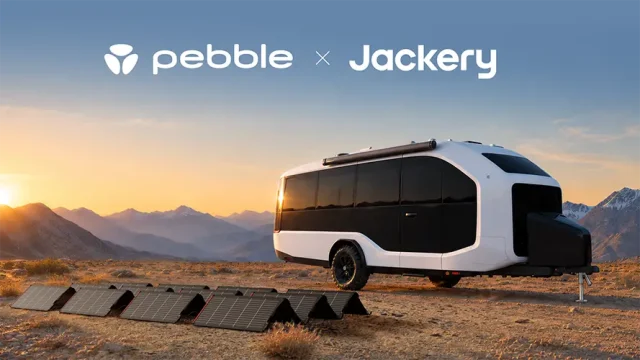
A campsite without an electrical hookup can put a different set of limits on a road trip. The view may be worth staying for, but the battery level helps determine how long travelers can comfortably remain. A new partnership between Jackery and Pebble aims to give owners of the all-electric Pebble Flow travel trailer more flexibility once they park.
Announced on October 5, 2026, the collaboration brings custom Jackery portable solar panels to the 2027 Pebble Flow through a new Self-Powered Package. The system connects directly to the trailer’s onboard energy system, adding solar charging capacity intended to support longer stays away from campground power.
For travelers, the appeal is practical: more opportunity to replenish the battery during the day, less dependence on an electrical hookup, and a way to enjoy the comforts of an RV without running a fuel-powered generator.
What the Jackery Solar Package Includes
Developed specifically for the 2027 Pebble Flow, the package includes four 500-watt solar panels, four matching three-meter extension cables, and a four-in-one solar connection junction.
Together, the portable panels provide 2 kW of rated solar capacity when deployed at a stop. They feed electricity into Pebble Flow’s existing energy system, which uses a 45 kWh lithium iron phosphate, or LFP, battery.
The arrangement brings Jackery’s solar technology into the trailer itself. Owners connect the panels to charge the onboard battery, making the additional solar generation part of the same system that supports life inside the Flow.
That integration is central to the partnership. Pebble founder and CEO Bingrui Yang says the companies wanted a solution that connected directly to the trailer’s energy system, with straightforward operation for travelers.
Understanding the Solar Capacity
Pebble’s model-year announcement clarifies how the portable panels work alongside its rooftop solar. The Self-Powered configuration combines the 1.1 kW integrated rooftop array with 2 kW of portable panels, giving the setup up to 3.1 kW of combined solar capacity.
The 2027 trailer can support up to 4 kW of total solar input with additional compatible equipment. That figure describes the system’s maximum supported input; the announced rooftop-and-Jackery-panel combination totals 3.1 kW.
For trip planning, these ratings indicate charging potential. Actual energy collected over a day will vary with sunlight, shade, panel positioning, and weather, while the amount left in the battery also depends on how much electricity travelers use.
What It Could Mean for Longer Camping Stays
Jackery and Pebble say the solar-equipped Flow can generate more electricity than it consumes on a typical day, including air-conditioning use. That is a manufacturer claim, and the announcement does not spell out the conditions or daily consumption used for the comparison.
The practical benefit is the ability to replace more of the energy used at camp while remaining parked. In suitable conditions, that could mean staying longer at a favorite site before needing another charging source.
The Flow’s all-electric approach also removes the need for propane to run its onboard living systems. Solar panels generate electricity without the engine noise or exhaust of a fuel-powered generator, an appealing difference for travelers who value a quiet campsite.
Power remains one part of planning an extended stay. Water supplies, waste-tank capacity, and the conditions at the chosen campsite still help determine how long a visit can last.
Portable Power Meets an All-Electric Travel Trailer
The partnership extends Jackery’s work in portable power and home backup into a system designed for a specific RV. Pebble Flow, designed in California and built in Fremont, sleeps up to four and combines accommodation with a substantial onboard battery.
Its energy system also supports up to 12 kW of power export, with the companies describing applications that include supplying another RV, an electric tow vehicle, or a suitably equipped home.
For readers exploring portable power on a smaller scale, DRIFT’s Jackery HomePower 1000 Plus V2 review looks at a separate product suited to camping and road trips. The Pebble collaboration applies solar charging to a much larger, integrated travel setup.
When the Self-Powered Package Will Be Available
Orders for the 2027 Pebble Flow, including the Self-Powered Package, opened on October 5, 2026. Hardware for the package is expected to begin shipping in December 2026, according to the announcement.
For RV travelers considering an all-electric trailer, the collaboration offers another way to manage energy away from hookups. Its value will ultimately come down to the places owners visit, the sunlight available, and how they use power once they arrive.
Configuration and availability details are available through Pebble.