
A country’s heritage can be found in the food people gather, the boats they build, and the ways they spend time outdoors. Up Norway’s new Norwegian Heritage Journey takes that approach to exploring the country, connecting city life with rural communities and the fishing villages of the Lofoten Islands.
The itinerary travels through Trondheim, the countryside of Trøndelag, Lofoten, and Oslo, with experiences ranging from guided foraging and farm dining to Arctic surfing and encounters with local hosts. Along the way, the emphasis is on how Norway’s landscapes have influenced daily life, food traditions, craftsmanship, and storytelling.
For travelers who want context alongside scenery, the journey offers a way to experience Norwegian culture through participation: stepping aboard a traditional wooden boat, tasting local produce, or learning about the edible ingredients found along the coast.
Trondheim: Heritage on the River and in the Wild
The journey begins in Trondheim, where the city’s long history provides an introduction to Norway’s cultural life.
A local foraging expert will lead travelers in search of wild edible ingredients, creating an opportunity to learn how seasonal foods connect people with the surrounding landscape. The experience brings the region’s food traditions outdoors, with local knowledge guiding what to look for and how to understand the ingredients encountered.
Back in the city, a private sightseeing tour aboard a traditional wooden boat follows the Nidelva River. Seeing Trondheim from the water adds another perspective to its history, with the boat itself becoming part of the story.
Together, the experiences establish the journey’s focus: heritage as something encountered in everyday practices, as well as in historic places.
Along the Golden Road to Rural Trøndelag
From Trondheim, the itinerary continues into the countryside of Inderøy along the Golden Road, a scenic detour that introduces travelers to rural Norway through local food and hospitality.
An introduction to Øyna includes a cheese and juice tasting before guests settle into an architect-designed Birdbox cabin on a working farm. The accommodation brings contemporary design into an agricultural setting, making the landscape part of the stay.
Dinner is served in a traditional stabbur, a Norwegian farm storehouse, with a meal centered on farm produce. It is a chance to spend time in a rural setting where food, buildings, and the surrounding land tell connected stories.
This part of the trip allows room for a quieter pace between the city experiences of Trondheim and the coastal adventures to come.
Lofoten: Fishing Villages and Arctic Adventure
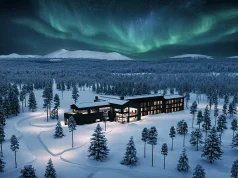
The next chapter takes travelers north to Ballstad, a working fishing village in the Lofoten Islands. Accommodation in a Hattvika Element cabin places guests close to the harbor, where fishing boats come and go beneath the surrounding mountains.
The setting provides a base for exploring the islands through a mix of activity and local encounters. Planned experiences include privately guided hiking and fishing, an Arctic surfing lesson, and lunch accompanied by storytelling in a farm landscape.
A personal seaweed discovery experience adds another dimension to the coast, drawing attention to ingredients and traditions that can be overlooked when the focus is solely on the view.
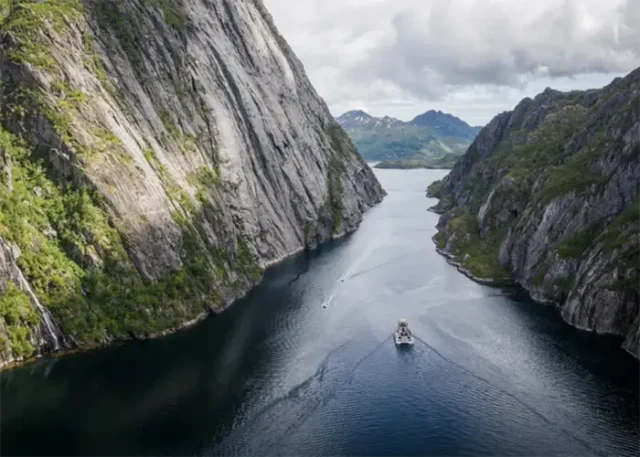
Travelers will also explore the Norwegian Scenic Route Lofoten, taking in sandy beaches, historic fishing villages, and the islands’ distinctive meeting of mountains and sea.
Walking is a natural part of this northern chapter. Readers considering a more hiking-focused trip can also explore DRIFT’s coverage of Up Norway’s approach to hut-to-hut hiking.
Oslo: A Contemporary View of Norwegian Culture
The journey concludes in Oslo, bringing the country’s urban life into the story.
A guided walking tour explores the capital’s past, present, and future, with the itinerary also featuring specially arranged access to a World War II bunker normally closed to the public. That historical encounter sits alongside time to discover the city’s contemporary design, food, and cultural scene.
Travelers are then encouraged to explore independently before a final dinner. After the farms, harbors, and outdoor experiences of the preceding stops, Oslo provides another perspective on how Norwegian identity continues to evolve.

A Journey Shaped Around the Traveler
Up Norway personalizes each trip and handles the travel arrangements, allowing guests to focus on the places and people they encounter. A digital itinerary brings together travel details, individual recommendations, and access to support from the team.
The new journey reflects the company’s broader emphasis on local hosts and experiences connected to Norwegian communities, explored further in DRIFT’s look at Up Norway’s decade of personalized travel.
Its appeal lies in the connections between each stop: food gathered outside Trondheim, farm traditions in Trøndelag, maritime life in Lofoten, and history interpreted on the streets of Oslo. Together, they offer a varied introduction to a country whose culture remains closely tied to the outdoors.
Further information and personalized itinerary inquiries are available through Up Norway.