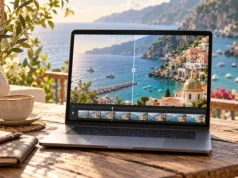


A cliff-top hotel at golden hour that does not exist. Generated with Seedance 2.5 at 720p for 98 cents.
Travel marketing runs on a handful of shots. The drone sweep along a coastline at golden hour. The slow walk up a cobbled lane to a discreet front door. A swimmer at the edge of an infinity pool as the sky turns orange. A lively market. A candlelit table with the city lights coming on below. Hotels, tourism boards and travel creators spend a great deal of money and waiting time to capture these moments: a drone pilot, a clear evening, a model, permission to film, and luck with the light.
AI video models now promise all of these shots from a sentence. We wanted to know how close they get, so we wrote five classic destination and boutique-hotel shots and generated them with Seedance 2.5, ByteDance’s latest video model. We also ran the opening coastline shot at a higher resolution and on a cheaper model, to see how much quality the price buys. Seven clips in total, $3.24, all generated in under three minutes because the requests ran at the same time.
Every place and person in this article is invented. The hotel name that appears on a sign, Hotel Mirador, was made up for the test, and as we explain below, that turned out to be an instructive mistake.
How we generated the clips
We used Seedance 2.5 through an API, which lets a short script send a description and receive a finished video file. Many platforms also offer the same models in a web page, so no coding is required to try this. All clips were five seconds long, in 16:9 landscape format, with sound generated by the model. The core of the script looks like this:
import time, requests
BASE = “https://api.apimart.ai/v1”
H = {“Authorization”: “Bearer YOUR_KEY”}
def shot(prompt, resolution=”480p”, model=”seedance-2.5″):
tid = requests.post(f”{BASE}/videos/generations”, headers=H, json={
“model”: model, “prompt”: prompt, “size”: “16:9”,
“resolution”: resolution, “duration”: 5,
}).json()[“data”][0][“task_id”]
while True:
d = requests.get(f”{BASE}/tasks/{tid}”, headers=H).json()[“data”]
if d[“status”] in (“completed”, “failed”):
return d
time.sleep(6)
Each description deliberately included at least one element that video models are known to find difficult: written text on a sign, human hands handling small objects, reflections in water, large crowds, and a precise camera movement. Those are also the elements that make or break a travel clip, because they are what a viewer’s eye looks for to decide whether a place is real.
Test 1: the golden-hour coastline
The opening shot of almost every coastal destination film is a drone gliding along cliffs at sunset. This is the description we sent:
Golden hour drone shot gliding forward along a rugged Mediterranean coastline, a small whitewashed boutique hotel perched on the cliff edge, turquoise water and rocks below, long warm shadows, sun low on the horizon, sound of wind and distant waves.
The 480p version took 2 minutes 18 seconds and cost 44 cents. It delivers the brief literally: a low, warm sun, a rugged headland, turquoise water around dark rocks, and a small white building with a flat roof and a pergola on the cliff edge. The camera glides forward and slightly up, and the hotel grows in the frame in a smooth, believable arc. The sound is gentle wind and surf.
The weakness is the light itself. The model placed the sun almost directly behind the hotel, so the building is backlit and much of the cliff falls into shadow. That is physically correct, which is to the model’s credit, but it is not the shot a hotel wants. Professional crews plan golden-hour shots with the sun to the side or behind the camera so that the facade glows. If you want that look, you have to ask for it: “the low sun lights the white facade from the side” would be a better description than “sun low on the horizon”.
Test 2: does paying more buy a better shot?

The same description at 8, 44 and 98 cents. Each version invented a different hotel on a different cliff.
We sent the identical description to Seedance 2.5 at 720p (98 cents, 2 minutes 57 seconds) and to Seedance 2.0 mini, the cheapest model in the family (8 cents, 2 minutes 5 seconds). The result is a useful lesson about what you are paying for.
The 720p version is sharper, as expected, and its composition is different: a taller headland, the sun just clearing a ridge, a sharper beam of light, and a longer white building. The 8-cent version from the smaller model is perhaps the most “brochure” of the three: a four-storey white hotel stepping down the cliff, pine trees, a beach cove, and a bright path of sunlight on the sea. Many marketers would choose it.
What none of them did was show the same hotel. Each request generates a new place from scratch. That is fine for mood footage, but it means you cannot render a shot cheaply, approve it, and then re-render the identical shot at higher quality by changing the resolution. You get a new coastline. For campaigns, the practical workflow is to explore ideas cheaply, then generate your final shots at the resolution you need and choose the best one, rather than upscaling an approved draft.
Test 3: a hotel sign, a hand and a key

The sign is spelled correctly and the hand and key look natural, across a cut the model added on its own.
Text on signs and hands handling objects were the two classic failures of earlier video models. We combined both in one description: a handheld walk up a cobbled lane to the entrance of a small boutique hotel, a polished brass sign by the door reading HOTEL MIRADOR, then a receptionist’s hands sliding an old brass room key across a marble counter. Cost 44 cents, 2 minutes 31 seconds.
This was the strongest clip of the set. The lane is a convincing European old town at blue hour, with half-timbered houses, wet cobbles and warm street lamps. The camera drifts toward a wall where a black-and-gold plaque reads “HOTEL MIRADOR” in an elegant serif typeface, spelled correctly and stable as the camera moves. The model then cut, on its own, to a close-up at a marble reception desk lit by a table lamp, where a hand slides a large antique key toward the camera. The hand has five fingers, the knuckles bend naturally, and the key’s teeth and bow look like real brass. The receptionist’s face stays soft in the background, which keeps the attention on the key.
Now the instructive mistake. We chose “Mirador” because it sounds like a hotel. A quick search afterwards found real hotels with exactly that name in Spain, the Philippines and Belize, among others. A generated clip with a real hotel’s name on the door could easily mislead travellers or annoy that hotel. If you are making mood footage, use your own property’s name, or a name you have checked, or no legible name at all.
Test 4: the infinity pool and its reflections

The infinity pool: the water picks up the sunset colour, but the palms are not mirrored and the white swimsuit never appears.
Water is where AI video often gives itself away, because reflections must match the scene above them. We asked for an infinity pool on a hotel terrace at sunset, a woman in a white swimsuit swimming slowly toward the edge, the orange sky and palm trees reflected in the still water, and a static wide shot. Cost 44 cents, 2 minutes 31 seconds.
The overall picture is attractive: a peach-coloured sky, a row of palms, a modern hotel block with balconies, and a pool edge that disappears into the view. But the details did not follow the description. The surface carries the warm colour of the sky, yet there is no mirrored image of the palms, and with the calm water we asked for there should be. The swimmer is only a head and shoulders moving slowly across the pool, so the white swimsuit we specified is never visible. And the “static wide shot” is static, which is correct but leaves the clip feeling flat compared with the moving shots.
For a hotel’s own marketing, this is also the most problematic type of shot. A pool is a real amenity that guests will judge on arrival. A generated pool that looks nothing like yours is not mood footage. It is a misrepresentation.
Test 5: a crowded market

A crowded market at walking pace. Faces, hands and stalls stay coherent over five seconds.
Crowds used to be a reliable tell: faces melted, people merged into each other, and limbs multiplied. We asked for a crowded old-town market on a sunny morning, shoppers and tourists walking between stalls of fruit, spices and woven baskets, with the camera moving forward through the crowd at walking pace. Cost 44 cents, 2 minutes 31 seconds.
The result is impressively coherent. The camera moves through a narrow lane past heaped mangoes and bananas, then woven baskets and sacks of brightly coloured spices. At least a dozen people are clearly visible, each with a distinct face, outfit and walk, and they move at different speeds in different directions without colliding or merging. In one frame a woman in a sun hat points at a stall while her companion turns to look, a small human moment that makes the scene feel observed rather than staged. Even at 480p, we found no melting faces or extra limbs in the frames we checked.
The weakness is subtler. The market is a generic “Mediterranean or North African” souk, with fruit that would not all be in season together and tourists who look like stock footage. It conveys “lively market” well. It conveys no particular city.
Across the five shots, each 480p clip cost the same 44 cents for five seconds, or about 8.7 cents per second, and the 720p version cost a little over twice as much. If you are budgeting a reel, the published Seedance 2.5 API cost per second at each resolution is the number to multiply by your running time, plus a margin for the takes you throw away.
Test 6: the rooftop dinner and the camera move

Our last description asked for the camera to do something specific: a slow 180-degree orbit around a candlelit table for two on a rooftop terrace at dusk, with wine glasses, plates of grilled fish and the city lights coming on below, while a waiter’s hand pours red wine. Cost 44 cents, 2 minutes 31 seconds.
The details of the table are lovely. Cut-crystal glasses catch the candlelight, the grilled fish looks properly charred, and the waiter’s hand pours a clean stream of red wine into one glass, which fills to a realistic level. But the orbit did not happen. Comparing the first and last frames, the camera drifted only a short distance sideways; the candle that stood behind the left glass ends up between the two glasses. That is a modest arc, nowhere near a half circle.
More surprising was the background. In the first frame, the view below the terrace is a wide, hazy spread of city lights with dark hills. By the last frame, a cluster of downtown towers has appeared on the horizon. A viewer might not notice in five seconds, but it is exactly the kind of change that makes a location feel invented, and it would be impossible to match with any other shot of the same place.
Test 7: the scorecard

Our verdicts across the five Seedance 2.5 clips at 480p.
Summing up the five 480p clips: Seedance 2.5 handled the things travel marketers used to worry about most, signs, hands and crowds, better than we expected. Golden light was convincing, though not always flattering. What broke was the model’s obedience to specific instructions: a requested swimsuit colour, a requested camera move, and reflections that should follow from the scene. And in one clip, the location itself changed during the shot.
The pattern is consistent with what we have seen in other tests: video models now render surfaces and atmosphere very well, but they treat a description as a set of suggestions rather than a shot list. The more a shot depends on several specific things happening together, the more likely one of them is missing.
Test 8: from clips to a website reel

The downloaded files are heavy. A silent web version is 91 to 95 percent smaller.
Many hotels want a short, silent background loop for their website header rather than a social video. We took four of the clips and re-encoded them as silent web video, using a standard setting (x264 at CRF 28 with fast start) that keeps them visually clean. The 480p coastline shrank from 4.1 MB to 220 KB, the 720p coastline from 8.7 MB to 448 KB, the market from 6.1 MB to 533 KB and the pool from 2.2 MB to 148 KB. The downloaded files are encoded at very high bitrates, up to about 14 megabits per second for the 720p clip, which is wasteful on a web page.
Two practical notes. First, the generated sound was quiet, measured at −29.8 LUFS for the coastline and −25.8 LUFS for the market, well below the level of most social video, so for social posts you will want music or a voice-over anyway. Second, every downloaded file contained embedded provenance metadata stating that it was AI-generated, but re-encoding for the web removed it. If you want your site to disclose that a clip is generated, you will need to say so in the page itself.
Test 9: what a destination reel costs

Seven clips, $3.24, all generated in parallel.
The full test cost $3.24: $2.18 for five Seedance 2.5 clips at 480p, 98 cents for the 720p coastline, and 8 cents for the mini version. Waiting times ranged from 2 minutes 5 seconds to 2 minutes 57 seconds, and because the requests run in parallel, the whole set was ready in about three minutes. Five usable clips make a 25-second reel. A realistic project would generate two or three takes of each shot and choose the best, which would put a 30-second destination reel at roughly $10 to $15 at 480p, or about twice that at 720p.
That is a tiny fraction of the cost of a drone pilot and a golden-hour shoot. But it buys something different. A shoot captures your place. These clips capture a place like yours.
Where AI clips fit in travel marketing, and where they do not
There is a sensible line to draw, and it follows from the tests above. Generated footage works well for atmosphere that is not a promise: a generic sunset over the sea, a lively market, rain on a cobbled lane, steam rising from a coffee cup. It is risky for anything a traveller will compare with reality on arrival: your pool, your rooms, your view, your beach, your neighbourhood. Advertising standards in most countries require that ads do not mislead consumers about what they are buying, and a generated infinity pool attached to a real hotel listing is an obvious way to fall foul of that.
The most useful approach we see is a hybrid one. Film your real property, even on a good phone, and use generated clips as transitions, openers and mood pieces between the real shots. Label the generated parts, either in the caption or with a small on-screen note. And if you use a hotel or business name on a generated sign, make sure it is yours.
Checklist for travel and hotel clips
- Describe the light, not just the time. “Sun low on the horizon” gave us a backlit, shadowed facade.
- Explore on the cheap model, finalise at full price. Changing resolution or model gives a new location, not a sharper version.
- Signs and hands are now reliable. HOTEL MIRADOR was spelled correctly and the key-handling hand looked natural.
- Check reflections and clothing. The palms were not mirrored and the white swimsuit never appeared.
- Do not rely on precise camera moves. A requested half circle became a short arc.
- Watch the background. Hills turned into a skyline within five seconds.
- Check names before you put them on a sign. Ours belonged to many real hotels.
- Never generate your actual amenities. Use AI for mood, film the pool and rooms you sell.
The walkthrough video
The narrated video below shows all seven clips with our notes on what held up and what broke.
Walkthrough: destination and boutique-hotel clips generated with Seedance 2.5 (about 3 minutes).
The bottom line
Seedance 2.5 can now produce golden-hour drone shots, legible hotel signs, natural hands, believable crowds and candlelit tables for under half a dollar per shot, and most viewers would accept them as filmed. It still ignores parts of a careful description, mirrors water only loosely, and sometimes changes the location in the middle of a shot. For travel brands, that makes it an excellent tool for mood and a poor substitute for showing the real place. If you want to experiment with the same models, including the cheaper draft tier we compared, they are available on the APIMart platform.