
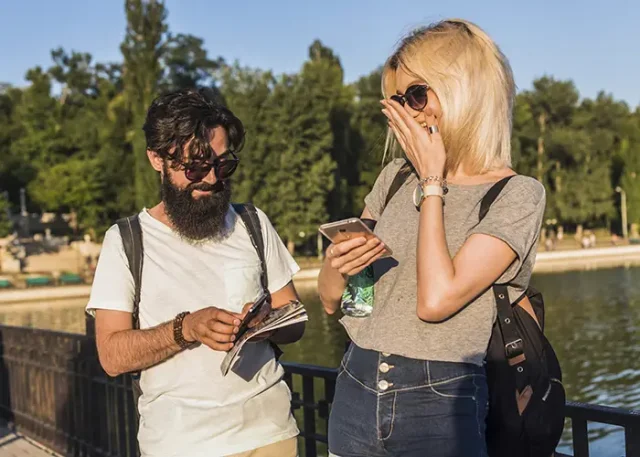
A beach in Portugal, a hostel bar in Thailand, a coffee shop in Buenos Aires. The person sitting across from you has a return flight booked in 10 days, and so do you. You exchange numbers anyway. Maybe Instagram handles. You tell yourself you will figure it out later.
Most people assume these connections dissolve the moment the plane touches down at home. The skepticism makes sense. Geography is a stubborn obstacle, and the vacation version of a person rarely matches the one who shows up on a Tuesday after a bad day at work. But writing off travel romances entirely ignores what actually happens to some of them.
The Numbers Behind the Postcard Romance
A survey conducted by Appinio for MEININGER Hotels in January 2025 asked 1,000 participants about their vacation love stories. Over a quarter reported falling in love while on a trip. Of that group, 45.8% said the connection stayed a short fling. But 16.4% watched their romance become a long-term relationship. Nearly a quarter considered that person the love of their life.
These figures suggest something less romantic and more practical. Vacation romances fail most of the time. They also succeed often enough to warrant taking them seriously.
The same survey found 39.8% of respondents believed falling in love comes easier while traveling. People attribute this to a relaxed state of mind and a willingness to talk to strangers. The context matters. You are not worried about your commute or your inbox. You have time to sit and actually listen to someone.
Finding Love in the Wrong Zip Code
People seeking connection abroad often turn to technology before arriving at their destination. Dating apps are widely used among travelers who want to meet people, date, or make plans in new cities. Tinder Plus offers a subscription feature called Passport that lets users set their location in advance to any city worldwide. Bumble’s Travel Mode, available through a Premium subscription, allows users to select the city their profile appears in for 7 days so they can start meeting people ahead of a trip.
Beyond mainstream platforms, travelers also use niche apps that cater to specific relationship types or lifestyle preferences. People who enjoy alternative relationship structures like ethical non-monogamy, polyamory, or platonic intimacy will find a dating base on Feeld, which hosts a large glossary of romantic and sexual preferences. Score is a dating platform with a high standard for entry: a good to excellent credit score of 675 or above. Others prioritize mentorship-style arrangements through a sugar dating app. Bumble data shows 33 percent of users are open to dating someone in another city, and long-distance relationships succeed about 60 percent of the time according to 2024 statistics..
Where It Usually Starts
Location plays a role in how these connections form. The MEININGER survey found 25.6% of respondents met their vacation romance in public areas of their accommodation. Lobbies, shared kitchens, rooftop terraces. Places where strangers end up in the same space with nothing to do but talk.
Beach holidays accounted for 46.2% of cases where travelers met a romantic partner. The setting lends itself to extended conversations. You are not rushing anywhere. Neither are they.
Chemistry tends to arrive quickly in these situations. The survey reported 71.8% of respondents felt it within a few days. Another 20.6% met their vacation love right after arriving. Speed does not automatically mean superficiality. Sometimes two people simply recognize compatibility faster when neither is distracted by ordinary life.
The Long-Distance Problem
A travel romance that survives the trip still faces an obvious hurdle. Someone has to get on another plane, or both people have to keep getting on planes, or one person has to move. None of these options are simple.
Long-distance relationships succeed more often than people assume. Data from 2024 puts the success rate around 58% to 60%. These numbers apply to couples who commit to making the arrangement work, not to casual connections that fizzle after a few video calls.
The willingness to try matters. Plenty of Fish data indicates members increasingly consider traveling or relocating for the right person. A Pew Research Center report from 2023, cited by CNN, found that 40% of recent dating app users were looking for a long-term partner or spouse. People are not always looking for something disposable.
What Travel Does to Couples
Research published in ScienceDirect in February 2024 examined 238 partners who traveled together. Couples reporting more novel and self-expanding activities during vacations showed higher romantic passion and relationship satisfaction afterward. A separate part of the study looked at 102 couples and found that those with more novel shared moments reported greater physical intimacy after returning home.
Travel forces couples into unfamiliar situations. You have to make decisions together in real time. You see how someone handles a missed train or a language barrier or a disappointing hotel room. TravelAge West reports 73% of couples consider travel the ultimate relationship test.
This cuts both ways. A trip can reveal incompatibility as easily as it can strengthen a bond. But for couples who handle the stress together, the payoff seems to extend past the vacation itself.
The Role of Technology
Dating apps have changed how people approach travel romance. A 2024 survey from SSRS found 37% of American adults have used a dating site or app at some point. Among adults aged 18 to 29, the number jumps to 56%.
Bumble’s 2024 global survey of over 25,000 users found nearly a third were practicing slow dating, being deliberate about how often they went on dates. The approach suggests people are filtering for quality over quantity, even when using technology to meet partners abroad.
The platforms themselves report positive outcomes. Bumble claims responsibility for over 5,000 engagements and weddings worldwide. About half of matches on the app turn into conversations.
Why Some Survive and Others Don’t
Emotional connection seems to matter more than physical attraction for longevity. Bumble research found 32% of users surveyed believed emotional intimacy is more important than sex and more attractive than a physical connection.
Travel romances that last tend to involve two people who share values and communication styles, not two people who happened to be attractive to each other in a beautiful location. The setting can accelerate attraction, but it cannot manufacture compatibility.
The MEININGER survey found opinions split on long-term potential. About 25.3% of respondents believed vacation romances cannot last. Nearly as many, 23.5%, thought they had a real chance. The data supports both perspectives. Most of these relationships do end. Some of them become permanent.
The Honest Answer
Dating while traveling works out long-term for a minority of people who try it. The odds favor short flings and pleasant memories over lasting partnerships. But the odds also favor someone, somewhere, building a life with the person they met on a trip they almost did not take.
The question is less about probability and more about what you are willing to do. Long-distance requires effort, money, and patience. It requires two people who want the same outcome badly enough to accept inconvenience as the price of admission.
A vacation romance is a gamble with low chances and high stakes. Some people win. Most do not. The math has not changed. What changes is the person deciding to place the bet.