Traveling by e-bike can make a destination feel more accessible. Hills become manageable, longer routes open up and travelers can explore well beyond the usual tourist districts. The drawback is that an e-bike is valuable, recognizable and often easier to resell than a conventional bicycle.
Protecting one requires more than buying the thickest-looking lock on the shelf. The most effective approach combines a tested primary lock, a second layer of security, careful parking, secure overnight storage and a record of the bike’s identifying details.
No lock can make an e-bike impossible to steal. A good security setup is designed to increase the time, effort, noise and number of tools required—often enough to persuade a thief to choose another target.
Start With an Independently Rated Lock
Packaging claims such as “heavy duty” and “maximum security” are not standardized. Independent ratings provide a more useful basis for comparison.
Sold Secure tests locks against defined attack methods and publishes separate ratings for pedal cycles and powered cycles, a category that includes e-bikes. Diamond is its highest powered-cycle rating, followed by Gold. Some insurers specify an approved rating, so travelers should read their policy before buying a lock rather than assuming that any premium model will qualify.
For an expensive e-bike that will be left in a city or other high-risk location, look first for a Sold Secure Powered Cycle Diamond or Gold rating. Also check the exact model and size in the current database; similar product names do not always share the same certification.
The Best Type of Lock for an E-Bike
U-Locks: The Strongest Everyday Choice
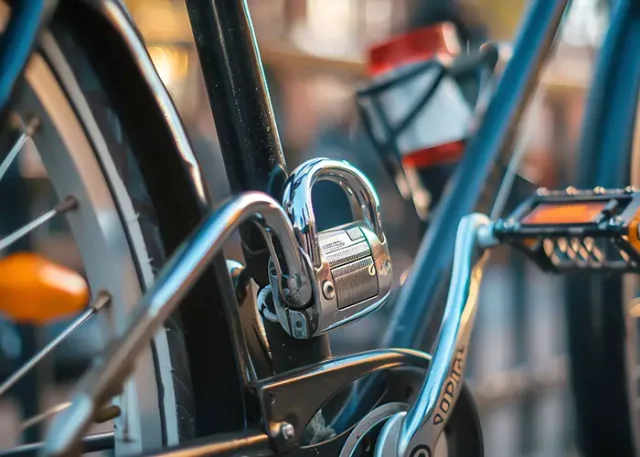
A high-quality U-lock, also called a D-lock, is usually the best primary lock for travel. Its rigid shape gives thieves less material to manipulate than a long chain, while a close fit leaves less room for leverage attacks.
Newer anti-angle-grinder models use composite materials around a hardened metal core. They are not indestructible, but they can require substantially more cutting time, abrasive discs and battery power than a conventional steel lock. That extra resistance is particularly valuable for high-end e-bikes parked in urban areas.
The tradeoff is fit. Compact U-locks are easier to carry and leave less room for tools, but they may not fit around oversized e-bike tubes and a thick rack. Measure the frame and consider the types of bike stands found at the destination before choosing a size.
Chain Locks: Flexible but Heavy
A hardened chain can be easier to route around a cargo bike, step-through frame, lamppost or awkward bike rack. The strongest chains are also extremely heavy, making them more suitable for an RV, vacation rental or long-term storage location than for carrying on every ride.
When using a chain, keep it tight and off the ground. A loose chain resting on pavement gives a thief a stable surface for cutting or striking it.
Folding Locks: Convenient, With Compromises
Folding locks pack neatly onto a bike and provide more reach than many U-locks. They can be useful where racks are inconsistent, but the joints introduce additional potential attack points. Choose one with a respected independent rating and treat portability—not maximum resistance—as its main advantage.
Cable Locks: Accessories, Not Primary Security
A cable can help secure a helmet, saddle or front wheel, but it should not be the only lock protecting an e-bike. Even a thick cable is generally much easier to cut than a quality U-lock or hardened chain. REI’s lock guidance similarly recommends cables for removable components rather than the bike frame.
Quality E-Bike Locks and Anti-Theft Gear on Amazon
Availability and sellers can change, so confirm the exact model, dimensions and certification before ordering. Avoid look-alike listings with a similar product name.
Hiplok D1000: Premium Protection for High-Risk Stops
The Hiplok D1000 is designed to resist angle-grinder attacks and carries Sold Secure Diamond ratings for both pedal cycles and powered cycles. Its internal locking area is approximately 6.1 by 3.6 inches, and it weighs about 4.25 pounds.
That compact opening can limit where it fits, but it also reduces space for leverage tools. It is a strong choice for a valuable e-bike routinely parked in a city.
Kryptonite New York Fahgettaboudit Mini: Compact Conventional Security
The Kryptonite New York Fahgettaboudit Mini uses an 18 mm hardened-steel shackle with a double-deadbolt design. It is compact and carries a Sold Secure Pedal Cycle Diamond rating.
At about 4.55 pounds, it is substantial, and the small opening demands careful parking. It is an excellent conventional U-lock, although buyers specifically concerned about portable angle grinders may prefer a purpose-built anti-grinder model.
ABUS Granit XPlus 540: A Practical Balance of Reach and Security
The ABUS Granit XPlus 540 provides more usable locking space than many mini U-locks while remaining relatively manageable at approximately 3.3 pounds.
The current model is rated Sold Secure Pedal Cycle Diamond and Powered Cycle Gold. It is a sensible option for travelers who need a strong lock that fits a wider range of racks.
Kryptonite Evolution 1090: A Flexible Second Lock
The Kryptonite Evolution 1090 Integrated Chain uses 10 mm manganese-steel links, measures about 35.5 inches and weighs approximately 6.1 pounds.
Its flexibility works well with bulky frames and awkward anchors. Because of the weight, it is better carried in a pannier or kept at a regular overnight base than worn by the rider.
Knog Scout: An Alarm and Tracker for iPhone Users
The Knog Scout Bike Alarm and Finder combines an 85-decibel motion-sensitive alarm with Apple’s Find My network. It mounts to standard bottle-cage points and can be concealed beneath a bottle cage.
It is compatible with iOS, not Android, and should be viewed as a recovery aid and extra deterrent—not a substitute for a physical lock.
Use Two Locks in Higher-Risk Locations
Two locks do more than double the visible security. Using different types—such as a U-lock and a chain—may force a thief to use different tools and spend more time at the bike.
For a travel setup, use the strongest U-lock around the frame and an immovable rack, then use the second lock to secure the other wheel and frame.
How to Lock an E-Bike Correctly
Even an expensive lock can fail if the bike is attached to a weak object or only secures a removable wheel.
- Choose a real anchor. Use a purpose-built rack or another solid object fixed to the ground. Tug on it and check that the bike cannot simply be lifted over the top.
- Lock the frame, not just a wheel. Capture the main frame and the rack with the primary lock. If space allows, include the rear wheel as well.
- Remove empty space. Position a U-lock tightly so there is little room to insert a pry bar, jack or cutting tool.
- Keep the lock away from the ground. A raised lock is harder to strike and gives a thief less support while cutting.
- Secure both wheels. Use the second lock for the front wheel, or replace quick-release hardware with locking skewers or security bolts.
- Take removable accessories. Bring the display, lights, GPS unit, panniers and helmet with you whenever practical.
Bike Index recommends locking the frame to an immovable object, securing both wheels and continuing to lock the bike even inside a supposedly secure room.
E-Bike Security at Hotels and Vacation Rentals
Ask about bike storage before booking rather than after arrival. “Bike-friendly” may mean anything from a locked indoor room to an exposed rack beside the parking lot.
Useful questions include:
- Is the storage room locked and accessible only to guests or staff?
- Is there a fixed rack or ground anchor inside?
- Can the e-bike remain locked to an immovable object overnight?
- Is battery charging permitted, and is there a designated charging area?
- Does the property assume responsibility for bikes stored there?
Lock the e-bike inside the storage room. Bike theft also occurs in garages, cages and communal storage areas, and a closed door should not replace the bike’s own locks.
If a removable battery is permitted inside, take it with you along with the display. Use the manufacturer’s charger and follow the property’s charging rules; do not charge a damaged, wet or unusually hot battery.
Protecting an E-Bike on a Vehicle Rack
The cable included with a hitch rack is useful for brief stops but may not provide enough protection for an expensive e-bike. Lock the rack to the vehicle, then add a separate high-security lock between the bike frame and a solid part of the rack. Check that the rack itself cannot be released with an exposed lever or pin.
Remove the battery if the manufacturer permits it. This reduces weight on the rack and makes the bike less appealing and harder to ride away. Keep the battery and display out of sight inside the locked vehicle.
Do not leave an e-bike on an exterior vehicle rack overnight if indoor storage is available. REI advises bringing an e-bike indoors for overnight stays because a determined thief can defeat a rack’s integrated cable.
Registration, Documentation and Insurance
Before the trip, photograph the complete bike, serial number and any distinctive marks. Save the purchase receipt and record the motor, battery and lock serial numbers where available.
Register the bike with a recovery service such as Bike Index, which offers free bicycle registration.
Review insurance details before departure. Home, renters, travel and specialty bicycle policies can differ in how they treat theft away from home, theft from a vehicle and e-bike classifications. Confirm the required lock rating, overnight-storage conditions, geographic coverage and documentation needed for a claim.
A tracker can help establish a bike’s last known location, but riders should not confront a suspected thief. Share the registration, serial number, photos, tracker information and police report with local authorities and the insurer.
A Simple E-Bike Security Checklist for Travelers
- Pack one independently rated high-security U-lock.
- Add a second lock of a different type for city or overnight parking.
- Confirm that both locks fit the bike’s frame and likely rack styles.
- Remove the battery, display and accessories when practical.
- Arrange locked indoor storage before booking accommodations.
- Photograph and register the bike before departure.
- Save receipts, serial numbers and insurance information online.
- Use an alarm or tracker only as an additional layer.
- Never rely on a cable lock alone.
Travel security is ultimately about reducing opportunity. A high-quality lock, used correctly and supported by smart parking and good documentation, makes it much less likely that an e-bike adventure will end with an empty rack.