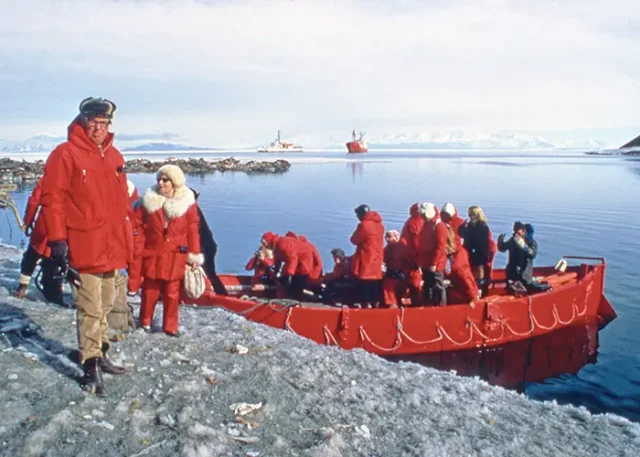
Today marks the 60th anniversary of a defining moment in expedition travel. Sixty years ago today, Lars-Eric Lindblad led the first group of non-scientific travelers to Antarctica, opening one of the world’s most remote regions to curious explorers and forever reshaping how people experience the planet.
That landmark voyage in 1966 laid the foundation for modern expedition cruising. Just one year later, Lindblad brought the first civilian expedition to the Galápagos Islands, reinforcing a vision that was never limited to a single destination or climate. From the outset, Lindblad Expeditions was built on the founding principle that expedition travel has the power to reshape how people experience and perceive the world.
“Lars-Eric Lindblad pioneered expedition travel with a simple belief: how you see the world matters,” said Natalya Leahy, CEO of Lindblad Expeditions. “Sixty years after the voyage that started it all, that vision continues to guide us. Every sailing is shaped by decades of experience, deep relationships with local communities, and the expertise of some of the world’s most seasoned captains, navigators, and naturalists. What defines our expeditions isn’t just where we go, but how we approach each place—creating life-expanding moments that spark curiosity and stay with our guests long after they return home.”
National Geographic-Lindblad Expeditions now sails to more than 100 destinations worldwide, spanning iconic regions such as Antarctica and the Galápagos alongside expeditions across Europe, Asia, Africa and beyond. From Greece and Croatia to Egypt, India, and Vietnam, each itinerary is defined by immersive, expert-led experiences that foster deeper understanding and connection to place.
As a recognized leader in expedition travel, Lindblad Expeditions continues to set industry benchmarks through purposeful innovation, including the launch of National Geographic Endurance, the first PC-5 polar class ship built for civilian expeditions, and private flight access in and out of Puerto Natales, Chile as part of its Antarctica Direct: Fly the Drake Passage itinerary, expanding access while enhancing the expedition experience.