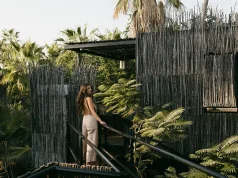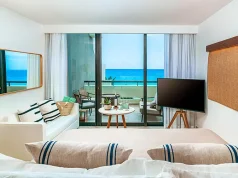
At La Mejorada, one of the most evocative neighborhoods in the historic center of the White City, a grand house of high walls and deep courtyards comes back to life behind its doors. Just steps from the former Franciscan convent, the Railway Museum, the Museum of Yucatecan Song, and the recently renewed Parque La Plancha, echoes of the peninsula’s first railway lines still linger in the streets. Where travelers once arrived by train, a house now opens its doors to those looking to pause in Mérida and allow the city to reveal itself slowly: through morning coffee, map-free walks, and warm evenings by the water. The sound of bicycles, distant street calls, and the rising heat complete a daily tableau that welcomes guests and sets the rhythm of the days unfolding within.
The spirit of this new house is born from a desire to reclaim the calm that lives in the grand homes of the historic center: high ceilings, shaded corridors, and tree-filled courtyards where light filters through leaves. Crossing the threshold means leaving the bustle behind and entering a more intimate world of cool shadows and quiet courtyards. Rather than a conventional hotel, the feeling is one of arriving at a thoughtfully inhabited home, where each room seems prepared to welcome someone staying for a few days—opening the windows, arranging their books, and experiencing Mérida from within. Everything invites guests to lower their voices, slow their pace, and let climate, light, and texture set the agenda.
The architectural project—led by Roger Escalante—respects the essence of the residence, protected by Mexico’s National Institute of Anthropology and History. Its proportions, original structures, and the distinctly Yucatecan way of connecting indoors and outdoors through courtyards, corridors, and entryways have been preserved. New volumes with serene lines integrate seamlessly into this scheme, engaging in dialogue with the garden and the light. Chukum walls, tropical woods, pasta tile floors, stone, and clay evoke the region’s building traditions, creating cool spaces meant to be experienced barefoot—places to leave a towel in the sun, rest a book by the pool’s edge, and feel the daystretch out effortlessly. Every gesture invites the eye upward, tracing historic moldings and discovering greenery emerging between walls and rooftops.
Interior design by Stacy Echeverría deepens this vision through a palette of beige and black tones that distinguishes CIGNO Mejorada from its sister property in La Ermita. Petatillo patterns run along walls and screens, custom-madefurniture nestles into niches and corners, and lamps cast a warm, intimate glow. A quiet luxury reveals itself in thedetails: a chair by the window to watch the rain, a stone bench inviting rest in the shade, a shelf of books about Yucatán to leaf through before sleep. Objects feel arranged with a sense of everyday familiarity, as if they belonged to the memory of a family that has lived here for generations.
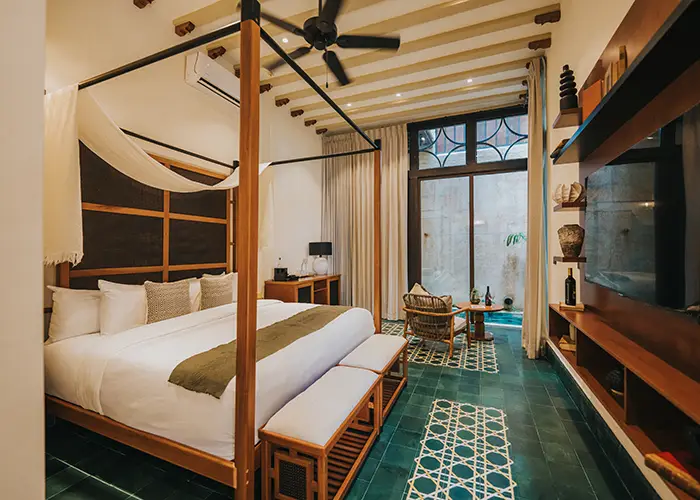
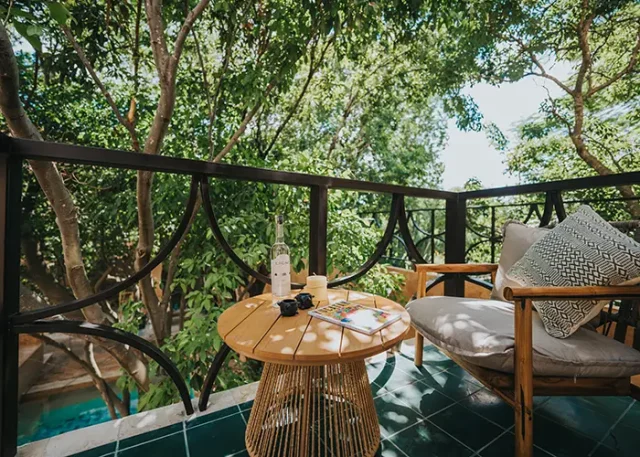
The hotel’s 22 rooms are distributed between the original house and new structures embracing the garden. Some preserve original floors and restored beams that tell the story of the residence, while others open onto more secluded spaces with private pools, hammocks, and generous vegetation—intimate retreats in the very center of the city. Four pools dotted around the property invite guests to experience the water at different moments of the day, and each room proposes its own way of inhabiting Mérida. This serene, enveloping atmosphere defines the hotel’s character: a discreet setting where time adjusts itself to conversation, shared silence, and unhurried pauses, while the cultural lifeof the historic center waits just outside.