
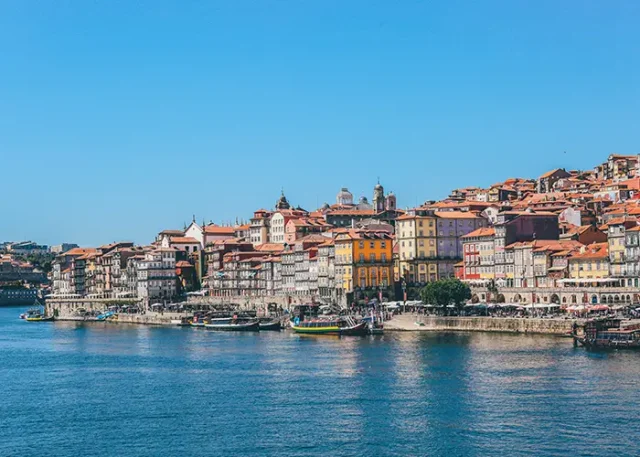
A month is the right length of time for Porto. Three nights is enough for most city breaks, and in Porto that buys you the Ribeira waterfront, a port lodge across the river in Vila Nova de Gaia and one sunset from the Dom Luís I Bridge. Four weeks gives you a routine: the same bakery in the morning, a metro stop you know by heart, and weekdays free for the Douro Valley and the Atlantic beaches.
These six steps take you from choosing a base to setting a budget.
1. Choose the neighborhood before the flat
Porto is compact, but its neighborhoods feel very different, and on a long stay the street you live on matters as much as the flat.
The historic center and Ribeira put you on the river, a short walk from the cathedral and the bridge, with crowds to match from spring to autumn. Cedofeita, west of the center, has the city’s gallery scene and plenty of cafés. Bonfim, to the east, is mostly residential, with old commercial buildings turned into apartments, and it is quieter at night. Boavista is the business district, with wider avenues and good transport links.
If you want to wake up near the sea, look at Foz do Douro, where the river meets the Atlantic, or Matosinhos a little further north, with its long beach and grilled-fish restaurants. Both are calmer than the center, and you will spend more time on trams and the metro getting into town. Campanhã, around the main railway station, is the practical choice if you plan a lot of day trips by train.
A few pages are worth reading before you commit:
- Visit Porto, the city’s official tourism site, for events and opening hours during your dates
- a neighborhood-by-neighborhood guide to Porto’s property market, which describes what each district is like to live in and what homes there cost
- Metro do Porto, for the network map, so you can check how far a listing is from the nearest station
2. Book one flat for the whole month
Filter searches by monthly stay. Many hosts on the big rental platforms discount stays of 28 nights or more, and some list month-long lets only.
Before you pay, ask the host three things: the measured internet speed, whether the flat has heating, and how many flights of stairs stand between the front door and your bed. Porto winters are damp and rainy, and plenty of older buildings in the center have no elevator.
Holiday lets in Portugal are licensed as Alojamento Local, and the listing should show the registration number. If it does not, ask for it before you pay.
3. Get an Andante card in your first days
Porto’s metro, city buses and suburban trains share one ticket system, the Andante card. The violet metro line runs from the airport into the city, so you can buy a card at the airport station and use it straight away.
For a month, a monthly pass usually beats topping up single trips. The metropolitan pass costs around €40 and covers the whole Porto area, but it has to be loaded onto a personalized card, which you request with ID and a photo. Apply in your first week so the card is ready when you need it.
Walk whenever you can, and plan for hills. The center climbs steeply from the river, and the Guindais funicular between Ribeira and Batalha saves your legs on the worst stretch.
4. Build your working week around the time zone
Portugal keeps the same time as London, five hours ahead of New York and eight ahead of California. If your team is in the US, your mornings are free and your meetings fall in the late afternoon and evening. Use the mornings for the city and do focused work after lunch.
Porto has coworking spaces with day passes and monthly desks, and a trial day will tell you more than the photos. A café works for an hour of email; for video calls, book a desk with a door or a phone booth.
Check the paperwork before you plan more than a visit. Travelers from the US, UK, Canada and Australia can generally spend up to 90 days in any 180-day period in the Schengen area without a visa, and a month in Porto fits well inside that. If the month turns into plans for a longer stay, the rules change. As a guide to Portugal’s D8 remote-work visa explains, applicants in 2026 need a foreign income of at least €3,680 a month, four times the Portuguese minimum wage.
5. Give the Douro a full day and the coast a few afternoons
The Douro line runs east from São Bento and Campanhã stations into wine country, and after Régua the track follows the river past terraced vineyards. Pinhão, a little over two hours from Porto, is the usual stop for a day trip, with several wine estates within walking distance of the station. Take an early train so you have time for a tasting and lunch before the ride back, and sit on the right-hand side heading east for the river views. CP, the national rail operator, publishes the timetables.
The coast takes less planning. Tram 1 runs along the river from near the Ribeira to Foz, where you can walk the seafront promenade to the beaches. Matosinhos is on the blue metro line. Further out, Aveiro and Guimarães are each about an hour away by train and make good weekday trips, when their old centers are quieter.
6. Set a monthly budget
Rent is the biggest cost, though it runs about a fifth below Lisbon rents. Long-term listings for a one-bedroom apartment in Porto run from roughly €1,100 to €1,400 a month, and a furnished month-long stay usually costs more once platform and cleaning fees are added. Food, utilities and everyday spending for one person come to a little over €700 a month on top of that.
Then add the extras: the transport pass, one or two Douro days with train fares and tastings, and a coworking membership if you need one.
Set that total before you start searching, filter listings by your monthly ceiling and by walking distance to a metro station, and book the first flat that passes both.