
More of us are choosing to holiday at home with our dogs rather than book kennels or a pet sitter. A UK road trip gives you the freedom to stop where you like, explore beaches, forests and hills together, and avoid the paperwork of travelling abroad with a pet. It also means hours in the car for your dog, so a good trip starts well before you load the boot.
This guide walks through planning the route, what to pack, how to keep your dog safe on the road and how to make overnight stays go smoothly.
Plan the route around your dog
A route that works for you may be too much for your dog. Most dogs cope best with shorter driving days and regular breaks, so think about breaking a long journey into two days rather than pushing through in one.
- Plan a stop roughly every two hours for a walk, water and a toilet break.
- Look for stopping points with green space: country parks, forest car parks and motorway services with dog walking areas.
- Avoid driving through the hottest part of the day in summer. Early mornings and evenings are cooler and usually quieter on the roads.
- Build in time at each destination for a proper walk before you check in, so your dog can settle more easily.
Your road trip packing list
Pack your dog’s things in one bag that stays in the car rather than in the boot under the luggage. That way, everything you need at a service station or lay-by is within reach.
- Food for the whole trip plus a couple of extra days, in case you are delayed.
- Water and a travel bowl. Spill-proof bowls designed for cars are worth the small cost.
- Lead, spare lead and harness.
- Poo bags, towels and a waterproof seat cover.
- Bedding and a favourite toy, which help a dog settle in unfamiliar places.
- Any medication, plus a copy of your dog’s vaccination record and your vet’s phone number.
- A basic pet first aid kit.
Before you set off: restraint and the law
Rule 57 of the Highway Code says animals in a vehicle must be suitably restrained so they cannot distract the driver or injure you, or themselves, if you stop quickly. It lists seat-belt harnesses, pet carriers, dog cages and dog guards as suitable options.
This matters for more than comfort. Driving with a loose dog could lead to a charge of careless driving if it distracts you, and an unrestrained pet may affect an insurance claim after an accident.
Whatever you choose, introduce it before the holiday. A dog that has spent a few short trips in its crate or harness will travel far more calmly than one meeting it for the first time on the motorway. The guide to driving with pets from Compare the Market sets out the legal position and the main restraint options in more detail.
On the road: keeping your dog comfortable
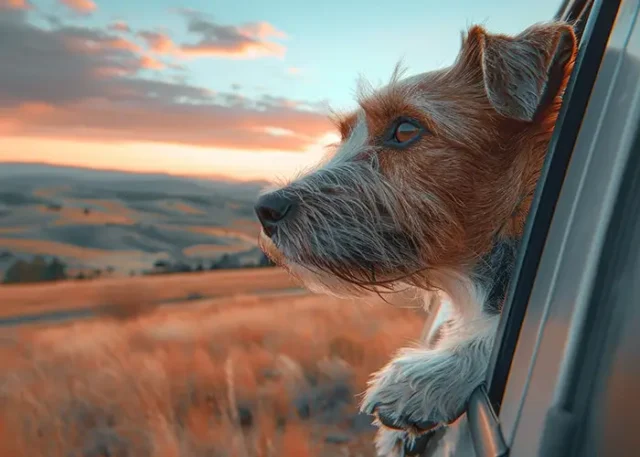
Keep the car cool and well ventilated, but do not let your dog put its head out of the window, where grit and insects can injure its eyes. Avoid letting your dog ride in the front seat, where it can distract you and an airbag could hurt it in a collision.
Watch for signs of stress or travel sickness, such as drooling, repeated lip licking, yawning, whining or panting. If you see them, pull over somewhere safe and give your dog a break. Feeding two to three hours before travelling and keeping the first few journeys short both help.
Hot weather and parked cars
Never leave your dog alone in a parked car. The RSPCA warns that when it is 22°C outside, the inside of a car can reach 47°C within an hour, which can cause fatal heatstroke. Plan food stops around places where your dog can come in with you, or where one person can stay outside with your dog.
Choosing dog-friendly places to stay
Dog-friendly accommodation ranges from campsites and glamping pods to cottages and hotels. When booking, check:
- Whether there is an extra charge or a limit on the number or size of dogs.
- Whether dogs can be left alone in the room or property, even briefly.
- Whether the garden or pitch is enclosed.
- Which rooms or areas dogs are allowed in, especially in pubs and hotels.
When you arrive, walk your dog around the area first, then set up its bed in a quiet corner before you unpack. A familiar blanket or toy helps it settle in a new place.
If you break down
If you break down on a motorway, the Highway Code says you should leave animals in the vehicle, or in an emergency keep them under proper control on the verge. When you call your breakdown provider, tell them you have a dog with you so they can plan for it.
With a well-planned route, the right kit and a dog that is used to travelling, a UK road trip can be one of the best holidays you take together.